Jean-Marc Ferré | Flickr (CC BY-NC-ND 2.0)
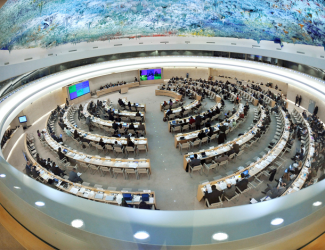
A general view of participants at the 16th session of the Human Rights Council in Geneva, Switzerland.

Special Focus

AWID is an international, feminist, membership organisation committed to achieving gender equality, sustainable development and women’s human rights

Human Rights Council (HRC)

The Human Rights Council (HRC) is the key intergovernmental body within the United Nations system responsible for the promotion and protection of all human rights around the globe. It holds three regular sessions a year: in March, June and September. The Office of the UN High Commissioner for Human Rights (OHCHR) is the secretariat for the HRC.

The HRC works by:

  • Debating and passing resolutions on global human rights issues and human rights situations in particular countries

  • Examining complaints from victims of human rights violations or activist organizations on behalf of victims of human rights violations

  • Appointing independent experts (known as “Special Procedures”) to review human rights violations in specific countries and examine and further global human rights issues

  • Engaging in discussions with experts and governments on human rights issues

  • Assessing the human rights records of all UN Member States every four and a half years through the Universal Periodic Review

Learn more about the HRC


AWID works with feminist, progressive and human rights partners to share key knowledge, convene civil society dialogues and events, and influence negotiations and outcomes of the session.

With our partners, our work will:

◾️ Monitor, track and analyze anti-rights actors, discourses and strategies and their impact on resolutions

◾️ Raise awareness of the findings of the 2017 and 2021 OURs Trends Reports.

◾️Support the work of feminist UN experts in the face of backlash and pressure

◾️Advocate for state accountability
 
◾️ Work with feminist movements and civil society organizations to advance rights related to gender and sexuality.
 

Related Content

Snippet - CSW69 - Feminist Solidarity Space - ES

Espacio de solidaridad feminista

✉️ Requiere inscripción previa para grandes grupos. Entrada libre para grupos reducidos. Reserven aquí

📅Martes 11 de marzo de 2025
🕒 de 12:00 a 02:00 p.m. y de 04:00 a 06:00 p.m., EST
🏢 
Chef's Kitchen Loft with Terrace, 216 East 45th St 13th Floor New York

Organiza: AWID

Forum anchors (Forum page)

El Foro de AWID estará organizado alrededor de 6 tópicos interconectados. Estos «ejes» se centran en las realidades feministas.

Explora

July 2015

Women's Forum on Financing for Gender Equality

  • The Forum took place on 10 July 2015 in Addis Ababa and convened feminists, grassroots women, gender advocates, academics and representatives of women’s rights organizations/networks with specific inputs by UN representatives and other policy makers.
  • The objectives of the Women's Forum were to: share information on the state of play in the latest FfD negotiations; jointly analyze the FfD panorama and follow-up; build a common women’s rights positioning; and strategize on how to meaningfully and substantively engage from a feminist perspective at the Addis FfD Conference.
  • The Women's Forum was organized by the Women's Working Group on FfD, in collaboration with FEMNET, African Women's Development Fund (AWDF) and the Post 2015 Women's Coalition with support from UN Women.
  • Read the Women's Working Group reaction to the Addis Ababa Action Agenda

CSO FfD Forum

  • The CSO FfD Forum took place in Addis Ababa on 11-12 July 2015 and aimed to: inform participating CSOs on the state of play of the official process and coordinate civil society participation in the 3rd FfD Conference; develop a collective CSO Forum Declaration as well as the CSO messages for the FfD Conference Roundtables, the CSO FfD Group-led side events and any other opportunities that might emerge; and plan and organize future areas of CSO engagement on Financing for Development, beyond the 3rd FfD Conference.
  • Read the Declaration from the Addis Ababa Civil Society Forum on Financing for Development
  • For more information, please visit the CSO FfD Group's website or contact the Addis Ababa CSO Coordinating Group (addiscoordinatinggroup@gmail.com).

The Third UN International Conference on Financing for Development

  • The third Conference on Financing For Development took place in Addis Ababa, Ethiopia, from 13-16 July 2015 and focused on: assessing the progress made in the implementation of the 2002 Monterrey Consensus and the 2008 Doha Declaration; addressing new and emerging issues, including in the context of the recent multilateral efforts to promote international development cooperation. Taking into account: the current evolving development cooperation landscape; the interrelationship of all sources of development finance; the synergies between financing objectives across the three dimensions of sustainable development (economic, social and environmental); and the need to support the United Nations development agenda beyond 2015; and reinvigorating and strengthening the financing for development follow-up process.
  • The Addis Ababa Action Agenda was adopted on 15 July 2015 by Heads of State, Governments and High Representatives at the UN.
  • The feeling however from developing countries, CSOs and more specifically women's organisations was that the Addis Ababa Action Agenda failed to meet the target. The Women's Working Group expressed its strong disappointment and demanded structural changes in the global economic governance and development architecture. Read their reaction to the outcome document. Hundreds of civil society organizations and networks from around the world also expressed deep concerns and reservations. Read their response to the outcome document.

Anti-Rights Discourses

Chapter 3

Anti-rights discourses continue to evolve.  As well as using arguments related to religion, culture, and tradition, anti-rights actors co-opt the language of social justice and human rights to conceal their true agendas and gain legitimacy.

Alison Howard, Alliance Defending Freedom, speaks outside the construction site of the Washington, D.C. Planned Parenthood.
© American Life League/Flickr
Alison Howard, Alliance Defending Freedom, speaks outside the construction site of the Washington, D.C. Planned Parenthood.

Three decades ago, a US television evangelist and Republican candidate famously said that feminism is an “anti-family political movement that encourages women to leave their husbands, kill their children, practice witchcraft, destroy capitalism and become lesbians.” Today, this conspirative notion gains unprecedented grasp and legitimacy in the form of “gender ideology” discourse, a catch-all bogey-man created by anti-rights actors for them to oppose. 

Across a range of discourses employed by anti-rights actors - including notions of “cultural imperialism” and “ideological colonization”, appeals to “conscientious objection” and the idea of a “pre-natal genocide” - a key theme is co-optation. Anti-rights actors take legitimate issues, or select parts of them, and twist them in service of their oppressive agenda.

Table of Contents

  • Gender Ideology
  • Cultural Imperialism and Ideological Colonization
  • Abortion: Conscientious Objection
  • Abortion: Prenatal Genocide
  • Exercise: Let’s Take Back the Narrative
  • Movement Resistance Story: The Nairobi Principles: Cross-Movement Commitments on Disability and SRHR 
     

Read Full Chapter >

Paula Andrea Rosero Ordóñez

"[Ella] era una persona que se caracterizaba por su arduo trabajo a favor de la defensa de los derechos humanos y la construcción de la paz en Nariño, especialmente en el municipio de Samaniego-Nariño". - Jorge Luis Congacha Yunda para Página10.

Paula Andrea Rosero Ordóñez fue abogada de primera instancia en la oficina del Ministerio Público en Samaniego, Nariño, la principal agencia de defensa de los derechos de la ciudadanía en Colombia.

Paula se  especializó en los derechos civiles y políticos, las  problemáticas de la impunidad y la justicia, y contribuyó a descubrir abusos de poder, incluida la corrupción. Paula participó también en proyectos para la consolidación de la paz en su ciudad natal, Samaniego, a través del Consejo Municipal de Paz y la Junta Municipal de Mujeres.

Paula recibió amenazas de muerte tras exponer el manejo irregular de los recursos y de denunciar actos de corrupción en el Hospital Lorencita Villegas del municipio nariñense. Fue asesinada el 20 de mayo de 2019, cuando dos hombres se acercaron y le dispararon a corta distancia.