Confronting Extractivism & Corporate Power
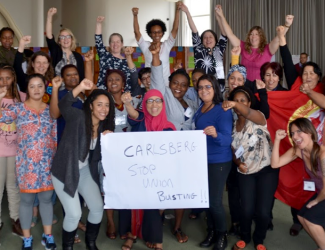
Women human rights defenders (WHRDs) worldwide defend their lands, livelihoods and communities from extractive industries and corporate power. They stand against powerful economic and political interests driving land theft, displacement of communities, loss of livelihoods, and environmental degradation.
Why resist extractive industries?
Extractivism is an economic and political model of development that commodifies nature and prioritizes profit over human rights and the environment. Rooted in colonial history, it reinforces social and economic inequalities locally and globally. Often, Black, rural and Indigenous women are the most affected by extractivism, and are largely excluded from decision-making. Defying these patriarchal and neo-colonial forces, women rise in defense of rights, lands, people and nature.
Critical risks and gender-specific violence
WHRDs confronting extractive industries experience a range of risks, threats and violations, including criminalization, stigmatization, violence and intimidation. Their stories reveal a strong aspect of gendered and sexualized violence. Perpetrators include state and local authorities, corporations, police, military, paramilitary and private security forces, and at times their own communities.
Acting together
AWID and the Women Human Rights Defenders International Coalition (WHRD-IC) are pleased to announce “Women Human Rights Defenders Confronting Extractivism and Corporate Power”; a cross-regional research project documenting the lived experiences of WHRDs from Asia, Africa and Latin America.
We encourage activists, members of social movements, organized civil society, donors and policy makers to read and use these products for advocacy, education and inspiration.
-
"Women Human Rights Defenders confronting extractive industries: an overview of critical risks and Human Rights obligations" is a policy report with a gender perspective. It analyses forms of violations and types of perpetrators, quotes relevant human rights obligations and includes policy recommendations to states, corporations, civil society and donors.
-
"Weaving resistance through action: Strategies of Women Human Rights Defenders confronting extractive industries" is a practical guide outlining creative and deliberate forms of action, successful tactics and inspiring stories of resistance.
-
The video “Defending people and planet: Women confronting extractive industries” puts courageous WHRDs from Africa, Asia, and Latin America in the spotlight. They share their struggles for land and life, and speak to the risks and challenges they face in their activism.
-
Challenging corporate power: Struggles for women’s rights, economic and gender justice is a research paper outlining the impacts of corporate power and offering insights into strategies of resistance.
Share your experience and questions!
Tell us how you are using the resources on WHRDs Confronting extractivism and corporate power.
◾️ How can these resources support your activism and advocacy?
◾️ What additional information or knowledge do you need to make the best use of these resources?
◾️ How can these resources support your activism and advocacy?
◾️ What additional information or knowledge do you need to make the best use of these resources?
Thank you!
AWID acknowledges with gratitude the invaluable input of every Woman Human Rights Defender who participated in this project. This project was made possible thanks to your willingness to generously and openly share your experiences and learnings. Your courage, creativity and resilience is an inspiration for us all. Thank you!
Related Content
Key opposition actors
We are witnessing an unprecedented level of engagement of anti-rights actors in international human rights spaces. To bolster their impact and amplify their voices, anti-rights actors increasingly engage in tactical alliance building across sectors, regional and national borders, and faiths.
This “unholy alliance” of traditionalist actors from Catholic, Evangelical, Mormon, Russian Orthodox and Muslim faith backgrounds have found common cause in a number of shared talking points and advocacy efforts attempting to push back against feminist and sexual rights gains at the international level.
Holy See
-
Key activities: As the government of the Roman Catholic Church, the “Holy See” uses its unique status as Permanent Observer state at the UN to lobby for conservative, patriarchal, and heteronormative notions of womanhood, gender identities and “the family”, and to propagate policies that are anti-abortion and -contraception
-
Based in: Vatican City, Rome, Italy.
-
Religious affiliations: Catholic
-
Connections to other anti-rights actors: US Christian Right groups; interfaith orthodox alliances; Catholic CSOs
Organization of Islamic Cooperation (OIC)
-
Key activities: Self-described as the “collective voice of the Muslim world”, the OIC acts as a bloc of states in UN spaces. The OIC attempts to create loopholes in human rights protection through references to religion, culture, or national sovereignty; propagates the concept of the “traditional family”; and contributes to a parallel but restrictive human rights regime (e.g. the 1990 Cairo Declaration on Human Rights in Islam).
-
Based in: Jeddah, Saudi Arabia
-
Religious affiliations: Muslim
-
Connections to other anti-rights actors: Ultra conservative State missions to the UN, such as Russia
World Congress of Families
-
Key activities: International and regional conferences; research and knowledge-production and dissemination; lobbying at the United Nations “to defend life, faith and family”
-
Based in: Rockford, Illinois, U.S.
-
Religious affiliation: Predominantly Catholic and Christian Evangelical
-
Connections to other anti-rights actors: Sutherland Institute, a conservative think-tank; the Church of Latter-Day Saints; the Russian Orthodox Church’s Department of Family and Life; the anti-abortion Catholic Priests for Life; the Foundation for African Culture and Heritage; the Polish Federation of Pro-Life Movements; the European Federation of Catholic Family Associations; the UN NGO Committee on the Family; and the Political Network for Values; the Georgian Demographic Society; parliamentarians from Poland and Moldova, etc; FamilyPolicy; the Russian Institute for Strategic Studies; and HatzeOir; C-Fam; among others
Center for Family and Human Rights (C-Fam)
-
Key activities: Lobbying at the United Nations, particularly the Commission of the Status of Women to “defend life and family”; media and information-dissemination (Friday Fax newsletter); movement building; trainings for conservative activists
-
Based in: New York and Washington D.C., U.S.
-
Religious affiliations: Catholic
-
Connections to other anti-rights actors: International Youth Coalition; World Youth Alliance; Human Life International; the Holy See; coordinates the Civil Society for the Family; the Family Research Council (U.S.) and other Christian/Catholic anti-rights CSOs; United States CSW delegation
Family Watch International
-
Key activities: Lobbying in international human rights spaces for “the family” and anti-LGBTQ and anti-CSE policies; training of civil society and state delegates (for example, ‘The Resource Guide to UN Consensus Language on Family Issues’); information dissemination; knowledge production and analysis; online campaigns
-
Based in: Gilbert, Arizona, U.S.
-
Religious affiliations: Mormon
-
Connections to other anti-rights actors: leader of the UN Family Rights Caucus; C-Fam; Jews Offering New Alternatives to Homosexuality (JONAH); the National Association for Research and Therapy of Homosexuality (NARTH); World Congress of Families; CitizenGo; Magdalen Institute; Asociación La Familia Importa; Group of Friends of the Family (25 state bloc)
World Youth Alliance
-
Key activities: Advocacy in international policy spaces including the United Nations, the European Union, and the Organization of American States for “the family”, against sexual and reproductive rights; training youth members in the use of diplomacy and negotiation, international relations, grassroots activities and message development; internship program to encourage youth participation in its work; regular Emerging Leaders Conference; knowledge production and dissemination
-
Based in: New York City (U.S.) with regional chapter offices in Nairobi (Kenya), Quezon City (The Philippines), Brussels (Belgium), Mexico City (Mexico), and Beirut (Lebanon)
-
Religious affiliations: primarily Catholic but aims for interfaith membership
-
Connections to other anti-rights actors: C-Fam; Human Life International; the Holy See; Campaign Life coalition
Russian Orthodox Church
-
Key Activities: The Russian Orthodox Church (ROC), capitalizing on its close links to the Russian state, has operated as a “norm entrepreneur” in human rights debates. Russia and the ROC have co-opted rights language to push for a focus on “morality” and “traditional values” as supposed key sources of human rights. Russia led a series of “traditional values” resolutions at the Human Rights Council and has been at the forefront of putting forward hostile amendments to progressive resolutions in areas including maternal mortality, protection of civil society space, and the right to peaceful protest.
-
Connections to other anti-rights actors: Organization of Islamic Cooperation; Eastern European and Caucasus Orthodox churches, e.g. Georgian Orthodox Church; U.S. Christian Right including U.S. Evangelicals; World Congress of Families; Group of Friends of the Family (state bloc)
Other Chapters
Rapport Annuel 2010
Notre rapport annuel 2010 souligne nos réalisations et l’impact de notre travail durant l'année.
Vous pouvez lire comment nous traduisons notre vision et mission en stratégies et en activités entreprises en collaboration avec les membres, partenaires et allié-e-s de l’AWID pour faire la promotion des droits des femmes et de l’égalité de genre à l’échelle mondiale.
Ce rapport comprend égalment des liens vers nos dernières publications.
ours chapter 5
Capítulo 5
Tácticas, estrategias e impactos anti-derechos
Los actores anti-derechos adoptan una estrategia doble. Además de atacar abiertamente al sistema multilateral, los actores anti-derechos también socavan los derechos humanos desde adentro. Se involucran con el fin de cooptar procesos, consolidar normativas regresivas, y erosionar responsabilidades.
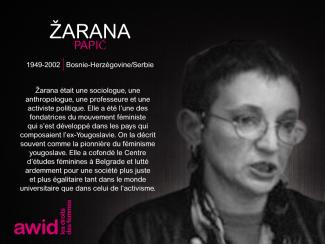
Zarana Papic
Snippet - COP30 - Radical Democracy - EN
Radical Democracy and Climate Justice - the missing debate of COP30
As the world struggles with multiple intersecting crises, local communities and collectives of various kinds are resisting as also creating constructive alternatives.
📅 Wednesday, November 12, 2025
📍 Seminario Mar Nossa Sra Da Assunção, Pará, Brazil
Ayanda Denge
« Je suis un miracle… Je suis donc née d’une mère! Moi qui commence à bégayer, J’ai eu une vie à nulle autre pareille... » - Ayanda Denge (lisez le poème entier ci-dessous)
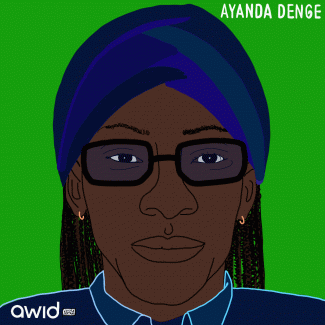
Ayanda Denge était une femme trans, travailleuse du sexe, activiste et poète. Elle était une Xhosa de Port Elizabeth, dans la province du Cap-Oriental en Afrique du Sud. Après avoir traversé différentes villes du pays, elle s'est installée au Cap.
En tant qu’activiste fervente et engagée de la justice sociale, elle s'est battue pour les droits des travailleures du sexe, des personnes trans et des personnes vivant avec le VIH et le sida. Elle a également été une conférencière motivatrice sur la sensibilisation au cancer ainsi que fait campagne en faveur de logements sociaux et abordables, en particulier au profit des pauvres et des travailleures. Ayanda s'est dressée comme une montagne contre les différents visages souvent violents de la discrimination.
« Lorsque vous êtes transgenre, ce n’est pas une double dose, mais une triple dose de stigmatisation et de discrimination que vous recevez. Vous êtes discriminé·e en raison de votre identité sexuelle, en raison de votre travail et en raison de votre statut sérologique VIH. » - Ayanda Denge, 2016
Elle a été présidente par intérim de la Sex Workers Education and Advocacy Taskforce (SWEAT, groupe de travail sur l’éducation et la défense des travailleures du sexe) et coordonnatrice de liaison pour Sisonke, un mouvement national de travailleures du sexe sud-africain.
« D’ici, de notre siège régional à SWEAT, où je siège au conseil d'administration, en passant par Sisonke, un mouvement de travailleures du sexe au Cap, nous ne faisons qu’un. Nous avons un même cri et c'est un cri qui est reconnu dans le monde entier par les travailleures du sexe de toute la planète. Nous voulons la décriminalisation du travail du sexe ». - Ayanda Denge, 2016
Elle vivait dans la maison Ahmed Kathrada, qui était occupée par la campagne Reclaim the City en faveur de logements sociaux. En 2018, Ayanda avait été élue responsable de la maison. Le 24 mars 2019, elle a été poignardée à mort dans sa chambre. L'année précédente, un autre résident avait été tué.
Reclaim the City fait le lien entre la sécurité des résident·e·s des maisons et le gouvernement de province qui les prive d'électricité et du droit humain à l'eau potable :
« Nous ne pouvons dissocier la sécurité des femmes et des personnes LGBTQI vivant dans le squat du refus du gouvernement de la province du Cap-Occidental de rétablir l'électricité et l'eau potable dans la maison Ahmed Kathrada.
La maison est dans le noir complet le soir. Nous avons besoin de lumière pour nous protéger les un·e·s les autres. On a l'impression que la province veut punir les pauvres et les ouvrier·ère·s, dont le seul crime était d'avoir besoin d'un toit. Certes, ils ont le droit de ne pas être d’accord avec nos raisons de squatter, mais ils devraient avoir honte de faire passer la politique avant la sécurité et la dignité des résident·e·s de cette ville.
Repose en paix, camarade Ayanda Denge, nous reprenons le flambeau et nous nous souviendrons de toi dans cette lutte pour un logement décent et central. »
Poème d’Ayanda :
Je suis un miracle…
Je suis donc née d’une mère!
Moi qui commence à bégayer,
j’ai eu une vie à nulle autre pareille.
Née dans la douleur
Nourrie par la pluie
Pour gagner en hauteur
Je vivais dans les égouts.
Là je verse une larme,
je me relève et brandis ma lance.
Les voix résonnent, n’ayez pas peur
Des défis à relever dans l’année,
Des défis de souffrance dans mon dossier;
La communauté applaudit, croyant que j’ai gagné la course;
Mais en réalité mon travail avance à pas de tortue;
À genoux je m’incline et demande grâce.
Car le Seigneur
Est mon épée;
Pour rappeler à l’humanité
Qu’il apporte la sérénité.
Pourquoi, Seigneur, suis-je ce miracle?
Le Seigneur me répond par la pluie et le tonnerre,
Pour avoir interrogé mon père
Qui a dans le livre des agneaux
Un prénom nommé Ayanda.
Dans la rue ma vie n’a jamais été douce
Les personnes que j’ai dû croiser;
Parfois, je ne les saluais jamais;
Et même lorsque j’avais besoin de manger;
Je préférais tirer ma révérence
Plutôt que de prendre place.
Écoutez le poème de la voix d'Ayanda
« Car ma vie est pareille à celle d’une fleur de lotus, hors des eaux sombres et troubles, j'ai fleuri pour être belle et forte… »- Ayanda Denge, regardez et écoutez
Hommages :
« Ayanda, je voudrais te dire que dans nos coeurs, dans nos esprits, tu es toujours une survivante. Tu n’es plus là mais tu es partout, parce que tu es amour. Comme c’est merveilleux d’être aimé·e, et de donner de l’amour. Et c’est là, Ayanda, le cadeau que tu nous as fait. Merci pour tout cet amour, nous avions vraiment besoin de toi. Je te promets qu’à l’avenir, nous nous engageons tou·te·s à poursuivre la lutte à laquelle tu as consacré tant d’énergie et de temps. Et nous nous engagerons à obtenir justice pour cette fin de vie abominable que tu as connue. » - Transcription d’un message, lors d’un hommage d'adieu à Ayanda
« Ayanda était une activiste par nature. Elle connaissait ses droits et n’hésitait pas à se battre pour les droits des autres. En ce qui me concerne, je n’ai pas été surprise qu’elle s’implique auprès de nombreuses organisations, il était évident qu’elle aimait les gens. Elle ne défendait pas nécessairement les droits des LGBTI, mais les droits de toutes et de tous. » - la soeur d’Ayanda
I’ve never traveled before. What should I know?
We know that first time travel can be exciting but also stressful. In recognition of the many challenges involved, we will be providing more information and details about how to get to Bangkok when Registration opens early next year.
Defendiendo nuestra tierra del poder corporativo

Estas industrias 'extraen' materias primas de la tierra: minería, gas, petróleo y madera son algunos ejemplos.
Este modelo económico explota desenfrenadamente la naturaleza e intensifica las desigualdades norte, donde sus grandes corporaciones se benefician y sur, de donde extraen los recursos.
Contaminación del agua, daño irreparable al medioambiente, comunidades forzadas a desplazarse son algunas de las consecuencias inmediatas.
Lee nuestro reporte de INDUSTRIAS EXTRACTIVAS
Hay alternativas sostenibles para el medioambiente y los derechos humanos de la mujer.
Descubre además cómo nos afecta económicamente
Stephanie Bracken
Biography
Stephanie Bracken es una feminista dedicada a construir y a apoyar sistemas fuertes orientados a atender las necesidades del momento y las personas que interactúan con ellos y responden a principios de la justicia. Tiene una maestría en Derechos Humanos de la Universidad de Sydney y una licenciatura en Estudios de Género, Historia y Filosofía de la Universidad McGill. Posee experiencia de trabajo con organizaciones feministas y por la justicia social en seguimiento, evaluación y aprendizaje, planificación del trabajo estratégico, gobernanza, gestión de proyectos y establecimiento de sistemas y procesos operacionales. Stephanie vive en Tiohtià:ke/Montreal, donde disfruta de cantar con otrxs, acampar, el arte textil y pasar tiempo con sus hijes y su comunidad.
Position
Gerente de Operaciones
Add to stories
Off
BD: La super-héroïne féministe qui déboulonne les mythes antidroits
BD: La super-héroïne féministe qui déboulonne les mythes antidroits
Dans cette BD illustrée par Sophia, suivez les aventures de notre super-héroïne féministe qui dément les récits des antidroits dans le monde entier et sauve la mise aux mouvements féministes.
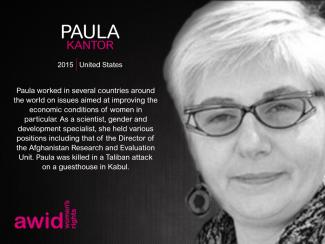
Paula Kantor
Snippet - COP30 - Actions - ES
Eventos y acciones en la COP30
8-16 de noviembre de 2025
¿Cuáles son los idiomas del Foro?
Los idiomas de trabajo de AWID son inglés, francés y español. El tailandés se agregará como idioma local, al igual que el lenguaje de señas y otras medidas de accesibilidad. Es posible que se añadan otras lenguas si la financiación lo permite, así que mantente atentx a las actualizaciones. Nos importa la justicia lingüística y trataremos de incluir tantos idiomas como sea posible y según nuestros recursos lo permitan. Esperamos crear múltiples oportunidades para que muchxs de nosotrxs podamos participar en nuestras lenguas y comunicarnos entre nosotrxs.
Framework & Theme
The theme of the 14th AWID International Forum is: “Feminist Realities: our power in action”.
In our 14th Forum, we will celebrate and amplify Feminist Realities that are around us, in all stages of development.
We want to make this Forum our Feminist Reality - a place where you can inhabit a different world, where you bring your victories, the solutions you have devised; what makes you feel stronger, hopeful and ready to go on. It will be different from any other convening you have previously attended.
We urge you to join us in co-creating this world. It will be worth it!
Each Forum has a theme that reflects the needs of our membership and movements, and responds to our analysis of the current context.
The global context
Currently fascisms, fundamentalisms, authoritarianism and unfettered corporate power are gaining momentum globally. We see these threats converging with the State to shape public norms, narratives, and policies, entrenching a culture of fear, hate and incitement to violence in public discourse. States, previously the target of advocacy and rights claims, in many cases no longer feel accountable and in some cases themselves don’t have the power to uphold rights.
This time of volatility, complexity and uncertainty requires creativity in how we organize across movements, coherence in what we demand and daring in what we propose.
From Feminist Futures to Feminist Realities
AWID’s 2016 Forum centered on Feminist Futures and the conditions needed to bring such futures about. It was clear then, and remains evident now, the enormous challenge for many social justice movements to think outside of the current system for structural solutions. Imaginations can become narrowed from long experiences of inequality and oppression. But what we also heard then and we see all around us is that feminist movements are indeed living and promoting rights-and justice-oriented realities and solutions in big and small ways.
Indeed we see an urgency to mobilize from a place of hope, rather than from a lowest common denominator - hope that is grounded in the certainty that across the globe, however imperfectly, are experiences and practices that embody more just ways of being in the world and that by sharing, strengthening and building on these experiences, we can help them grow their influence.
These are not impossible dreams, but lived realities. This sense of possibility is a spark to re-examine and re-appreciate the transformative dimensions in our work.
A few examples of Feminist Realities across the globe
At AWID, we understand feminist realities as the living, breathing examples of the worlds we know are possible. We understand these diverse feminist realities as reclamations and embodiments of hope and power. They are embedded in the multiple ways that show us that there is a different way of living, thinking and doing-- from the daily expressions of how we live and relate to each other, to alternative systems of governance and justice. Feminist Realities resist dominant power systems such as patriarchy, capitalism, and white supremacy.
These are powerful propositions that orient us toward a vision of what is possible, and show how feminist organizing is blazing a path toward justice in movements and communities around the world.
-
In a deeply marginalized Black community in Jackson, Mississippi, an experiment in solidarity and cooperative economics is taking place through Cooperation Jackson. An ambitious plan to build community ownership outside of capitalist modes of production.
-
In West Africa, women farmers are resisting land grabbing and refusing industrialized agriculture projects, boldy claiming We Are The Solution, in a campaign to build agro-ecological solutions that center women farmers and their knowledges as the solutions to feed communities and mitigate climate change
-
Similarly, in India, 5,000 women have come together to develop community-based food sovereignty systems based on local knowledge, including grain and seed banks
-
Women in Mexico have created a moneyless economy project created by and for women and everyone they know. In El Cambalache everything has the same value: people exchange things they no longer need for things they want as well as knowledge, abilities and mutual aid that people would like to share. El Cambalache was built on the anti-systemic, anti-capitalist values of local social movements
-
In Rojava, Kurdish people are building democracy without the state and Kurdish women offer Jineology as a framework for challenging patriarchy, capitalism and the state, creating systems and institutions to put this framework into practice
-
In the UK, Anarcho Agony Aunts are a sex and dating advice show, covered from a feminist, antifascist, anarchist perspective. Hosts Rowan and Marijam are reclaiming space from the alt-right in giving people (mostly men) a space to ask tricky questions in a judgment-free zone.
-
The African Feminist Judgment Project drafts and disseminates alternative judgments for important African landmark cases on a range of legal issues. At the heart of the project is propositional feminist judicial practice and alternative feminist judgments that contribute to African jurisprudence, legal practice and judicial decision-making
-
The Usha Cooperative in India was founded when mainstream banks refused services to sex workers in Sonagachi. Sex workers self-organized to prioritize their economic concerns and set up their own financial institution. The Usha Cooperative is cooperative bank of over 20,000 sex workers and has provided over USD 4.7M in loans to 7,231 sex workers in a span of one year. With a membership entirely of sex workers, the bank provides real ownership and influence over the cooperative’s governance and management, pioneering ways for individuals and communities on the margins to build economic power on their own terms.
-
In Puerto Rico, a community land trust is helping to transform an informal settlement around a polluted and flood prone river channel into a sustainable community. It provides a new model for improving informal settlements in cities without them then becoming unaffordable for the original residents.
-
In several Latin American countries activists are providing peer-to-peer counselling and accompaniment on medical abortion, reclaiming women´s right to decide over their bodies as well as to medical knowledgde. (for safety reasons, no links are provided.
The 14th AWID international Forum
The AWID Forum will be organized around 6 thematic anchors:
- Resources for Communities, Movements and Economic Justice
- Governance, accountability and justice
- Digital Realities
- Bodies, pleasure and wellbeing
- Planet and living beings
- Feminist organizing
Learn more about these anchors
Building on those realities, we expect the 2020 Forum to:
- Build the power of Feminist Realities, by naming, celebrating, amplifying and contributing to build momentum around experiences and propositions that shine light on what is possible and feed our collective imaginations
- Replenish wells of hope and energy as much needed fuel for rights and justice activism and resilience
- Strengthen connectivity, reciprocity and solidarity across the diversity of feminist movements and with other rights and justice-oriented movements
The Forum is a collaborative process
The Forum is more than a four-day convening. It is one more stop on a movement strengthening journey around Feminist Realities that has already begun and will continue well beyond the Forum dates.
Margarita Salas Guzmán
Biography
Margarita est une militante féministe et LGBTIQA d'Amérique latine. Elle est passionnée de transformation sociale et de bien-être collectif. Elle est titulaire de diplômes en psychologie, communication et en administration publique, ainsi que de certificats en politiques publiques, leadership, gestion et prise de décision. Durant son parcours professionnel, Margarita a acquis une vaste expérience auprès d'organisations de terrain, d'ONG nationales et régionales, d'universités et du secteur public, développant la facilitation, le renforcement des capacités, le plaidoyer politique, la communication et l'évaluation des politiques.
Position
Cheffe de Projets Spéciaux
Add to stories
Off
فقدان الكلام | كلمة العدد
كلمة العدد
فقدان الكلام
بدأنا التخطيط لعدد المجلّة هذا مع نانا داركوا قُبيل مهرجان «ابدعي، قاومي، غيٍّري: مهرجان للحراكات النسوية» لجمعية «حقوق المرأة في التنمية» AWID، وانطلقنا وقتها من سؤالٍ هو بالأحرى ملاحظة حول حالة العالم، ورغبة في تغيير الاعتقادات السائدة: لماذا لا تزال جنسانيّاتنا وملذّاتنا تخضع للترويض والتجريم مع أنّه يتمّ تذكيرنا مراراً وتكراراً بأنّها لا تأتي بأيّ قيمة أو تطوّر؟ واستنتجنا أنّ جنسانيّاتنا، لمّا تتجسّد، فيها ما يتعارض مع النظام العالمي الذي ما زال يتجلّى من خلال ضوابط الحدود، والتمييز العنصري في توزيع اللقاح، والاستعمار الاستيطاني، والتطهير العرقي، والرأسمالية المُستشرية. هل يمكننا إذاً القول إنّ لجنسانيّاتنا قدرةٌ تعطيليّة؟ وهل يصحّ هذا القول عندما ننظر إلى واقع حركاتنا التي يتمّ الاستيلاء عليها ومأسستها في سعيها للتزوّد بالموارد؟
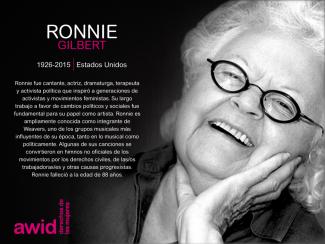
Ronnie Gilbert
Snippet - COP30 - Our Tools title - EN
Herramientas de organización para la COP30
ours 2021 - chapter 2 es
Capítulo 2
Entender el contexto de las amenazas anti-derechos
El creciente poder de los actores anti-derechos no se está desarrollando en un vacío. Entender el auge del ultranacionalismo, del poder corporativo irrestricto, del incremento de la represión y de la disminución del espacio cívico resulta clave para contextualizar las amenazas anti-derechos que enfrentamos actualmente.
El Fondo Acceso para el Foro de AWID
Nos esforzamos para hacer que el Foro de AWID sea un encuentro verdaderamente global, con participación de un conjunto diverso de movimientos, regiones y generaciones. Con este fin, AWID moviliza recursos para un Fondo Acceso (FA) limitado para ayudar a algunxs participantes con los costos de asistir al Foro.
El 14° Foro Internacional de AWID tendrá lugar entre el 11 y el 14 de enero de 2021 en Taipei, Taiwán.
¿Cómo será asignado el Fondo Acceso?
Para este Foro de AWID no habrá proceso de postulación.
Las becas del Fondo Acceso serán asignadas sólo por invitación para:
- Dos personas por actividad seleccionada para el programa del Foro (decididas por aquellas organizaciones, grupos o individuos que organizan la actividad)
- Participantes que se identifiquen como parte de Colectivos Prioritarios del Foro (CPF) recomendadxs por las organizaciones, redes y grupos que están creando el Foro junto con AWID. Los CPF son aquellos que consideramos que fortalecerían nuestro poder colectivo como movimientos, que no estén centrados en los movimientos feministas dominantes, y cuyas realidades feministas nos gustaría honrar, celebrar y visibilizar:
- Feministas negrxs
- Feministas indígenas
- Feministas trans, de género no convencional e intersex
- Feministas con discapacidades
- Feministas trabajadorxs sexuales y trabajadorxs informales, incluyendo trabajadorxs migrantes
- Feministas afectadxs por la migración
- Mujeres afectadas por la política de drogas
- Feministas de las regiones del Foro (con el foco en el Pacífico y en China continental)

Además, AWID va a financiar a aproximadamente 100 participantes del país anfitrión del Foro. Lxs integrantes de los Comités del Foro (Contenidos y Metodología, Acceso y Anfitrionxs así como el Grupo de Trabajo de Artistas también tendrán apoyo del Fondo Acceso.
¿Qué cubre el Fondo Acceso?
Para lxs participantes seleccionadxs, el Fondo Acceso cubrirá el costo de su:
- Vuelo
- Alojamiento
- Visa
- Transporte local en Taipei
- Seguro médico de viaje
El Fondo Acceso no cubrirá su:
- Inscripción al Foro, una pequeña suma de $100 dólares
- Transporte hacia y desde el aeropuerto en su ciudad de partida
- Otros costos eventuales
Aparte del Fondo Acceso, ¿cómo puedo financiar mi participación en el Foro?
Hemos preparado una lista con otras ideas sobre cómo puedes financiar tu participación en el Foro de AWID en la página de Ideas sobre financiamiento.