AWID es un organización feminista internacional de membresía, que brinda apoyo a los movimientos que trabajan para lograr la justicia de género y los derechos de las mujeres en todo el mundo.
Una organización creativa, frente a una creciente amenaza
El activismo joven feminista juega un papel fundamental en las organizaciones y los movimientos por los derechos de las mujeres a nivel mundial, ya que aborda los nuevos problemas a los que las feministas se enfrentan en la actualidad. Esta fuerza, creatividad y adaptabilidad son esenciales para la sostenibilidad de la organización feminista.
A la vez, enfrentan obstáculos específicos para ejercer su activismo, como acceso limitado al financiamiento y al apoyo, falta de oportunidades de capacitación, un incremento considerable de los ataques contra las jóvenes defensoras de los derechos humanos. Esto crea una falta de visibilidad que hace más complicada su inclusión y participación efectiva en los movimientos por los derechos de las mujeres.
Un enfoque multigeneracional
El programa de activismo joven feminista fue creado para garantizar que las voces de las jóvenes sean escuchadas y se vean reflejadas en el discurso feminista. Queremos garantizar que las jóvenes feministas tengan un mejor acceso al financiamiento, a las oportunidades de desarrollo de las capacidades y a los procesos internacionales.
Además de apoyar directamente a las jóvenes feministas, estamos trabajando con activistas por los derechos de las mujeres de todas las edades, con modelos y estrategias prácticas para procesos efectivos de organización intergeneracionales.
Nuestras acciones
Queremos que las activistas jóvenes feministas jueguen un papel en el proceso de toma de decisiones que afectan sus derechos a través de:
Fomento de la comunidad e intercambio de información a través de la Conexión Joven Feminista. Dada la importancia de los medios virtuales para el trabajo de las jóvenes feministas, nuestro equipo lanzó la Conexión Joven Feminista en mayo de 2010 para compartir información, construir capacidades a través de seminarios web y discusiones electrónicas y para alentar la construcción de la comunidad.
Investigación y generación de conocimientos sobre el activismo joven feminista, que aumenten la visibilidad y el impacto del activismo joven feminista en los movimientos por los derechos de las mujeres y otros actores clave, como los donantes.
Promoción de procesos más efectivos de organización intergeneracional, explorando mejores formas de trabajar en conjunto.
Apoyo a la participación de las jóvenes feministas en los procesos globales de desarrollo, por ejemplo en los procesos de Naciones Unidas.
Colaboración con todas las áreas prioritarias de AWID, incluyendo el Foro, para garantizar así que las contribuciones clave de las jóvenes feministas, así como sus perspectivas, necesidades y activismo se reflejen en los debates, políticas y programas que las afectan.
Contenido relacionado
O nosso grupo não recebeu qualquer financiamento nos três anos entre 2021 e 2023. Devemos preencher o questionário mesmo assim?
Sim, ainda queremos a sua resposta, independentemente de terem recebido financiamento em três, dois, um, ou qualquer um dos anos entre 2021 e 2023.
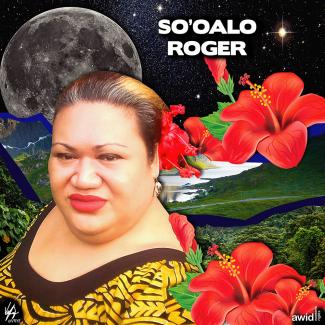
So'oalo était une fervente défenseure des droits humains, notamment en ce qui concerne les droits de la communauté LGBTQI dans le Pacifique.
Elle était membre de la Samoa Fa’afafine Association (SFA) et militait avec passion pour la reconnaissance d’un troisième genre dans le pays insulaire. Sous sa direction, la SFA a fait pression pour la reconnaissance du bien-fondé des droits de la communauté des fa’afafine et leur respect.
Elle a également été une pionnière dans l’articulation des liens entre les droits humains, l’exploitation des fa’afafines à Samoa et dans le Pacifique et la santé, le bien-être et la sécurité de la communauté LGBTQI.
Inspirante et visionnaire, on se souviendra de son dévouement admirable au service des droits de sa communauté.
Ali Chavez Leeds
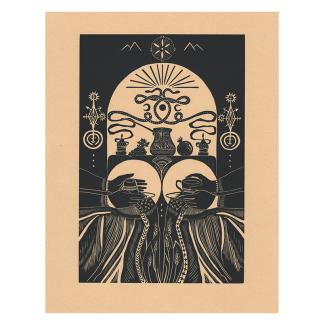
Impression sur papier, sérigraphie 4 couleurs, 8.5x11, 2016
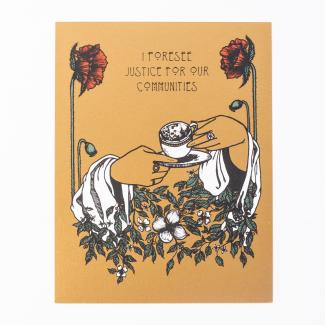
«Tasseography» (Tasséomancie)
La tasséomancie est une méthode de divination qui interprète les motifs dans les feuilles de thé et/ou le marc de café. Il s’agit d’une pratique qui se transmet par les femmes de mon côté arménien et qui m’a été enseignée par ma mère, qui elle-même l’a apprise de sa mère, et ainsi de suite. Lorsque je regardais ma grand-mère lire le marc de café du café arménien préparé pour la famille et les amis, je remarquais que, souvent, elle voyait ce qu'elle avait envie de dire. Ces gravures disent certaines des choses que j’ai envie de voir dans le monde ; j'espère que vous aussi.
Impression relief sur papier, 11 × 14 in, 2021
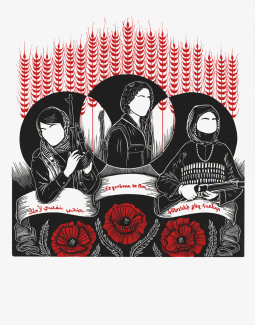
«Our Promise» (Notre promesse)
Cette gravure célèbre la résilience, le sacrifice et la force des combattant·e·s de la liberté de l’Asie du Sud-Ouest et de l’Afrique du Nord à travers l'histoire et la solidarité qui existe. Elle a été inspirée à l'origine par un article que j'ai lu sur une exposition organisée à Tatvan, un district de Bitlis, qui mettait en lumière la présence arménienne dans la région. Mes ancêtres sont originaires de Bitlis, se situant aujourd'hui sur le territoire de la Turquie actuelle.
Impression relief sur papier, 8.5 × 11 in, 2020
«Looking at the Cup» (Regarder la tasse)
La tasséomancie (la lecture du marc de café) est une pratique culturelle utilisée par les femmes arméniennes depuis des siècles pour se parler entre elles et les unes aux autres, un langage codé permettant d'entamer des conversations, d'établir des relations et de tisser des liens.
À propos d’Ali Chavez Leeds
Ali Cat Leeds (elle/iel) est une artiste et graveuse qui vit sur les territoires non cédés de Cowlitz, Multnomah et des tribus confédérées de Grand Ronde, au confluent de deux rivières, également connu sous le nom de Portland, Oregon. Elle produit ses œuvres sous le nom de Entangled Roots Press. Ses impressions mêlent le littéral et le métaphorique pour éclairer et commenter le monde qui nous entoure. Les impressions en relief, sérigraphiques et typographiques vont du carnage de la déforestation à la beauté des mouvements des peuples. Les impressions d'Ali s'inspirent d'histoires ancestrales et s'orientent vers des avenirs libérateurs ; elles enchevêtrent les leçons des jardins, les symboles dans le marc de café, les fils tissés d'Arménie et d'Euskal Herria, jusqu'à la page imprimée.
Snippet FEA Criminalization of sex workers (FR)
La plupart des États membres de l'Union européenne ont des lois et des pratiques qui pénalisent ou contrôlent de facon inacceptable le travail des travailleur·euses du sexe. La criminalisation des travailleur·euses du sexe et/ou de leurs client·e·s ne fait que contribuer à accroître la vulnérabilité des travailleur·euses du sexe, qui sont déjà confronté·es quotidiennement à la stigmatisation, à la discrimination et à l'exclusion de l'État et de la société, en particulier les femmes, les personnes trans, les migrant·e·s et/ou les travailleur·euses racialisés. En Espagne par exemple, le gouvernement essaie actuellement de faire passer une Loi pour l'Abolition de la Prostitution, ce qui entraînera plus de marginalisation et de violence. Venez entendre les histoires de travailleuses du sexe et d'organisatrices syndicales qui luttent pour décriminaliser le travail du sexe et promouvoir les droits et conditions de travail décentes pour les travailleur·euses du sexe.
Our values - Human Rights
Droits humains
nous croyons en une application complète du principe des droits, y compris ceux établis dans les lois internationales, et affirmons la conviction que tous les droits humains sont indissociables, interdépendants et indivisibles. Nous nous engageons à œuvrer pour l'éradication de toutes les discriminations fondées sur le genre, la sexualité, la religion, l'âge, les capacités, l'ethnicité, la race, la nationalité, la classe sociale ou d'autres facteurs.
لماذا تسألون عن اسم المجموعة، المنظمة و\ أو الحركة التي تعبئ الاستطلاع؟
نسأل عن هذه المعلومات كي نسهّل عملية المعالجة وكي نستطيع أن نتواصل مع مجموعتكم/ن في حالة لم تستطيعون تكملة الاستطلاع و\ أو في حالة كانت لديكم/ن شكوك أو أسئلة إضافية. يمكنكم/ن قراءة المزيد عن كيف نستعمل المعلومات التي نجمعها خلال عملنا هنا.
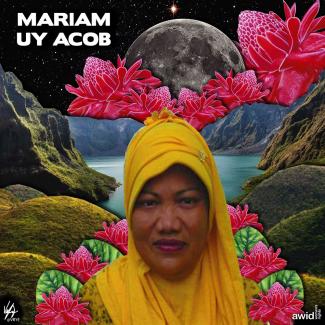
Mariam was a paralegal at the Kawagib Moro Human Rights Alliance.
Mariam was a staunch critic of militarization in Moro communities, and consistently denounced aerial bombardment and encampment. She had to seek sanctuary after exposing and calling out the injustices committed against Muslim communities in the Philippines.
She is believed to have been killed by suspected military agents because of her work as a WHRD. The assailants who killed Mariam waited for her, caught up with the vehicle she was using and shot her seven times.
L’AWID EN 2014 : Renforcer les processus d’organisation en faveur des droits des femmes dans le monde entier
A Film Series on Feminist Realities from the SWANA region
by Esra Ozban
In a product-obsessed world, prioritizing process is a fundamental feminist method. Processes matter, and curation is no exception. While figuring out which of the films from the SWANA region would speak the loudest to the Feminist Realities theme, the global pandemic we are still facing shifted our everyday lives tremendously. Even to think, write, or express myself has become an everyday struggle. I kept missing all of my deadlines and sending apology emails to Kamee Abrahamian, whom I was working with as an independent curator for AWID’s Feminist Film Club. Kamee’s invaluable support, understanding, and suggestions reminded me that even in two different parts of the world, as colleagues who never met in person, we can co-create micro versions of the Feminist Realities for which we live and yearn.
Feminist Realities for me have a lot to do with sisterhoods. Sisterhoods that help womxn clearing mines in Artsakh/Nagorno-Karabakh. Sisterhoods baked in Vegan Inclusive Trans Cake by young trans feminists in Ankara that remind cis-ters that they are not welcomed by the Z generation. Sisterhoods that are growing into the mint on Dragica Alafandi’s rooftop in the Dheisheh Refugee Camp in Occupied Palestine in Sowing seeds of resistance. Sisterhoods that embrace intimate, sexual, and revolutionary proximities in Gezi Park in #resistayol. Sisterhoods that unearth an imagined encounter between two generations of womxn in exile in the streets of Haifa in Your father was born 100 years old and so was the Nakba. Cross-species sisterhoods that build in a fictional (brave) space created by Mounia Akl in Submarine for her rebel character Hala, who refuses to evacuate from a city full of garbage and is left behind with a dog friend.
This selection gathers bits and pieces of many Feminist Realities that have been realized in the SWANA region over the last couple of years. We will continue to imagine, learn, and share feminist embodiments of hope and power. In the meantime, let’s immerse ourselves in the powerful alternatives brought to life by the filmmakers and protagonists of these films. We may co-create every step, every act, and every attempt as we continue to cohabitate this world with others who are living Feminist Realities and continue to dream more of them into existence.
MOTHERLAND
By Emily Mkrtichian& Jesse Soursourian
“With beautiful visuals paired with compelling verité scenes, Motherland is a show of female camaraderie and strength… The film is a testament of women around the world who are willing to work harder to overcome any obstacle they meet.”
- Nosarieme Garrick, award winning filmmaker
“Motherland is an inspiring visualization of solidarity, courage, and grit…”
- Hers is Ours Collective, organizers of the Outsider Moving Art & Film Festival
Emily Mkrtichian on Feminist Realities and Artsakh/NKR: We shot the short film, Motherland, in the Republic of Artsakh in 2018. I was drawn to each of these women for their strength, their resilience and their humor -- despite the context in which they lived. In 2018, that context was the aftermath of a brutal war in the 1990’s, after which their country remained an unrecognized (or, in the international community, disputed) territory that was not given the autonomy and independence so many other countries enjoy. Artsakh was also deeply affected by the consequences we see in almost all places that go through violent conflict -- consequences that so often fall on women to bear: PTSD, high rates of alcoholism, high rates of domestic abuse, less equality and freedoms granted to women, little to no representation of women in politics and civil service. In the face of all these challenges, this film tries to capture the fire and power of the women of Artsakh, one that might not fit the traditional Western feminist paradigm, but one they have created for themselves through deep community ties, care for their families, hard work, and the ability to laugh with eachother through it all. Today, the Republic of Artsakh has been newly devastated by another war that left it without 70% of the lands these women grew up understanding were theirs. Yet, I can promise you that these women, and thousands of others, continue to pull their families, communities, and culture together through the same networks of care, commitment to hard work, and deep riotous laughter in the face of an uncertain future.
SOWING SEEDS OF RESISTANCE
By Baladi-Rooted Resistance
“A timely film to watch after having born witness to the latest bombardment of Gaza by Israeli Defence Forces. A glimpse into the way that women in Palestinian communities survive structural oppression, through the story of a library of traditional seeds.. and the women that sustain them as a form of nourishing rebellion.”
- Jessica Horn, PanAfrican feminst strategist, writer and co-creator of the temple of her skin
“Watching women coming together and working collectively for food autonomy is both therapeutic and empowering for me.”
- Hers is Ours Collective, organizers of the Outsider Moving Art & Film Festival
Baladi-Rooted Resistance Team on Feminist Realities: How to talk about Feminist Realities when you live in Deheisheh, a Palestinian refugee camp, built 70 years ago to serve 3000 refugees, but now home to 15000 people, in the occupied West Bank? Or when the land you farm is under constant threat by illegal settlers.
If you’re a woman in occupied Palestine you will have to struggle not only against patriarchy but also against colonialism and a brutal military occupation.
Dragiča and Vivien are fighting these multiple systems of domination in their own way.
Vivien uses native seeds to help Palestinians maintain their identity. Growing traditional food in traditional ways has great significance: “If you’re not a producer anymore, you’re a consumer, and what better way to enslave someone than turning them into your consumer. This is happening all around the world, but here you have it doubled with the military occupation.”
31.5% of households in the West Bank are food insecure. Through a rooftop edible garden, Dragiča managed to increase her family’s food autonomy. In the crowded camp, where the Israeli army conducts regular nighttime incursions to arrest and harass residents, Dragiča’s rooftop garden not only nourishes her family, but it especially nourishes her soul.
#RESISTAYOL
By Ruzgar Buski
Ruzgar Buski on Feminist Realities: I don’t know what to say about Feminist Realities but as a trans artist, an activist from Turkey, I know our realities are harsh. We live with violences- physical, emotional, economical, sexual! That is why we have to build our own networks, and co-creating micro realities for each other is a Feminist Reality for me. #resistayol is my first film, and at the beginning I was planning to make a film by/for/with trans people that does not try to convince anyone to the fact that trans people are human or focuses on raising awareness on trans issues. However, Gezi Uprising, one of the biggest uprising in the history of Turkey, happened and the film became something different.
I believe the production process really affects what the film is. We tried very hard for women, trans and non-binary people to work on every step of the film. This film is made by people who gathered with camaraderie and friendship. Kanka Productions is founded on transfeminist comradeship. I want the film to give hope, to heal because we carry a lot of traumas in our bodies- this is what makes us and what bonds us. Healing is a never-ending process and we have to create spaces to breath. #resistayol is an hour of breathing collectively.
Boysan Yakar in #resistayol: Well lubunyas (queers) were sitting in the park, all of a sudden bulldozers arrived and everyone got pissed off. Actually in summary this is it. It's Lubunya's park,and we had thirty days to explain that to this huge city. Everyone acknowledged that at night ibnes (faggots) fuck in that park...LGBTI Block carried our commune there. We already didn't trust the state and police and didn't have any security, we've established our own ways of doing things, our own laws and customs to survive... We carried our law to Gezi rapidly...With an effort to establish some common language and understanding among all these groups, the LGBT language of togetherness spread all through the park. Every day was a Pride march, everyone was continuously saying ‘ayol’. We spruced up the stinky, fusty language of the left. I guess we had such an impact because we've been disowned for all these years. From the most radical ones to the most conservative and nationalist ones, they all needed us, because everyone got used to being confronted with everything. Τhey were not used to such energy, our energy. That’s why it was a great political space for us. Every day, we actualized our biggest and main struggle there, that is, a struggle for visibility and recognition. That’s why we left Gezi with a huge gain.
VEGAN INCLUSIVE TRANS CAKE
By Pembe Hayat
“...a multifaceted statement, showing the joy that exists in the friendships within the queer community in Turkey as a display of rebellion and resistance.”
- Nosarieme Garrick, award winning filmmaker
“...fun, light, and random. In a world constantly marked and scarred by violence against the trans community, nothing, no action, is (unfortunately) deprived of meaning. So to more joy, love, and meaningful randomness!”
Cayan Azadi in Vegan Inclusive Trans Cake: Hello Barbies, Kens, porcelain dolls, Olive Oyls, cabbage dolls. Brides of Chucky, sisters of Chucky, brother-in-laws of Chucky and last but not least, esteemed brother-in-law lovers.
So why did we make this cake.
Now we got the news that a trans woman sex worker has attempted suicide due to the violence from street-guards and police on the street. She’s being kept at a police station now and that’s exactly why we made this cake. This transvestite cake is baked to show that we exist in every part of life, that we exist persistently and this cake shows that won’t be wiped off or ignored in this society.
Yes, there is violence in our lives, yes there is a lot of shade as well but despite all of that, we can still have fun, enjoying life as much as we can. Bon appetit, sis!
YOUR FATHER WAS BORN 100 YEARS OLD AND SO WAS THE NAKBA ابوكي خلق عمره ١٠٠ سنة، زي النكبة
By Razan AlSalah
SUBMARINE
By Mounia Akl
“It is directed as a poem is written… simple, a touch abstract, and moving.”
Esra Ozban: Esra Ozban is a film programmer and filmmaker from Turkey. Their artistic, curatorial, and scholarly work intersects critical archival practices, sex work, pornography, feminist/queer film cultures among others.
Follow us on Social Media to receive news about upcoming events and screenings:
Facebook: @AWIDWomensRights
Instagram: @awidwomensrights
Twitter ENG: @awid
Twitter FR: @awid_fr
Twitter ES: @awid_es
LinkedIn: Association for Women's Rights in Development (AWID)
Snippet FEA Union Otras Photo 4 (EN)
Membership why page - Angelina Mootoo quote
"Joining AWID, I hope I can help in the mobilization of the feminist movement. Not just for the privileged women, but for ALL women and feminist activists."
- Angelina Mootoo, Intersectional and Caribbean Feminist, Guyana/USA
Мы проанализируем ответы, чтобы получить представление о тенденциях, и представим результаты на 15-м Международном форуме AWID в Бангкоке, а также в режиме онлайн, в декабре 2024 года. Зарегистрируйтесь для участия в Форуме здесь!
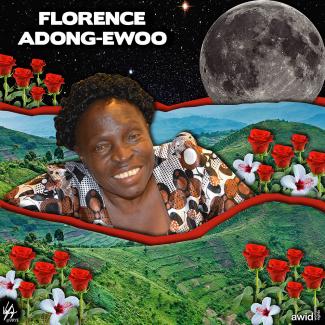
Florence fue una activista por los derechos de las personas con discapacidad que trabajó con varias organizaciones de mujeres con discapacidad en Uganda.
También ocupó la Dirección del Distrito de Lira de la Asociación de Mujeres con Discapacidad, así como del foro de Consejeras Mujeres del Distrito de Lira. Formada como consejera para personas con discapacidad y para madres y padres de niñxs con discapacidad, apoyó muchos proyectos que reclamaban mayor representación de las personas con discapacidad.
AWID began preparing this annual report just as the global pandemic began to unravel how we gather, organize and live our lives. It is impossible to review what we have done without COVID-19 tinting our assessment.
Co-Creating Feminist Realities is no longer just an AWID Forum theme - it is a rallying cry in response to a pandemic that has laid bare the failures of social, political and economic systems.
It is an urgently needed affirmation that there are other, more just ways of organizing our lives. During 2019 hundreds of groups shared their experiences and proposals for feminist realities with us, ranging from radical networks of community support in Latin America facilitating self-managed abortion, to practices of community-centered economies in Indonesia and community-centered food systems in India and the US, to a re-imagination and new practice of harm-free rites of passage in Sierra Leone. These are the experiences that will chart a path forward for a “new normal”.
Yet long histories of oppression and violence can make it difficult to imagine the possible. A key part of our work in 2019 was to spark these explorations through a toolkit AWID launched to support groups interested in unearthing the stories and aspirations that are the building blocks of feminist propositions.
While we focus on our proposals for a different world, we recognize the challenging context around us.
Through the Observatory on the Universality of Rights, Feminists for a Binding Treaty, Count Me In! and other alliances, AWID has continued to push back against unfettered corporate power and fascist and fundamentalist agendas that undermine women’s rights and gender justice. With dim prospects for transformative change through multilateral processes and limited responsiveness from most states, we are redoubling our efforts to ensure that feminist movements, in all their diversity, are resourced in ways that match the critical roles they play - supporting their communities, demanding rights and responding to crises. In 2019 we introduced feminist principles and approaches to ground-breaking funds like the Spotlight Initiative and the Equality Fund, and succeeded in leveraging resources through feminist reality seed grant funding from feminist funders.
As we look ahead, it is clear that the context is calling for a transformation of our organizing strategies:
we are learning to navigate global advocacy confined to online channels,
we grapple with the uncertainty of when and how we can convene in person, and
we use the tools at our disposal to tighten connections across local to global spheres.
AWID is embarking on a new membership model that lowers barriers to access and emphasizes opportunities for engagement and cross-member connection. We will continue to experiment with different online tools and processes for building community. Cross-movement engagement will stay at the center of our work. AWID’s actions in solidarity with oppressed movements and identities, even and especially where these are marginalized in feminist movements, are important to drive change and support broad and inclusive movements for all.
Crisis is not new to feminist and social movements.
We are resilient, we adapt, and we show up for each other. And we have to keep doing better. Thank you to all who are part of the journey with us.
Los discursos anti-derechos continúan evolucionando. Además de utilizar argumentos relacionados con la religión, la cultura y la tradición, los actores antiderechos cooptan el lenguaje de la justicia social y los derechos humanos para ocultar sus verdaderas agendas y ganar legitimidad.
Hace tres décadas, un evangelista televisivo estadounidense candidato del Partido Republicano dijo una célebre frase: el feminismo es «un movimiento político antifamilia que alienta a las mujeres a dejar a sus maridos, matar a sus hijos, practicar brujería, destruir el capitalismo y convertirse en lesbianas». Hoy en día, esta idea conspirativa ha logrado un alcance y una legitimidad sin precedentes bajo la forma del discurso de la «ideología de género», un término genérico que, cual enemigo imaginario, ha sido creado por los actores antiderechos para oponerse a él.
Dentro de la serie de discursos empleados por los actores antiderechos (que incluyen nociones de «imperialismo cultural» y «colonización ecológica», apelaciones a la «objeción de conciencia» y la idea de un «genocidio prenatal»), un tema clave es la cooptación. Los actores antiderechos se apropian de problemáticas legítimas, o seleccionan partes de estas, y las distorsionan al servicio de sus agendas opresivas.
Índice de contenidos
Ideología de género
Imperialismo cultural y colonización ideológica
Aborto: objeción de conciencia
Aborto: genocidio prenatal
Ejercicio: Recuperemos la narrativa
Historia de movimiento de resistencia: Los principios de Nairobi: compromisos inter-movimientos sobre discapacidad y derechos a la salud sexual y reproductiva
![]Ali Chavez Leeds portrait](/sites/default/files/styles/max_325x325/public/2021-10/portrait.jpeg?itok=0yU3PqLe)