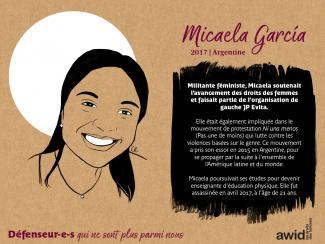
Durvin Ramírez Díaz en.jpg
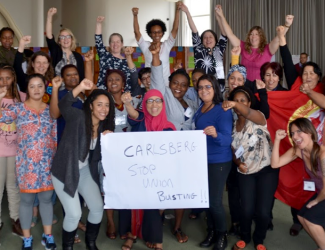
Defensoras de derechos humanos de todo el planeta defienden sus tierras, medios de subsistencia y sus comunidades ante las industrias extractivas y el poder corporativo. Ellas hacen frente a fuertes intereses económicos y políticos que promueven el robo de tierras, el desplazamiento de comunidades, la pérdida de los medios de subsistencia y la degradación del medioambiente.
El extractivismo es un modelo económico y político de desarrollo que mercantiliza la naturaleza y prioriza la ganancia por sobre los derechos humanos y el medioambiente. Arraigado en la historia colonial, refuerza las desigualdades sociales y económicas tanto a nivel local como global. Muchas veces, las mujeres negras, rurales e indígenas son las más afectadas por el extractivismo, y además son notablemente excluidas de la toma de decisiones. Desafiando estas fuerzas patriarcales y neocoloniales, las mujeres se alzan en defensa de los derechos, las tierras, las personas y la naturaleza.
Las defensoras que enfrentan a las industrias extractivas, experimentan una diversidad de riesgos, amenazas y violaciones, incluidas la criminalización, la estigmatización, la violencia y laintimidación. Sus historias dan cuenta de marcados aspectos de violencia sexual y de género. Entre los perpetradores se incluyen autoridades estatales y locales, las corporaciones, la policía, el ejército, las fuerzas paramilitares y de seguridad privada, y en algunos casos, sus propias comunidades.
AWID y la Coalición Internacional de Mujeres Defensoras de Derechos Humanos (WHRDIC por su sigla en inglés) tienen el placer de anunciar «Defensoras de derechos humanos confrontado al extractivismo y al poder corporativo»; un proyecto interregional de investigación que documenta las experiencias vividas por las defensoras de Asia, África y América Latina.
Alentamos a activistas, integrantes de movimientos sociales, la sociedad civil organizada, donantes y responsables de políticas públicas, a leer y utilizar estas producciones para el trabajo de incidencia, con fines educativos y como fuente de inspiración:
«Defensoras de derechos humanos confrontando a las industrias extractivas: un panorama de los riesgos críticos y las obligaciones en materia de derechos humanos» es un informe sobre políticas desde la perspectiva de género (en inglés, pronto disponible en español). Analiza las formas de violaciones y los tipos de perpetradores, hace referencia a las obligaciones relevantes en derechos humanos e incluye recomendaciones de políticas para los estados, corporaciones, la sociedad civil y donantes.
«Tejiendo la Resistencia a través de la Acción: Las Estrategias de las Defensoras de Derechos Humanos contra a las Industrias Extractivas» es una guía práctica que expone formas creativas y deliberadas de acción, tácticas exitosas e inspiradoras historias de resistencias.
El video «Defendiendo a las Personas y al Planeta: Mujeres Confrontando a las Industrias Extractivas» está protagonizado por defensoras de derechos humanos de África, Asia y América Latina, que comparten sus luchas por la tierra y la vida, y hablan de los riesgos y desafíos que enfrentan en su activismo.
«Desafiar al poder corporativo: Las luchas por los derechos de las mujeres, la justicia económica y de género» es un informe de investigación que explica los impactos del poder corporativo y ofrece ideas sobre estrategias de resistencia.
AWID reconoce con gratitud las invaluables contribuciones de cada Defensora de Derechos Humanos que ha sido parte de este proyecto. Esta guía ha sido posible gracias su generosidad y apertura al compartir sobre sus experiencias y lecciones. Su coraje, creatividad y resiliencia son una inspiración para todxs nosotrxs. ¡Muchas gracias!
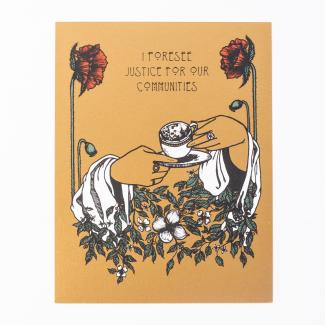
La taseografía es el estudio de los posos de café y/o de las hojas de té para la adivinación. Es una práctica que ha sido transmitida por las mujeres del lado armenio de mi familia, y me fue enseñada por mi madre, que a su vez la aprendió de su madre y así sucesivamente. Cuando miraba a mi Nana leer los posos del café armenio preparado para la familia y lxs amigxs, veía muchas veces como ella veía lo que quería decir. Estas impresiones dicen algunas de las cosas que quiero ver en el mundo: espero que sean las mismas cosas que ustedes quieren ver.
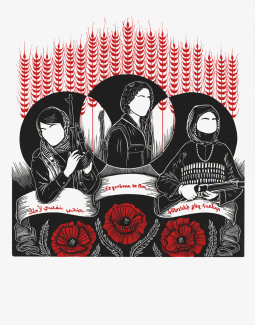
Esta impresión celebra la resiliencia, el sacrificio y la fortaleza de lxs luchadorxs por la libertad de SWANA, a través de la historia y la solidaridad existente. La inspiración original provino de un artículo que leí sobre una exposición en Tatvan, un distrito de Bitlis, que mostraba la presencia armenia en la región. Mis antepasadxs eran de Bitlis, que ahora se encuentra dentro de las fronteras de la Turquía moderna.
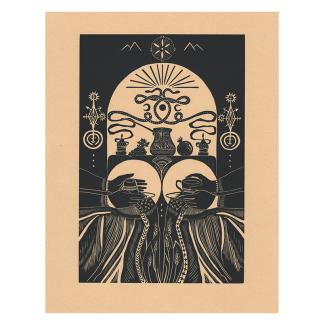
La taseografía (el estudio de la lectura de los posos de café) es una práctica cultural que las mujeres armenias han utilizado durante cientos de años para hablar entre sí. Es un lenguaje codificado para iniciar conversaciones, construir conexiones interrelacionadas y entretejidas.
![]Ali Chavez Leeds portrait](/sites/default/files/styles/max_325x325/public/2021-10/portrait.jpeg?itok=0yU3PqLe)
EN CHIFFRES
This information will only be available when registration opens.
Contenido relacionado
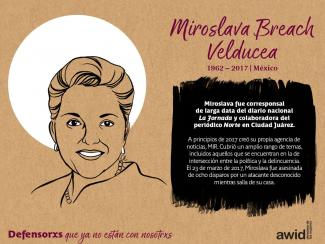
Norte Digital de Ciudad Juárez: Cerramos en protesta
La Jornada: Brazo del ‘cártel’ de Sinaloa ordenó asesinar a Miroslava Breach: FGE
BBC: Miroslava Breach, la periodista “incómoda” asesinada en México cuando llevaba a su hijo a la escuela
Préparée par Jess X. Snow
avec l’aide de Kamee Abrahamian et Zoraida Ingles
Révisée par Kamee Abrahamian
Dans toute l’Asie et le Pacifique, et dans sa diaspora tout entière, des femmes et des trans farouches se battent pour un avenir où iels pourraient être libres. Alors que l’élévation du niveau des mers menace les îles du Pacifique et les côtes de l’Asie continentale, la lutte pour protéger la Terre et les océans s’intensifie dans le monde entier. La mémoire géologique de notre planète enregistre toutes les expériences qu’elle a vécues : la montée des colonisations, de l’industrialisation et de la destruction de l’environnement est liée à la montée de l’État-nation patriarcal binaire. Le pouvoir au sein de la Terre de se réincarner et d’éclore face à la violence doit alors être mis en lien avec les femmes, la maternité, l’indigénéité et toutes les forces expansives, sacrées et queer. Les Réalités féministes unissent la lutte pour la protection des droits des femmes, des trans et des personnes LGBTQ+ avec celle pour la protection de la Terre, et ce n’est pas une coïncidence. Des mères et filles protégeant le Mauna Kea au Royaume de Hawai’i aux relations complexes entre mères et enfants chez les réfugié·e·s du Vietnam, en passant par les réveils sexuels de personnes queer dans l’Inde conservatrice, la réclamation de la construction de maisons en Mongolie intérieure et la lutte pour la libération des personnes LGBTQ aux Philippines, cet ensemble de films est une constellation des manières selon lesquelles les femmes, personnes queer et trans en Asie-Pacifique défendent de nos jours les multiples voies vers notre libération collective, au-delà des océans et des frontières.
Tous ces films témoignent du sens fort accordé aux lieux : des activistes autochtones protègent leurs terres sacrées, des jeunes déconstruisent les récits coloniaux sur leurs terres et découvrent des vérités cachées, les liens complexes de maternité et de soins sont examinés, et des personnages se tournent vers leur propre corps et leur sexualité comme autant de sanctuaires, lorsque la famille et la ville qui les entourent menacent leur sécurité.
De Jess X. Snow
« Un film envoûtant avec des plans époustouflants qui invoquent la résistance écologique féministe et comment elle prend directement source dans l'histoire culturelle et la terre… »
- Jessica Horn, stratège féministe panafricain·e, écrivain·e et cocréateur·rice de The temple of her skin (Le temple de sa peau)
Dans le documentaire expérimental Afterearth, quatre femmes se battent pour protéger les volcans, les océans, la terre et l’air pour les générations futures. En s’appuyant sur de la musique, de la poésie et le témoignage poignant qui rend honneur aux lieux qu’atteint l’océan Pacifique – Hawai’i, les Philippines, la Chine et l’Amérique du Nord, Afterearth est une méditation poétique sur la relation intergénérationnelle et féministe de quatre femmes avec les terres et les plantes dont elles sont issues.
De Jalena Keane Lee
Dans Standing Above the Clouds, des mères et filles activistes indigènes de Hawai’i se tiennent côte à côte pour protéger leur montagne sacrée, Mauna Kea, contre sa transformation en un site de construction des plus grands télescopes au monde. En tant que protectrices de Mauna Kea, ce film souligne l’interconnexion entre Aloha ʻĀina (l’amour de la terre) et l’amour pour ses aîné·e·s et les générations à venir.
De Quyên Nguyen-Le
Dans ce court-métrage narratif expérimental, Nước (Eau/Terre natale) un·e ado genderqueer vietnamo-américain·e questionne les récits dominants sur la guerre du Vietnam à Los Angeles, Californie. Par le jeu de séquences oniriques fortes et d’intrusions de la réalité, ce film suit le parcours qui lui permet de recomposer et de comprendre l’expérience de sa mère, réfugiée de la guerre du Vietnam.
De Kimi Lee
Dans Kama’āina, une jeune queer de seize ans doit se débrouiller pour vivre dans les rues de Oahu, jusqu’à ce qu’elle finisse par pouvoir se réfugier, sur les conseils d’une tata, à Pu’uhonua o Wai’anae, le plus gros camp organisé de sans-abris de Hawai’i.
By Karishma Dev Dube
Dans Devi (« déesse » en hindi), Tara, une jeune lesbienne « dans le placard », s’oppose à la fois à sa famille et à la tradition pour vivre son attirance pour la servante de la maison. Située à New Delhi, Devi est une histoire de révélation tout autant qu’un commentaire sur les lignes sociales et de classe qui divisent les femmes de l’Inde contemporaine.
De Yuan Yuan
Dans Heading South, Chasuna, une fillette de 8 ans élevée par sa mère sur le Plateau de la Mongolie intérieure, rend visite à son père abusif à la grande ville. Pendant qu’elle est chez son père, on lui présente une nouvelle venue dans la famille. Elle doit alors reconnaître et accepter que sa véritable maison est inséparable de sa mère et de la terre.
De Johnny Symons & S. Leo Chiang
Dans le long métrage Outrun, nous suivons le parcours de la première femme transgenre au Congrès des Philippines. Face à l’oppression d’une nation majoritairement catholique, son parcours victorieux devient un cri de victoire pour les droits des personnes LGBTQ+ du monde entier.
Alliant le documentaire, le récit et des formes expérimentales, ces films illustrent que l’attention de la communauté, l’amour de soi et une écoute profondément transformatrice entre celleux que nous aimons sont une entrée dans les Réalités féministes auxquelles nous donnons vie aujourd’hui. De toute l’Asie Pacifique et sa diaspora, ces histoires nous montrent que, face à la violence, la tendresse est la plus féroce des résistances.
Regardez notre conversation avec les cinéastes
Facebook: @AWIDWomensRights
Instagram: @awidwomensrights
Twitter ENG: @awid
Twitter ES: @awid_es
Twitter FR: @awid_fr
LinkedIn: Association for Women's Rights in Development (AWID)
English, French, Spanish and Mandarin.
Day 2
Anti-rights discourses continue to evolve. As well as using arguments related to religion, culture, and tradition, anti-rights actors co-opt the language of social justice and human rights to conceal their true agendas and gain legitimacy.

Three decades ago, a US television evangelist and Republican candidate famously said that feminism is an “anti-family political movement that encourages women to leave their husbands, kill their children, practice witchcraft, destroy capitalism and become lesbians.” Today, this conspirative notion gains unprecedented grasp and legitimacy in the form of “gender ideology” discourse, a catch-all bogey-man created by anti-rights actors for them to oppose.
Across a range of discourses employed by anti-rights actors - including notions of “cultural imperialism” and “ideological colonization”, appeals to “conscientious objection” and the idea of a “pre-natal genocide” - a key theme is co-optation. Anti-rights actors take legitimate issues, or select parts of them, and twist them in service of their oppressive agenda.
La Cooperativa Textil Nadia Echazú lleva el nombre de una pionera en la lucha por los derechos de las personas trans y travesti en Argentina. En muchos sentidos, el trabajo de la cooperativa celebra la vida y el legado de Nadia Echazú, que tuvo una notable trayectoria activista.
Era una de las cofundadoras de "El Teje", el primer periódico trans de América Latina, junto a Lohana Berkins, Diana Sacayán y Marlene Wayar. Nadia formó parte de la Asociación de Travestis, Transexuales y Transgéneros de Argentina (ATTTA) y fundó la Organización de Travestis y Transexuales de Argentina (OTTRA).
Poco después de su muerte, sus compañeras activistas fundaron la cooperativa en su nombre, para honrar la profunda huella que dejó en el activismo trans y travesti en Argentina.
We will update the outcomes of this process in the website in due time.
📅 Miércoles 13 de marzo
🕒 10:30 a. m. - 12:00 p. m. EST
Organizan: AWID, Red-DESC, Franciscan International y Womankind Worldwide como parte de Feministas por un Tratado Vinculante
🏢 Church Center de las Naciones Unidas, 777 United Nations Plaza, piso 11, Nueva York
Related content
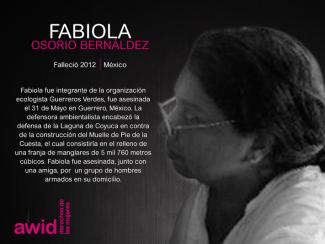
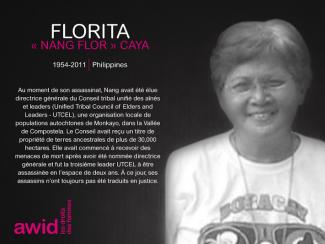
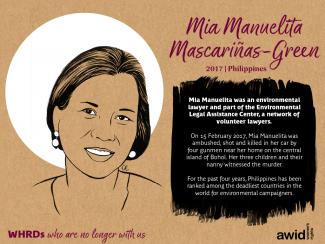
ABS - CBN (Original: Agence France Presse): Environmental lawyer murdered in Bohol
Business and Human Rights Resource Centre: Philippines: Killing of lawyer Mia Mascariñas-Green brings to 112 the number of environmental campaigners murdered in the country in the last 15 years
BBC: Mia Mascarinas-Green: Widower tells how wife was killed in Philippines (Audio)
 |
Hind and Hind were the first documented queer couple in Arab history. In today’s world, they are a queer artist from Lebanon. |
When I was 6, I learned that my grandfather owned a movie theater. My mother recounted to me how it had opened in the early 1960s, when she was also about 6 years old. She remembered that they screened The Sound of Music on the first night.
I would pass by the theater every weekend and watch my grandfather play backgammon with his friends. I didn’t know he was living in the theater, in a room right under the projection booth. I later learned that he moved there after he and my grandmother separated and after the theater closed, in the 1990s, shortly after the Lebanese civil war had ended.
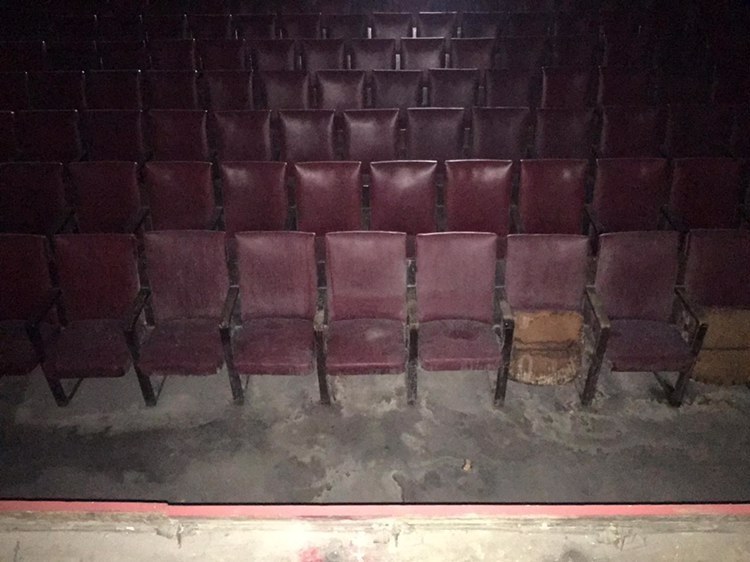
For years and until he passed away, I would mostly see my grandfather play backgammon in the unmaintained reception area of the movie theater. Those repeated scenes are all I remember of him. I never got to properly know him; we never talked about cinema, even though he spent all his time in a run-down movie theater. I never asked him what it was like to live in a place like this. He died when I was 12, on Christmas Eve, from a fall down the spiraling steps that led to the projection booth. It is almost poetic that he passed away in movement, in a house where moving images are perpetually suspended in time.

In the spring of 2020, my cousin called me to say he had cleaned up my grandfather’s movie theater and asked me to meet him there. The two of us had always dreamed of renovating it. I got there before he did. In the reception area, the film poster frames were still there but the posters were gone. I knew there must have been some ticket stubs left somewhere; I found them stacked away in a small rusty tin box, on a shelf in the ticketing booth, and I pocketed some.
I began to walk around. On the main stage, the projection screen was quite dirty and a little torn on the side. I glided my index finger on the screen to remove a patch of dust and noticed that the screen was still white underneath. The fabric seemed to be in good shape too. I looked up to see that my grandmother’s curtains were still in place. They were made of white satin with a little embroidered emblem over the bridge of the curtain, representing the theater. There was a main seating area and a gallery. The chairs seemed to be very worn out.
I noticed the projector peeking out of a small window at the very end of the balcony seating area. I led myself up the spiraling steps of the projection booth.
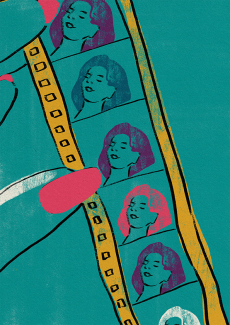
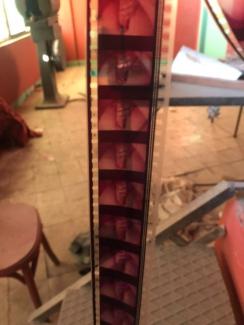
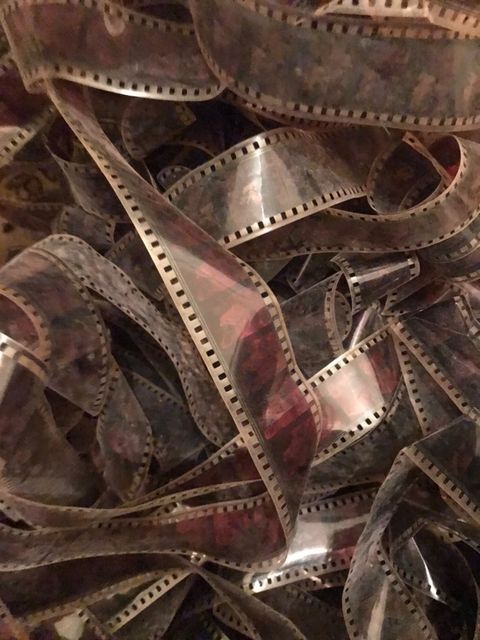
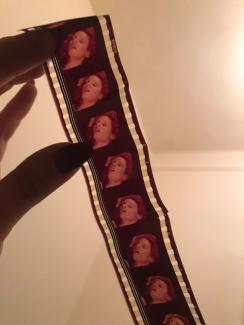
The room was dark, but a source of light coming from the dusty windows revealed a stack of film reels tossed in a corner. Lifeless celluloid strips were tangled up against the foot of the film projector. The dusty reels were all Western, Bollywood, and Science-Fiction genre films with bad titles like The Meteor that Destroyed Earth, or something of the sort. My attention was caught by the dusty film strips – mostly snippets cut out from reels. One by one, the short strips depicted different kissing scenes, what seemed like a suggestive dance, a nondescript scene of a gathering, a close-up of a woman lying down with her mouth open, opening credits to a Bollywood film, and a “Now Showing” tag that went on for several frames.
The Bollywood film credits reminded me of my mother. She used to tell me how they would hand out tissues to audience members on their way out of screenings. I kept the kissing scene and suggestive dance strips; I assumed they had been cut out for censorship reasons. The close-up of the woman reminded me of an excerpt from Béla Balázs’ Visible Man, or The Culture of Film, The Spirit of Film, and Theory of the Film. He said that close-ups in film provided a
silent soliloquy, in which a face can speak with the subtlest shades of meaning without appearing unnatural and arousing the distance of the spectators. In this silent monologue, the solitary human soul can find a tongue more candid and uninhibited than any spoken soliloquy, for it speaks instinctively, subconsciously.
Balázs was mostly describing the close-ups of Joan in the silent film La Passion de Jeanne d’Arc. He pointed out how, “...in the silent (movie), facial expression, isolated from its surroundings, seemed to penetrate to a strange new dimension of the soul.”
I examined the film strip further. The woman looked dead, her face almost mask-like. She reminded me of Ophelia by the painter John Everett Millais. In her book On Photography, Susan Sontag says a photograph is “a trace, something directly stenciled off the real, like a footprint or a death mask.” These death masks are like a presence that reminds of an absence.
I remembered encountering a discourse between death and photography in Roberto Rossellini’s forgotten film The Machine that Kills Bad People. In this film, a cameraman goes around taking photographs of people, who would in turn freeze, and are later suspended in time. French film critic André Bazin used to say that photography snatches bodies away from the flow of death and stores them by embalming them. He described this photographic mummification as “the preservation of life by a representation of life.”
This projection booth, its whole layout, all the things that looked like they were moved, the celluloid strips on the ground, everything my grandfather left a mark on – I felt very protective of.
Underneath the strips was an undone dusty film reel. It seemed like someone had been watching the reel manually. At that moment, my cousin made his way up the spiraling steps to find me examining it. He rubbed his fingers along his chin and, in a very-matter-of-fact way, said, “You found the porn.”

I looked at the film strip in my hand and realized it was not a death scene. The strip was cut out of the porn reel. The woman was moaning in ecstasy. Close-ups are meant to convey feelings of intensity, of climax, but I had never really used Balázs’ theories to describe a porn scene. He wrote how “the dramatic climax between two people will always be shown as dialogue of facial expressions in close-up.” I pocketed the film strip and I named the woman Ishtar. She has lived in my wallet ever since. It seemed strange to compare the close depiction of Joan’s fears and courage with Ishtar’s facial expression in ecstasy.
According to my cousin, my grandfather’s brother would wait until my grandfather left the theater and, instead of closing, invite his friends for some after-hour private screenings. I didn’t think much of it. It was a common practice, especially during and after the Lebanese civil war. After the war, television sets were almost in every Lebanese household. I even remember having one in my bedroom in the late 1990s, when I was around 6 years old. I was told that buying porn films on VHS was popular at the time. Mohammed Soueid, a Lebanese writer and filmmaker, once told me that movie theaters used to screen art films and pornography from the mid-1980s to the mid-1990s, so that they could survive. I also heard that projectionists would cut up porn reels to make different montages, so that they could screen something different every night. Eventually, people stayed within the comforts of their homes to watch VHS tapes on their televisions, and movie theaters began to run out of business.

My cousin went back downstairs to go through an archive of paperwork in the office space. I stayed in the booth and began to slip the film strip between my index and middle finger, sliding it up with my thumbs and slowly running the frames through my hands. I lifted the strip against the dusty window and squinted to make sense of the monochrome vignettes. In this series of frames was an extreme close-up of a dick shoved into a vagina. It went on for several frames until I came across a knot in the film, and I imagined the rest.
Hank is showcasing his hard-on in front of Veronika who is lying in bed across a Louis XIV secrétaire knockoff. She gets up slowly and slides the thin strap of her see-through négligé off her left shoulder. Hank unties her veiled robe, turns her around, slaps her ass, and pushes her down against the secrétaire. He thrusts his dick inside her pussy repeatedly as the back of the furniture bangs against the wallpaper-adorned wall.
I was always attentive to the interior décor, ever since I was told by my Women in Porn Studies professor that the largest porn archives in North America are interestingly used to examine the middle-class furniture of that epoch. So, while Veronika is bending over and being taken from behind by Hank, a university research assistant could very well be trying to guess the design of the gold motif on the secrétaire, or study the rococo relief on a wooden chair in some corner.
For a moment, the booth became a space for female sexual imagination, disrupting a space otherwise promised for the freedom of male sexuality. I was sure that only men were able to access movie theaters that screened porn films. The film reel was too entangled to undo in a projection booth where dust had accumulated for over a decade, so I stuffed it into my duffle bag and walked out of the theater.
I am not sure what came over me, but I felt compelled to keep it. I wanted to feel the thrill of safeguarding something mysterious, something unorthodox. In my mind, I was sure people knew I was hiding something as I walked down the street. A feeling of guilt intertwined with pleasure came over me. It felt kinky.
I got into the house, preoccupied with the thought of having a porn reel in my duffle bag and the stream of thoughts that had unfolded on my walk home. I immediately went to my bedroom. In some distant part of my mind, I remembered that I shared a wall with Layla’s room next door. She was probably not home, but the possibility of being heard excited me. I closed my bedroom door and I took the film strip of Ishtar out.
I imagined her dressed in a light green veiled dress, dancing seductively in front of me, swinging her hips sideways and smiling with her eyes. I got onto my bed. I slipped my fingers into my panties. I lifted my hips. I trailed my hand down my thighs to part them, and slid two fingers in. I tensed up as I palpated my various creases. I moaned before I could stop myself. I panted and swayed. The rays of sun coming through my window planted reluctant kisses onto my skin. I held my breath in and my limbs quivered. I swallowed my breath and laid flat on the mattress.
When I was an undergraduate student, I had taken an introductory film class and Professor Erika Balsom had scheduled a screening of Bette Gordon’s Variety. I was excited to watch producer Christine Vachon’s first film before she moved onto producing films that are now part of the New Queer Cinema movement. Variety was described as a feminist film about Christine, a woman who begins to work as a ticketing clerk in a porn movie theater in New York city called The Variety Theater. Christine overhears the films at the theater but never goes in. Eventually, she becomes interested in a regular customer, whom she watches closely. She follows him to an adult shop where she stands aside and flips through adult magazines for the first time.
Christine’s voyeurism was displayed in different ways throughout the film. The script was also ridden with excess, and erotic monologues that would be considered obscene or vulgar.
In a scene set in an arcade, she reads erotica to her boyfriend. The camera goes back and forth between a close-up of her boyfriend Mark’s butt as he was playing pinball, swinging his hips back and forth against the arcade machine, and a close-up of Christine’s face as she recited her monologue.
“Sky was hitchhiking and he got a ride from a woman in a pick-up truck. It was late at night and he needed a place to stay, so she offered him her place.
She showed him to his room and offered him a drink. They drank and talked and decided to turn in. He couldn’t sleep, so he put on his pants and walked down the hall to the living room. He was a stop short of being seen, but he could see. The woman was naked and spread on the coffee table with only her legs dangling over. Her whole body was excitingly white as if it’d never seen the sun. Her nipples were bright pink, fire-like, almost neon. Her lips were open. Her long auburn hair licking the floor, arms stretched, fingers tickling the air. Her oiled body was round with no points, no edges. Slithering between her breasts was a large snake curving up around one, and down between the other. The snake’s tongue licking toward the cunt, so open, so red in the lamp light. Hot and confused, the man walked back to his room, and with great difficulty, managed to fall asleep. The next morning, over strawberries, the woman asks him to stay another night. Again, he couldn’t sleep […]”
When I was 23, Lynn, the girl I was dating from film class, surprised me by taking me to watch erotica short films on Valentine’s Day. The event took place at The Mayfair Theater, an independent old movie theater. The architecture of the theater recalled North American Nickelodeons, but with a campy touch. Its balconies were decorated with life-size cardboard cutouts of Swamp Thing and Aliens.
That year, the festival was judged by adult star Kacie May and the program consisted of an hour and a half of short films. The content ranged from soft-core machismo-ridden shorts to scat fetish films. We watched a few minutes of what seemed to be heterosexual soft porn. It followed a couple who start making love in a modern living room space, then move to the bedroom. It was mostly footage of them kissing each other, touching each other, and making love missionary-style. Then a woman with a short brown bob crawled onto the bed, licking the back of her own hand in short strokes. She meowed and crawled over the unconcerned couple. They continued to make love. She crawled out to the kitchen, picked up her empty bowl with her teeth, and placed it onto a pillow. She kept walking over them until the end of the short. It seemed quite absurd. I began to laugh, but Lynn looked a bit uncomfortable. I then looked to our left, watching other audience members chugging beers and inhaling popcorn while laughing hysterically. Their uninterrupted laughter and loud comments really set the tone of the festival. Watching the audience became more interesting than watching the erotic films. The Mayfair Theater often showed cult films, and watching cult films is a communal experience.
It’s not exactly how I imagined my mother’s uncle watching porn in my grandfather’s theater. Movie theaters were openly screening porn films at that time, but I could not picture it happening within my mother’s hometown. I pictured him watching the film from the projector in the booth, so he could quickly stop the screening in case any unexpected guests decided to stop by. His friends sat on the balcony in the back. No one could get in from there unless they had a key, so it was safe. They had to think of everything. It was a conservative Christian neighborhood and they would not want to cause any trouble. They were most likely overcome with excitement and guilt. The voices of loud homoerotic banter merged with sound bites of grunting and moaning, but they reminded each other to keep it down every few minutes. They took turns to check the windows to make sure the sound was not loud enough to alarm any neighbors. Sometimes, they would turn off the speaker and there would be no sound.
After a political protest in 2019, I came across a bookstand on Riad El Solh street, close to Martyr’s Square in downtown Beirut. Towards the end of the table, past the copies of Hugo and de Beauvoir, I found a stack of erotica novels and adult magazines. They were all translations of Western publications. I really did not care which one I picked; I just knew I wanted to own a copy for the thrill of it. I looked for the most interesting cover art.
As he was giving me my change back, the vendor asked me, “Don’t I know you from somewhere?”
He scanned my breasts, gliding his eyes downwards. He probably assumed I worked in the porn or sex industry. I looked into his eyes and said, “No.” I turned around, ready to walk away with my magazine. He then stopped me to say that he had a large archive in his basement, and that he regularly sold porn collections and publications on EBay, to Europe and the USA. Although I was interested in rummaging through that archive, I was not comfortable enough to take his offer. It did not feel safe. I asked him where he found these novels. To my surprise, they were produced in Lebanon.
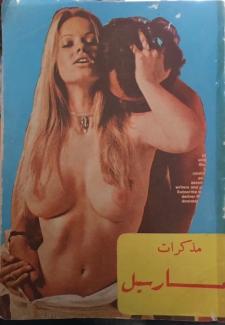
Walking towards the Riad El Solh statue, I read through the journal I had bought and found the format of the text somewhat canted; the font was a bit smudged, making it illegible. The photographs inside were comprised of faded pornographic collages. It looked raw; I liked that. The title of the novel read, Marcel’s Diaries.
The cover art was clearly a magazine cut-out pasted over a blue sheet. In the picture, a shirtless woman is grabbing her lover’s head, digging her fingers in his hair, while he is kissing her neck from behind. Her skirt is zipped down. Her lover has his hand on her lower right hip. She has her hand over his. Her lips are puckered up and open, almost like she is moaning with pleasure, her 1970s straight blonde hair running down her chest and partially covering her nipples.
I opened the first page. The preface read
which either translates to
“Desire
and deviance”
or to
“Desire
and kink”
I read through the first chapter and I found that whoever translated the text had changed the main character’s name to Fouad, an Arabic name. I assumed they wanted their Lebanese male audience to identify. As I read through, I found that all of his lovers had foreign names like Hanna, Marla, Marcel, Marta.
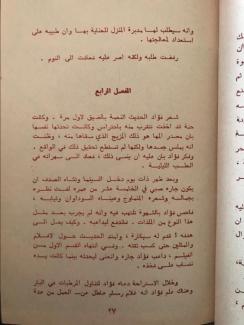
I realized on page 27, chapter four, that Marcel was one of Fouad’s lovers.

The scene took place in a movie theater. Movie theaters were often spaces for sexual freedom in North America, especially since the 1970s after the sexual revolution.
I also assumed they kept all the other foreign names so that it sounds exotic and less taboo. Pornography and erotica were attributed to West Hollywood, despite the fact that the Arab world historically produced erotic texts. Erotica became taboo, and the only way to safely produce it was to market it as foreign, as exotic.
It is interesting how the exotic covers for the erotic. The difference between the two adjectives is rooted in their Greek etymologies: exotic is from exo, “outside,” meaning alien or foreign. Erotic is derived from Eros, the god of sexual love. So, what’s exotic is mysterious and foreign – what’s erotic is sexy.
In Lebanon there is a thin line between the exotic and the erotic in cinema, like the thin line between art films and porn films. In 2015, during a conversation with filmmaker Jocelyne Saab in a Vietnamese restaurant in Paris, I learned that she had to shoot her art film Dunia a second time to change the dialect from Egyptian to Lebanese. She told me that her actors were Egyptian, and that she wasn’t strict about the script. She was not allowed to use Egyptian dialect. It had to be in Lebanese because the producers were concerned about the borderline erotic scenes in the film. So, they made it foreign.
Syndicat Réseau Solidarité