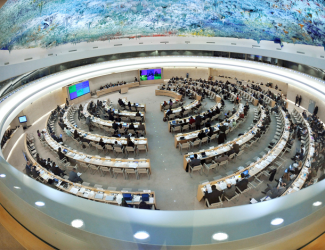
A general view of participants at the 16th session of the Human Rights Council in Geneva, Switzerland.
Análisis Especiales
AWID es un organización feminista internacional de membresía, que brinda apoyo a los movimientos que trabajan para lograr la justicia de género y los derechos de las mujeres en todo el mundo.
El Consejo de Derechos Humanos (CDH) es el cuerpo intergubernamental del sistema de las Naciones Unidas responsable de la promoción y protección de todos los derechos humanos en todo el mundo. El HRC se reúne en sesión ordinaria tres veces al año, en marzo, junio y septiembre. La La Oficina del Alto Comisionado para los Derechos Humanos (ACNUDH) es la secretaría del Consejo de Derechos Humanos.
El CDH trabaja de la siguiente forma:
Debate y aprueba resoluciones sobre cuestiones mundiales de derechos humanos y el estado de los derechos humanos en determinados países
Examina las denuncias de víctimas de violaciones a los derechos humanos o las de organizaciones activistas, quienes interponen estas denuncias representando a lxs víctimas.
Nombra a expertos independientes que ejecutarán los «Procedimientos Especiales» revisando y presentado informes sobre las violaciones a los derechos humanos desde una perspectiva temática o en relación a un país específico
Participa en discusiones con expertos y gobiernos respecto a cuestiones de derechos humanos.
A través del Examen Periódico Universal, cada cuatro años y medio, se evalúan los expedientes de derechos humanos de todos los Estados Miembro de las Naciones Unidas
Se está llevarando a cabo en Ginebra, Suiza del 30 de junio al 17 de julio de 2020.
AWID trabaja con socios feministas, progresistas y de derechos humanos para compartir conocimientos clave, convocar diálogos y eventos de la sociedad civil, e influir en las negociaciones y los resultados de la sesión.
Con nuestrxs socixs, nuestro trabajo será:
◾️ Monitorear, rastrear y analizar actores, discursos y estrategias anti-derechos y su impacto en las resoluciones
◾️ Desarrollar conjuntamente una labor de promoción conjunta para contrarrestar a los actores anti-derechos y debatir más a fondo las conclusiones del Informe de Tendencias de OUR de 2017
◾️ Apoyar, coordinar y desarrollar de manera colaborativa el Caucus feminista emergente en el CDH
Contenido relacionado
Reason to join 4
Voyez grand ! Notre rayonnement international nous permet de combiner notre travail analytique avec des outils politiques et pratiques de plaidoyer et de transformation afin de faire avancer la cause des mouvements féministes à tous les niveaux.
Ana était un ardente défenseure des droits des femmes et travaillait avec un large éventail de femmes au sein d’organisations de terrain ainsi que dans le secteur privé.
Elle croyait en la construction de ponts entre les secteurs. Ana était membre du Réseau national de promotion de la femme (RNPM) et participait activement à l'élaboration de nombreux programmes sociaux traitant de questions telles que la santé et les droits sexuels et reproductifs.
The Forum took place on 10 July 2015 in Addis Ababa and convened feminists, grassroots women, gender advocates, academics and representatives of women’s rights organizations/networks with specific inputs by UN representatives and other policy makers.
The objectives of the Women's Forum were to: share information on the state of play in the latest FfD negotiations; jointly analyze the FfD panorama and follow-up; build a common women’s rights positioning; and strategize on how to meaningfully and substantively engage from a feminist perspective at the Addis FfD Conference.
The CSO FfD Forum took place in Addis Ababa on 11-12 July 2015 and aimed to: inform participating CSOs on the state of play of the official process and coordinate civil society participation in the 3rd FfD Conference; develop a collective CSO Forum Declaration as well as the CSO messages for the FfD Conference Roundtables, the CSO FfD Group-led side events and any other opportunities that might emerge; and plan and organize future areas of CSO engagement on Financing for Development, beyond the 3rd FfD Conference.
The third Conference on Financing For Development took place in Addis Ababa, Ethiopia, from 13-16 July 2015 and focused on: assessing the progress made in the implementation of the 2002 Monterrey Consensus and the 2008 Doha Declaration; addressing new and emerging issues, including in the context of the recent multilateral efforts to promote international development cooperation. Taking into account: the current evolving development cooperation landscape; the interrelationship of all sources of development finance; the synergies between financing objectives across the three dimensions of sustainable development (economic, social and environmental); and the need to support the United Nations development agenda beyond 2015; and reinvigorating and strengthening the financing for development follow-up process.
The Addis Ababa Action Agenda was adopted on 15 July 2015 by Heads of State, Governments and High Representatives at the UN.
The feeling however from developing countries, CSOs and more specifically women's organisations was that the Addis Ababa Action Agenda failed to meet the target. The Women's Working Group expressed its strong disappointment and demanded structural changes in the global economic governance and development architecture. Read their reaction to the outcome document. Hundreds of civil society organizations and networks from around the world also expressed deep concerns and reservations. Read their response to the outcome document.
by Alejandra Laprea, Caracas, Venezuela (@alejalaprea)
I live in a country of the impossible, where there are no bombs yet we are living in a war.
A war that exists only for those of us living in this territory.
I live in a country no one understands, which few can really see, where various realities co-exist, and where the truth is murdered time and again.
I live in a country where one has to pay for the audacity of thinking for oneself, for taking on the challenge of seeing life another way.
I live in a country of women who have had to invent and reinvent, time and again, how they live and how to get by.
I live in Venezuela, in a time of an unusual and extraordinary threat.
Since 2012 my country has been subjected to an unconventional war. There are no defined armies or fire power. Their objective is to dislocate and distort the economy, affecting all households, daily life, the capacity of a people to dream and build a different kind of politics, an alternative to the patriarchal, bourgeois, capitalist democracy.
Venezuelan women are the primary victims of this economic war. Women who historically and culturally are responsible for providing care, are the most affected and in demand. However, in these years of economic and financial embargo, Venezuelan women have gone from being victims to the protagonists on the front lines defending our territory.
Battles are fought from the barrios, kitchens, and small gardens. We defend the right of girls and boys to go to school, and to be given something so simple as some arepas for breakfast.
Arepas are a kind of corn cake that can be fried, roasted or baked and served sweet or savoury as a side or main dish. It is a staple in the diet of all Venezuelans.
In Venezuela, arepas mean culture, family, food sovereignty, childhood nostalgia, the expert hands of grandmothers molding little balls, the warmth that comforts you when recovering from illness.
Arepas connect us as a people with the pre-Colombian cultures of corn, a resistance that has endured for more than five centuries. They are the Caribbean expressed differently on firm ground.
They are an act of resistance.
When my mother was a girl, they would start grinding the dry corn early in the morning to make arepas. The women would get up and put the kernels of corn in wooden mortars and pound it with heavy mallets to separate the shells. Then they would boil, soak, and grind the corn to make dough, and finally they would mold it into round arepas. The process would take hours and demand a lot of physical effort.
In the mid-20th century a Venezuelan company industrialized the production of corn meal. For an entire generation that seemed like an act of liberation, since there was now a flour that you could simply add water to and have hot arepas in 45 minutes time.
But that also meant that the same generation would lose the traditional knowledge on how to make them from scratch. My grandmother was an expert arepa maker, my mother saw it as a girl, and for me the corn meal came pre-packaged.
In the war with no military, the pre-cooked corn meal came to be wielded as an instrument of war by the same company that invented it, which was not so Venezuelan anymore: today the Polar group of companies is transnational.
We women began to recuperate our knowledge by talking with the eldest among us. We searched in the back of the closets for our grandmothers’ grinders, the ones we hadn’t thrown away out of affection. Some families still prepared the corn in the traditional way for important occasions. In some towns there were still communal grinding stations which had been preserved as part of local history or because small family businesses refused to die. All of these forms of cultural resistance were activated, and we even went so far as to invent new arepas.
Today we know that in order to resist we cannot depend on one food staple. Although corn arepas continue to be everyone’s favourite, we have invented recipes for arepas made of sweet potato, cassava, squash, and celery root.
We have learned that we can use almost any root vegetable to make arepas. Cooperative businesses have developed semi-industrial processes to make pre-cooked corn meal. In other words, we have recuperated our arepas and their preparation as a cultural good that belongs to all.
My artivism aims to decolonize our senses in everyday life. I like to create spaces that communicate how we weave together our different struggles, and that render visible dissident (re)existences, other possible worlds, and living bodies here in the SOUTH.
As we continue to fight in our struggles, let us remember how essential it is that we support each other, believe each other, and love ourselves and our sisters. When this system fucks us over, we must take time to look after our (physical and mental) health, that of our sisters, and to understand that each one of us carries unique stories, making us fighters in resist
Marga RH (@Marga.RH)
Until dignity becomes a habit
These portraits are inspired by the voices of resistance and protest movements in Latin America, especially by the key role that feminised bodies play in these struggles. It is a tribute to the grassroots feminist movements in resistance.
Devo fazer alguma preparação para responder ao inquérito?
Tendo em conta que o inquérito WITM foca-se nas realidades do financiamento de organizações feministas, a maioria das perguntas aborda o tópico do financiamento do seu grupo entre 2021-2023. Será preciso ter essas informações facilmente acessíveis para preencher o inquérito (por exemplo, os seus orçamentos anuais e as principais fontes de financiamento).
Snippet FEA Union Otras (EN)
UNION OTRAS
The Sex Workers' Trade Union Organisation (Organización de Trabajo Sexual, OTRAS) is the first union of sex workers in the history of Spain. It was born out of the need to ensure social, legal and political rights for sex workers in a country where far-right movements are on the rise.
After years of struggles against the Spanish legal system and anti-sex workers groups who petitioned to shut it down, OTRAS finally obtained its legal status as a union in 2021.
Its goal? To decriminalize sex work and to ensure decent working conditions and environments for all sex workers.
The union represents over 600 professional sex workers, many of whom are migrant, trans, queer and gender-diverse.
Our values - bodily autonomy
Bodily autonomy, integrity and freedoms<
We celebrate everyone's right to choose their identities, relationships, goals, work, dreams and pleasures, and what they do with their mind, body and spirit. We believe in working towards access to resources, information and safe and enabling environments that allow this to happen.
In memory of all women journalists who were killed in 2018
Just like women have learned to avoid dark streets for their safety, women journalists are forced to avoid reporting certain stories as a result of online harassment.
The physical, sexual and online abuse that has become a part of their daily work lives should never be normalized.
Harassment is not part of the job description and should be called out and challenged at every turn to ensure these important voices are not silenced.
This tribute to journalists was made on behalf of IFEX
¿Cuál es el tema del 14° Foro Internacional de AWID?
El tema del 14° Foro Internacional de AWID es «Realidades feministas: nuestro poder en acción».
Entendemos las realidades feministas como los diferentes modos de existir y ser que nos muestran lo que es posible, a pesar de los sistemas de poder dominantes, y en desafío y resistencia contra ellos. Entendemos estas realidades feministas como recuperaciones y corporizaciones de esperanza y poder, multidimensionales, dinámicas, y arraigadas en contextos y momentos históricos específicos.
Estas obras son un trabajo colaborativo de fotografías e ilustraciones realizadas por Siphumeze y Katia durante el confinamiento. Muestran narrativas negras queer de sexo y placer, bondage, sexo seguro, juguetes, salud mental y sexo, y mucho más. Fueron creadas para acompañar la antología Touch.
“Mental Health” [«Salud mental»]“Sex and Spirituality” [«Sexo y espiritualidad»]“Orgasm” [«Orgasmo»]
About the Artists:
Siphumeze Khundayi es una creadora de arte, fotógrafa y facilitadora interesada en las formas creativas de unir el diálogo y la práctica artística en relación con la identidad queer africana.
Es directora creativa de HOLAAfrica!, una colectiva en línea mujerista panafricanista.
Sus trabajos de performance individual y en colaboración han sido presentados en numerosos festivales y espacios teatrales, tales como el Ricca Ricca Festival de Japón.
En 2017 y 2018 dirigió dos producciones que fueron nominadas a los Naledi Theatre Awards y, en 2020, obtuvo un premio Standard Bank Ovation.
Como fotógrafa, participó en Italia en una exposición grupal titulada Flowers of my Soul, organizada por The Misfit Project. Produjo tres publicaciones para HOLAAfrica!, y sus trabajos fueron publicados dentro y como tapa del Volume Two: As You Like de las Gerald Kraak Anthologies.
Katia Herrera es una artista visual digital de 21 años, de la ruidosa ciudad de Santo Domingo, en la República Dominicana. A pesar de que se autodefine como introvertida, su obra es notablemente estruendosa en un mundo que intenta acallar las voces negras. Con títulos como “Black Woman” [«Mujer Negra»], “You Own the Moon” [«La Luna es Tuya»], “Earth Goddess” [«Diosa de la Tierra»], “Forever” [«Por Siempre»] y “Universe Protector” [«Protectora del Universo»], el legado de Herrera estará marcado por su pasión por poner de manifiesto la resistencia y la perseverancia de las personas negras del pasado y del presente, en contraposición a la narrativa de que la piel negra debería solamente ser asociada con la esclavitud.
Una de sus obras más hermosas y vivazmente tituladas, “Universe Protector”, representa al alma negra como una entidad divina plena de fortaleza, poder y grandeza. En su juventud, su amor por el diseño gráfico se vio estimulado por el talento artístico de su madre y su padre, y por el programa Photoshop que habían descargado en su computadora para su trabajo profesional de fotografía.
هل مشاركتي سريّة؟
أكيد. سيتم محي اجوبتك بعد عملية معالجة المعطيات وتحليلها وسيتم استعمالها لأهداف بحثية فقط. لن تتم أبداً مشاركة المعطيات خارج AWID وسيتم معالجتها فقط عن طريق طاقم AWID والمستشارات/ين اللواتي/ اللذين يعملن/وا في مشروع "أين المال" معنا. خصوصيتكم/ن وسرّيتكم/ن هي في أعلى سلم أولوياتنا. سياسة الخصوصية متواجدة هنا.
Snippet FEA Union Otras Photo 4 (ES)
Membership why page - Angelina Mootoo quote
Al unirme a AWID, espero poder ayudar a la movilización del movimiento feminista. No solo para las mujeres privilegiadas, sino para TODAS las mujeres y activistas feministas.- Angelina Mootoo, feminista interseccional y caribeña, Guyana/EEUU
“[She] was a person who was characterized by her hard work in favor of the defense of human rights and the construction of peace in Nariño, especially in the municipality of Samaniego-Nariño.” - Jorge Luis Congacha Yunda for Página10
Paula Andrea Rosero Ordóñez was a trial lawyer in the office of the Public Ministry in Samaniego, Nariño, the main agency defending citizens’ rights in Colombia.
She focused on civil and political rights, issues of impunity and justice, and contributed to uncovering the abuse of power, including corruption. She also participated in peacebuilding projects in her hometown Samaniego, such as the Municipal Peace Council and the Municipal Women’s Board.
Paula received death threats after exposing the irregular handling of resources and complaining about acts of corruption at the Lorencita Villegas Hospital in the Nariñense municipality. She was murdered on 20 May 2019, when two men approached and shot her at close range.
Siempre hemos trabajado para garantizar que nuestros Foros sean desarrollados conjuntamente con nuestrxs afiliadxs, los movimientos, y nuestros colectivos prioritarios.
Para el Foro 2020 queremos profundizar y fortalecer este espíritu y esta práctica de creación conjunta y colaboración. También reconocemos la necesidad de mejorar el equilibrio entre la inclusión de muchas voces y experiencias y el espacio para que lxs participantes y el equipo respiren, se tomen una pausa, y disfruten de un poco de tiempo de inactividad.
Este Foro será diferente en cuanto a que:
Tendremos muchas menos actividades organizadas, porque queremos que la gente tenga tiempo para relacionarse y hablar entre sí, experimentar, procesar, etc. Es fundamental que sepas que puedes venir al Foro, participar y ser muy activx, y no facilitar ninguna actividad organizada (o «sesión»).
Tendremos Espacios Abiertos (al menos una tarde entera sin ninguna actividad organizada), y también espacios físicos disponibles durante todo el Foro para que la gente organice sus propias reuniones.
Tendremos un Comité de Contenido y Metodología compuesto por feministas de distintas regiones con experiencia en metodologías participativas, para apoyar al equipo de AWID y a quienes lideren actividades en el Foro en el uso de formatos creativos e interesantes para las actividades del Foro.
Colectivo Moriviví est un collectif artistique de femmes. Notre production artistique comprend du muralisme, du muralisme communautaire et des performances/actions de manifestation. Notre travail consiste à démocratiser l'art et à amener les récits des communautés portoricaines dans la sphère publique afin de créer des espaces où ils seront validés. Nous croyons qu’à travers l'artivisme, nous pouvons promouvoir la sensibilisation aux questions sociales et renforcer notre mémoire collective.
“Cacibajagua” 2017, Projet mural. Jiangxi, Chine“Cacibajagua” 2017, Projet mural. Jiangxi, Chine“Paz para la Mujer” (“Paix pour la Femme”) 2015, collaboration avec l’organisation Paz para la Mujer. Santurce, Porto Rico
“Paz para la Mujer” (“Paix pour la Femme”) 2015, collaboration avec l’organisation Paz para la Mujer. Santurce, Porto Rico
Dans le cadre de sa participation au Groupe de Travail d’Artistes d'AWID, le Colectivo Moriviví a réuni un groupe divers de membres, partenaires et personnel pour faciliter un processus collaboratif visant à imaginer, documenter et déterminer le contenu d'une fresque communautaire par le biais d'un processus de co-création en plusieurs étapes. Le projet a commencé par une conceptualisation à distance avec des féministes de différentes régions du monde réuni·e·s par l'AWID, avant d'évoluer vers sa re-contextualisation et sa réalisation à Porto Rico. Nous avons eu l'honneur de bénéficier de la contribution des artistes locaux·ales Las Nietas de Nonó(@lasnietasdenono), de la participation des femmes locales à la session de peinture communautaire, du soutien logistique de la municipalité de Caguas et du soutien supplémentaire du FRIDA | The Young Feminist Fund.
La fresque explore la transcendance des frontières en présentant les corps tels des cartes, dans une étreinte qui met en évidence l'intersection des différentes manifestations, pratiques et réalités féministes.
Nous remercions également Kelvin Rodríguez, qui a documenté et capturé les différentes étapes de ce projet à Porto Rico :
À propos du Colectivo Morivivi
Moriviví est un collectif de jeunes femmes artistes qui travaille sur l'art public depuis Avril 2013. Basé·e·s à Porto Rico, nous sommes reconnu·e·s pour la création de fresques et d'arts dirigés par la communauté.
Le groupe a débuté dans les festivals d'art urbain locaux. Au fur et à mesure que notre travail devenait plus populaire, les organisations et les dirigeant.e.s communautaires ont commencé à nous contacter. Au départ, nous étions huit lycéen·ne·s qui voulaient peindre une fresque ensemble. Cependant, en huit ans de travail acharné, nous avons été confronté·e·s à de nombreux défis. Nous sommes aujourd’hui dans une période de transition. Au cours de l'année qui vient, nous souhaitons restructurer le collectif en interne. Notre objectif est d'ouvrir de nouvelles opportunités pour les collaborateurs·trices et d'étayer notre processus de prise de décisions par un nouveau système d'évaluation. À long terme, nous aspirons à devenir une école alternative de pratiques artistiques pour celles et ceux souhaitant s'immerger dans la production artistique communautaire.
Как долго будет доступен опрос?
Опрос будет доступен до конца августа 2024 года. Пожалуйста, заполните его в течение этого срока, чтобы ваши ответы были включены в анализ.