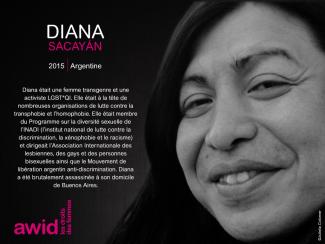
Diana Sacayan

Lxs defensorxs se identifican a sí mismas como mujeres y personas lesbianas, bisexuales, transgénero, queer e intersex (LBTQI) y otrxs que defienden derechos y que debido a su trabajo en derechos humanos están bajo riesgos y amenazas específicos por su género y/o como consecuencia directa de su identidad de género u orientación sexual.
Lxs defensorxs son objeto de violencia y discriminación sistemáticas debido a sus identidades y su inclaudicable lucha por derechos, igualdad y justicia.
El Programa Defensorxs colabora con contrapartes internacionales y regionales así como con lxs afiliadxs de AWID para crear conciencia acerca de estos riesgos y amenazas, abogar por medidas de protección y de seguridad que sean feministas e integrales, y promover activamente una cultura del autocuidado y el bienestar colectivo en nuestros movimientos.
lxs defensorxs enfrentan los mismos tipos de riesgos que todxs lxs demás defensorxs de derechos humanos, de comunidades y del medio ambiente. Sin embargo, también están expuestas a violencia y a riesgos específicos por su género porque desafían las normas de género de sus comunidades y sociedades.
Nos proponemos contribuir a un mundo más seguro para lxs defensorxs, sus familias y comunidades. Creemos que actuar por los derechos y la justicia no debe poner en riesgo a lxs defensorxs, sino que debe ser valorado y celebrado.
Promoviendo la colaboración y coordinación entre organizaciones de derechos humanos y organizaciones de derechos de las mujeres en el plano internacional para fortalecer la capacidad de respuesta en relación a la seguridad y el bienestar de lxs defensorxs.
Apoyando a las redes regionales de defensorxs y de sus organizaciones, tales como la Iniciativa Mesoamericana de Mujeres Defensorxs de Derechos Humanos y la WHRD Middle East and North Africa Coalition [Coalición de Defensorxs de Derechos Humanos de Medio Oriente y África del Norte], promoviendo y fortaleciendo la acción colectiva para la protección, poniendo el énfasis en establecer redes de solidaridad y protección, promover el autocuidado y la incidencia y movilización por la seguridad de lxs defensorxs.
Aumentando la visibilidad y el reconocimiento de lxs defensorxs y sus luchas, así como de los riesgos que enfrentan, a través de la documentación de los ataques que sufren, e investigando, produciendo y difundiendo información sobre sus luchas, estrategias y desafíos.
Movilizando respuestas urgentes de solidaridad internacional para lxs defensorxs que están en riesgo a través de nuestras redes internacionales y regionales y de nuestrxs afiliadxs activxs.
自2019年年末在印尼發生的一連串事件中,我們觀察到了當地軍事緊張與對同志權益的反彈跡象,AWID希望多元的與會者能在論壇齊聚一堂,但這讓我們自問是否能為與會者維持合理安全和讓人感到被歡迎的環境。
經過仔細商討後,AWID董事會在2019年11月決定將第十四屆AWID國際論壇的舉辦地點由峇里島改至台北。
台北擁有穩健的勤務服務能力,對旅客友善(針對國際論壇參與者提供便利的電子簽證流程)。
更多資訊請見以下 :
The rising power of anti-rights actors is not happening in a vacuum. Understanding the rise of ultra-nationalism, unchecked corporate power, growing repression, and diminishing civic space is key to contextualize the anti-rights threats we face today.
Avec Dre Vandana Shiva, Dre Dilar Dirik et Nana Akosua Hanson..
Follow Updates on Social Media
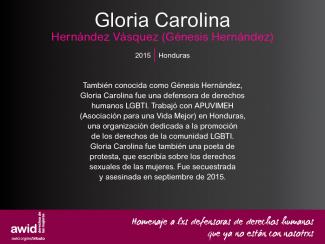
The 3 Women Human Rights Defenders (WHRDs) from the Pacific we are featuring in this year's Online Tribute have worked in the media, campaigned for disability rights and advocated for women’s rights. Their contributions are missed and we honor them in this Tribute. Please join AWID in commemorating these WHRDs, their work and legacy by sharing the memes below with your colleagues, networks and friends and by using the hashtags #WHRDTribute.
Please click on each image below to see a larger version and download as a file


New
Participants will physically gather at a number of sites outside the Bangkok venue, in different parts of the world, on each day of the Forum. All of these self-organized sites will be virtually connected to the Forum venue in Bangkok. As with individuals connecting online, Hub participants will be able to facilitate activities, participate in conversations and enjoy a rich and diverse program.
Hub locations to be announced in 2024!
قضايا تتعلق بالجسد والجندر ومختلف أنواع الجنسانية، واستكشف الروابط المتشابكة بين القضايا هذه وكونها تجاربَ مجسّدة بعمق ومكانًا يُعترض فيه على الحقوق تكون فيه الأخيرة مهدّدة في المجتمع.
تكمن قوّة الحركات النسوية في طريقة تنظيمنا وتنسيق نشاطنا، ليس ضمن مجتمعاتنا وحركاتنا فحسب إنما بالتعاون مع قضايا ومجموعات حليفة في مجال العدالة الاجتماعية. وفّرت المساحة هذه فرصًا للحركات لمشاركة طرق التنظيم واستراتيجيات تكتيكية مع بعضنا البعض وتعزيزها.
لقد أوضحت جائحة كوفيد-١٩ العالمية فشل الرأسمالية النيوليبرالي فبدا أكبر من قبل وكشفت عن التفكك الموجود في أنظمتنا أكثر من أي وقت سابق، فشددت على ضرورة بناء أنواع واقع جديد وفرص بنائها. يتطلّب التعافي النسوي الاقتصادي والاجتماعي منّا جميعًا أن ننجح كلّنا معًا. نصدر النسخة هذه من المجلة بالشراكة مع «كحل: مجلة لأبحاث الجسد والجندر»، وسنستكشف عبرها الحلول والاقتراحات وأنواع الواقع النسوية لتغيير عالمنا الحالي وكذلك أجسادنا وجنسانياتنا.
يمكنك تصفح المقالات عبر الإنترنت أو
قم بتنزيل ملف PDF
This collaborative zine originated from a series of sharing circles that brought together feminists from around the world throughout 2022. The purpose was to exchange ideas and mutually learn how communities are responding to the climate crisis in various local contexts.
Este kit incluye ejemplos de mensajes para ser utilizados en Twitter, Facebook y LinkedIn, como así también imágenes que puedes usar para acompañar a estos mensajes.
La utilización de este kit es muy simple. Solo tienes que seguir estos pasos:
Descarga aquí tus imágenes favoritas:
Twitter
Facebook
Instagram
Combina estos mensajes con las imágenes para Twitter
Yo voy al #AWIDForum. Es EL lugar para conectar con los movimientos por los derechos de las mujeres y la justicia social ¡Únete a mi!: http://forum.awid.org/forum16/es
¡Ya quiero re-imaginar los #FuturosFeministas c/ otrxs activistas x los DD. de las mujeres y la justicia social en el #AWIDForum! Únete: http://forum.awid.org/forum16/es
Me entusiasma poder asistir al Foro de AWID el próximo mes de mayo ¡Ahora ya podemos registrarnos! ¡Únete a mi! http://forum.awid.org/forum16/es
Se encuentra abierta la inscripción para participar del #AWIDForum! en Costa do Sauípe, Brasil, 8-11 de sept 2016: http://forum.awid.org/forum16/es
Únete al #AWIDForum, un encuentro histórico global de activistas x los derechos de las mujeres y la justicia social: http://forum.awid.org/forum16/es
Únete al #AWIDForum para celebrar los logros de nuestros movimientos y las lecciones aprendidas para seguir avanzando http://forum.awid.org/forum16/es
El #AWIDForum, no es solo un evento sino una oportunidad para confrontar la opresión y promover el avance de la justicia: http://forum.awid.org/forum16/es
Únete al #AWIDForum para celebrar, pensar estrategias y renovar nuestros movimientos y a nosotrxs mismxs: http://forum.awid.org/forum16/es
Construyamos juntxs los #FuturosFeministas. Inscríbete al #AWIDForum. Costa do Sauípe, Brasil: http://forum.awid.org/forum16/es
Únete a nosotrxs para re-imaginar y crear juntxs los #FuturosFeministas en el #AWIDForum. Inscríbete: http://forum.awid.org/forum16/es
#FuturosFeministas: aprovecha el momento en el #AWIDForum para promover nuestras visiones de un mundo mejor: http://forum.awid.org/forum16/es
Seremos 2000 activistas de movimientos sociales en el #AWIDForum, pensando estrategias para nuestros #FuturosFeministas http://forum.awid.org/forum16/es
Somos mucho más que una sola lucha. Únete a nosotrxs en el #AWIDForum: http://forum.awid.org/forum16/es
Únete al #AWIDForum, un espacio para pensar estrategias entre movimientos y hacer uso de nuestro poder colectivo: http://forum.awid.org/forum16/es
Movilicemos la solidaridad y el poder colectivo entre movimientos sociales en el #AWIDForum: http://forum.awid.org/forum16/es
Rompamos el aislamiento entre nuestros movimientos. Re-imaginemos y creemos juntxs nuestros futuros en el #AWIDForum: http://forum.awid.org/forum16/es
Solidaridad es un verbo. Pongámosla en acción en el #AWIDForum: http://forum.awid.org/forum16/es
Donantes se comprometen con los derechos de las mujeres y los movimientos sociales en el #AWIDForum: http://forum.awid.org/forum16/es
Los medios de comunicación y los movimientos amplifican los #FuturosFeministas en el #AWIDForum: http://forum.awid.org/forum16/es
Combina estos mensajes con las imágenes para Facebook
Estos mensajes pueden ser usados en Twitter también vía mensaje privado directo, ya que allí no hay límites de carácteres.
Descarga tus imágenes favoritas para usar en Instagram

Panel: In Panel discussions, explore an issue or challenge from different perspectives, or share a learning or experience, followed by audience questions if time allows.
Talk Show: Have a more spontaneous conversation in Talk-Show style. Talk Shows can be a conversation among several people, facilitated by a talk-show host. Audience questions can determine the conversation’s direction.
Discussion: These can take the form of world cafes, fishbowls, and other methodologies that facilitate participants’ active involvement in conversations. Highly participatory.
Workshop: Interactive sessions that invite participants to build new skills in any and all areas of life and activism.
Strategy Session: This is an invitation to think through an issue or strategy, in depth, with others. A space to learn from each other: what works, what doesn’t, and how do we develop new and collective strategies to create the worlds we dream of.
Sharing Circle (also known as “Birds of a Feather”): Ideal for small groups, in a more intimate setting, to hear from each other, spark discussion and carefully address topics that may be specific, sensitive and complex.
Arts – Participatory Workshop: Participatory activities involving arts and creative expression. Whether through visual art, theater, film, mural, dance, music, collective craft or artmaking, etc., we welcome all ideas celebrating feminist art and creativity as forms of social change, healing, expression and transformation.
Arts – Performances, Installations and Exhibitions: We welcome submissions that offer Forum participants new experiences and perspectives, expand our horizons, and challenge and inspire us to think, feel and organize in new ways.
Healing: Diverse activities tailored both for groups and individuals, from learning relaxation techniques to discussing burnout prevention, from trauma-informed practices of care for our body, mind and soul to healing rifts within our movements.
Thanks to our global feminist community! From May to August 2024, nearly 1,200 organizations working for Women's rights, gender justice, and LBTQI+ equality shared their experiences in the WITM survey. The results offer a unique picture of how feminist movements are resourced and where gaps remain.
After assessing your organization’s capacity and research goals, you may choose to conduct a survey as one of the methods of data collection for your research analysis.
In this section:
- Why conduct a survey?
- Identify your survey population 1. Online survey 2. Paper survey
- Create your questions 1. Short and clear questions 2. Simple and universal language 3. "Closed" and "open" questions 4. Logical organization 5. Less than 20 mins 6. Simple and exciting
- Test and translate 1. Your advisors 2. Draft and test 3. Translation
- Target the right population 1. Sample size 2. Degree of participation 3. Database and contact list
A survey is an excellent way to gather information on individual organizations to capture trends at a collective level.
For example, one organization’s budget size does not tell you much about a trend in women’s rights funding, but if you know the budgets of 1,000 women’s rights organizations or even 100, you can start to form a picture of the collective state of women’s rights funding.
As you develop your survey questions, keep in mind the research framing that you developed in the previous section.
Remember: Your framing helps you determine what information you are trying to procure through your survey. The data collected from this survey should allow you to accomplish your goals, answer your key questions, and create your final products.
This is an important step – the clearer you are about which populations you want to survey, the more refined your questions will be.
Depending on your research goals, you may want to create separate surveys for women’s rights organizations, women’s funds and donors. Or you may want to focus your survey on women’s groups and collect interviews for women’s funds and donors, as a survey for each population can be resource-intensive.
The questions you ask women’s groups may be different than ones you would ask women’s funds. If you plan on surveying more than one population, we encourage you to tailor your data collection to each population.
At the same time, some key questions for each population can and should overlap in order to draw comparative analysis from the answers.
If you can reach your survey population online, it is useful and efficient to create an online survey.
We recommend two online tools, both which offer free versions:
Survey Gizmo allows you to convert your data for SPSS, a statistical software useful for advanced data analysis
Your data analyst person(s) will be the best person(s) to determine which tool is best for your survey based on staff capacity and analysis plans.
For accessibility, consider making a PDF form version of your survey that you can attach via email. This ensures organizations that have sporadic internet connections or those that pay for it by the minute can download the survey and complete it without requiring a constant online connection.
You may decide that an online approach is not sufficiently accessible or inclusive enough for your popuation.
In this case, you will need to create a paper survey and methods to reach offline populations (through popular events or through post, with pre-stamped envelopes for returning).
Make it easy for participants to complete your survey.
If the questions are confusing or require complex answers, you risk having participants leave the survey unfinished or providing answers that are unusable for your analysis.
Ensure your questions only ask for one item of information at a time.
For example:
- What is your organization’s budget this year?
Easy to answer: participant can easily locate this information for their organization, and it is only asking for one item of information.- What percentage of your budget have you identified as likely sources for funding for your organization, but are still unconfirmed?
Confusing and difficult to answer: are you asking for a list of unconfirmed funding sources or percentage of funding that is likely but unconfirmed?
This information is difficult to obtain: the respondent will have to calculate percentages, which they may not have on hand. This increases the risk that they will not complete the survey.
Many words and acronyms that are familiar to you may be unknown to survey participants, such as “resource mobilization”, “WHRD”, and “M&E”, so be sure to choose more universal language to express your questions.
If you must use industry lingo – phrases and words common to your colleagues but not widely known – then providing a definition will make your survey questions easier to understand.
Be sure to spell out any acronyms you use. For example, if you use WHRD, spell it out as “Women’s Human Rights Defenders".
Closed questions:
Only one response is possible (such as “yes,” “no” or a number). Survey participants cannot answer in their own words and they typically have to choose from predetermined categories that you created or enter in a specific number. Responses to closed questions are easier to measure collectively and are often quantitative.
Example of a closed question: What is your organization’s budget?
Open-ended questions:
These are qualitative questions that are often descriptive. Respondents answer these questions entirely in their own words. These are more suitable for interviews than surveys.
They are harder to analyze at a collective level as compared to closed-end questions, especially if your survey sample is large. However, by making open-ended questions very specific, you will make it easier to analyze the responses.
Whenever possible, design your survey questions so that participants must select from a list of options instead of offering open-ended questions. This will save a lot of data cleaning and analysis time.
Example of open-ended question: What specific challenges did you face in fundraising this year?
Familiarize yourself with different types of questions
There are several ways to ask closed-ended questions. Here are some examples you can review and determine what fits best for the type of data you want to collect:
If you plan to conduct this research at regular intervals (such as every two years), we recommend developing a baseline survey that you can repeat in order to track trends over time.
Set 1: Screening questions
Screening questions will determine the participant’s eligibility for the survey.
The online survey options we provided allow you to end the survey if respondents do not meet your eligibility criteria. Instead of completing the survey, they will be directed to a page that thanks them for their interest but explains that this survey is intended for a different type of respondent.
For example, you only want women’s rights groups in a given location to take this survey. The screening questions can determine the location of the participant and prevent respondents from other locations from continuing the survey.
Set 2: Standardized, basic demographic questions
These questions would collect data specific to the respondent, such as name and location of organization. These may overlap with your screening questions.
If resources permit, you can store these answers on a database and only ask these questions the first year an organization participates in your survey.
This way when the survey is repeated in future years, it is faster for organizations to complete the entire survey, increasing chances of completion.
Set 3: Standardized and mandatory funding questions
These questions will allow you to track income and funding sustainability. Conducted every year or every other year, this allows you to capture trends across time.
Set 4: Special issues questions
These questions account for current context. They can refer to a changing political or economic climate. They can be non-mandatory funding questions, such as attitudes towards fundraising.
For example, AWID’s 2011 WITM Global Survey asked questions on the new “women & girls” investment trend from the private sector.
The shorter, the better: your survey shouldn’t exceed 20 minutes to ensure completion and respect respondents’ time.
It is natural to get excited and carried away by all the types of questions that could be asked and all the information that could be obtained. However, long surveys will lead to fatigue and abandonment from participants or loss of connection between participants and your organization.
Every additional question in your survey will add to your analytical burden once the survey is complete.
General tips
- Ask for exact budgets instead of offering a range (in our experience, specific amounts are more useful in analysis).
- Specify currency! If necessary, ask everyone to convert their answers to the same currency or ask survey takers to clearly state the currency they are using in their financial answers.
- Ensure you collect enough demographic information on each organization to contextualize results and draw out nuanced trends.
For example, if you are analyzing WITM for a particular country, it will be useful to know what region each organization is from or at what level (rural, urban, national, local) they work in order to capture important trends such as the availability of greater funding for urban groups or specific issues.
Involving your partners from the start will allow you to build deeper relationships and ensure more inclusive, higher quality research.
They will provide feedback on your draft survey, pilot test the survey, and review your draft research analysis drawn from your survey results and other data collection.
These advisors will also publicize the survey to their audiences once it is ready for release. If you plan on having the survey in multiple languages, ensure you have partners who use those languages.
If you decide to do both survey and interviews for your data collection, your advisor-partners on your survey design can also double as interviewees for your interview data collection process.
After your survey draft is complete, test it with your partners before opening it up to your respondents. This will allow you to catch and adjust any technical glitches or confusing questions in the survey.
It will also give you a realistic idea of the time it takes to take the survey.
Once the survey is finalized and tested in your native language, it can be translated.
Be sure to test the translated versions of your survey as well. At least some of your pilot testers should be native speakers of the translated languages to ensure clarity.
Your survey sample size is the number of participants that complete your survey.
Your survey sample should reflect the qualities of the larger population you intend to analyze.
For example: you would like to analyze the millions of women’s rights groups in Valyria but you lack the time and resources to survey every single one.
Instead, you can survey only 500 of the Valyrian women’s rights groups – a sample size - to represent the qualities of all the women’s groups in the region.
Recommended sample size
Although it is not necessary to determine your exact sample size before you launch your survey, having a size in mind will allow you to determine when you have reached enough participants or whether you should extend the dates that the survey is available, in case you feel that you have not reached enough people.
Even more important than size of a sample is the degree to which all members of the target population are able to participate in a survey.
If large or important segments of the population are systematically excluded (whether due to language, accessibility, timing, database problems, internet access or another factor) it becomes impossible to accurately assess the statistical reliability of the survey data.
In our example: you need to ensure all women’s groups in Valyria had the opportunity to participate in the survey.
If a segment of women’s groups in Valyria do not use internet, and you only pull participants for your sample through online methods, then you are missing an important segment when you have your final sample, thus it is not representative of all women’s groups in Valyria.
You cannot accurately draw conclusions on your data if segments of the population are missing in your sample size; and ensuring a representative sample allows you to avoid this mistake.
To gain an idea of what the makeup of women’s groups for your area of research (region, population, issue, etc) looks like, it may be useful to look at databases.
By understanding the overall makeup of women’s groups that you plan to target, you can have an idea of what you want your sample to look like - it should be like a mini-version of the larger population.
After participants have taken your survey, you can then gauge if the resulting population you reached (your sample size) matches the makeup of the larger population. If it doesn’t match, you may then decide to do outreach to segments you believe are missing or extend the window period that your survey is open.
Do not be paralyzed if you are unsure of how representative your sample size is – do your best to spread your survey as far and wide as possible.

4. Collect and analyze your data
For the first time, the AWID Forum offers three modes of participation