Forum de l'AWID : Co-créer nos horizons féministes
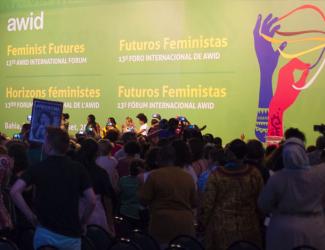
En septembre 2016, 1800 féministes et défenseur-e-s des droits des femmes venu-e-s des quatre coins de nos mouvements se réunissaient sur les côtes de Bahia à l’occasion du 13ème Forum international de l’AWID.
Cette section met l’accent sur les victoires, les enseignements et les ressources qui ont couronné nos conversations. Nous vous invitons à l’explorer, la partager et laisser vos impressions.
L’un des principaux éléments à retenir de ce Forum a été la nécessité d’élargir et d’approfondir notre travail de collaboration entre mouvements pour faire face à une montée des fascismes et des fondamentalismes, une exacerbation de la cupidité des entreprises et un changement climatique en progression.
L’AWID a donc travaillé avec plusieurs allié-e-s pour ériger ces semences de résistance :
-
Nos Initiatives Jeunes-pousses ont aidé 20 idées émérgées au Forum à évoluer en actions concrètes
-
La vidéo « Protéger les personnes et la planète » et le guide « Arrimer la résistance à l'action » mettent en lumière le courage des défenseur-e-s des droits humains et présentent des stratégies concrètes pour résister au pouvoir des entreprises
-
Avec nos animations L'état de nos mouvements féministes et La justice climatique et environnementale, les mouvements ont maintenant des outils créatifs pour appuyer leur travail de plaidoyer.
-
La compilation des expressions artistiques des mouvements continue d’inspirer une organisation plus forte et plus créative dans le monde entier.
-
Les mouvements peuvent aussi bénéficier d’une nouvelle méthodologie pour envisager nos horizons féministes. (à venir bientôt !)
A travers son prochain plan stratégique et le processus de son Forum, l’AWID s’engage à poursuivre et approfondir les rapports, les apprentissages et les processus amorcés lors du Forum 2016, tout en s’inspirant de l’actualité.
Et maintenant ?
Le prochain Forum de l’AWID se tiendra dans la région Asie-Pacifique (les dates et le lieu exacts seront annoncés en 2018). Nous attendons avec impatience de vous y retrouver !
A propos du Forum de l’AWID
Les Forums de l’AWID ont vu le jour en 1983, à Washington DC. Depuis, ils revêtent de nombreux aspects et incarnent, selon les personnes, tantôt un processus itératif visant à affiner nos analyses, notre vision et nos actions, un évènement clé galvanisant les féminismes des participant-e-s et leurs organisations ou un espace politique offrant refuge et solidarité aux défenseur-se-s des droits humains.
Contenu lié
Membership why page page - to join as a member block
To join as a member - step by step
- Read and endorse the AWID Values and Community Guidelines.
- Fill out your membership sign-up form and indicate your contribution to at least one type of action proposed.
- Check your mailbox for a confirmation of your membership.
- Fulfill your contribution commitment to the type(s) of action you chose in the sign-up form.
Freeing the Church, Decolonizing the Bible for West Papuan Women
By Rode Wanimbo (@rodwan986), Jayapura, Papua Province of Indonesia
“Lord, we are unworthy. We are the ones who committed sin for Eve ate the fruit in Eden. We are just women who grow sweet potatoes, look after pigs and give birth to children. We believe you died on the cross to set us free. Thank you, In Jesus’s name Amen.”
This is a typical prayer of women I have heard during my visits to ministries in several villages. Even I said the same prayer for many years.
I was born and grew up in Agamua, the Central Highlands of West Papua. My father belongs to the Lani tribe and my mother comes from Walak.
In Lani and Walak languages - languages spoken in the Central Highlands - tiru means a pillar. There are four tiru (pillars) standing firmly in the middle of the Lani roundhouse (honai), around wun’awe or a furnace. Tiru is always made of the strongest type of wood called a’pe (ironwood tree). The longer the wood gets heated and smoked from the fire in the honai, the stronger it becomes. Without tiru, the honai cannot stand firm. West Papuan women are these tiru.
West Papua is located in the western part of the New Guinea island, containing some of the world’s highest mountains, densest jungle, and richest mineral resources. It is home to over 250 groups and has an incredible biodiversity. Due to its natural wealth, West Papua has, over the centuries, been targeted by foreign occupiers. Until 1963, we were colonized by the Dutch. However in 1969, after a manipulative political act, we were transferred from the Dutch to Indonesia.
The first German missionaries arrived in Mansinam Island, Manokwari, in 1855. Then, in the 1950s, Christianity was brought to the Central Highlands of West Papua by Protestant missionaries of European descent from America, Canada, Australia and New Zealand.
According to Scripture in Genesis 1: 26-27, Man and Woman are created in the image of God. It means all humanity is made with the call and capacity to exercise dominion. Radah, the Hebrew word for dominion, means stewardship. Radah is not a call to exercise imperial power as declared by Pope Nicolas V, granting Catholic nations the right to “discover” and claim dominion over non-Christian lands. To diminish the capacity of humans to exercise dominion, is to diminish the image of God on earth (Lisa Sharon Harper, The Very Good Gospel).
The Evangelical Church of Indonesia (GIDI) was established as an institution in 1963. In the Sunday Service liturgy of GIDI, Women are considered unworthy to take any responsibility except collecting offerings. In 2003, after 40 years, the Department of Women was introduced within the structure of the Synod leadership.
In November 2013, I was entrusted to be a chairperson of the Women’s Department of the GIDI Synod.
Together with several other women leaders, we started a cell group that is committed to “decolonizing the Bible.” We learn together how to reconstruct the interpretation of biblical texts to champion women.
A feminist theologian named Elisabeth S Florenza calls it a feminist hermeneutic theory (Josina Wospakrik, Biblical Interpretation and Marginalization of Woman in the Churches of West Papua).
Besides the cell group, we interview our elderly women to collect our ancestors’ wisdom and values. As Bernard Narakobi in his book The Melanesian Way said: “Our history did not begin with contact with the Western explorers. Our civilization did not start with the coming of the Christian missionaries. Because we have an ancient civilization. It is important for us to give proper dignity and place to our history”.
Yum is a knotted net or woven bag handmade from wood fiber or leaves. Yum is highly valued for it symbolizes life and hope. When women of Lani and Walak get married, our maternal aunts put yum on our heads. It means we bear the responsibility for giving life and for providing food. Yum is used to carry garden produce as well as being used as a container to put a baby to sleep in as it gives warmth and a sense of security.
“West Papuan Women are Yum and Tiru” became the prime references as we contextualized women in the eyes of Jesus Christ in seminar and focus group discussions. From 2013 to 2018, we focused on reconstructing the view of women in GIDI and in gaining a healthy self-image. We are still in the process of understanding who we are to Jesus, rather than who we have been told we are by theologians and the fathers of the early Churches. Josina Wospakrik, a West Papuan Theologian said “The Gospel is incredibly rich but it was impoverished due to human ambitions and agendas.”
Since 2018, the GIDI Women Leadership team and I have formulated four priority programs: Decolonizing the Bible, Storytelling in a circle, Training of trainers for Literacy and Gender. The fourth, supported simple bookkeeping and savings groups workshops facilitated by Yapelin and Yasumat, which are faith based organizations established by GIDI leaders to reach the economic, social and health needs of women in the communities.
Storytelling in a Circle
In this programme we create a safe space for women to talk - each woman has a story. We all sit together and learn how to be good listeners.
“I became Christian and was taught that the government is God’s representative. Why did the government do nothing when the army burnt down my village and killed my relatives?” asked one woman in the storytelling circle. “My aunt was raped.” She stopped for a while. Could not talk. She cried. We all did.
The process of storytelling has driven us into deep conversation. We began to contextualize Biblical texts within our daily realities.
We started asking questions amongst ourselves: Where is God in our toughest times? Does the state government truly represent God on earth? Why does the Creator allow privileged people to destroy His own image in the name of Christianity and Development? During the process, I realized that I have been reading the Bible using somebody else’s glasses.
The church has to be a safe place to share stories and be a place of comfort to be still and rest. As we reflect on the testimonies, those who tell their stories begin the process of recovering from wounds and trauma.
Financial Literacy for Women
Culturally, West Papuans invest in relationships. The concept of saving is understood as an investment in relations, not in a bank account. And while the Indonesian central government has granted special autonomy to respond to West Papuans’ demand for self-determination, many government policies harm the quality of family life and they do not account for women’s lives. High illiteracy rates amongst women mean most women do not have access to a bank account. With no money saved, access to medical services becomes a struggle.
Through the priority programmes, Yapelin, with the active involvement and support of women, created saving groups in Bokondini and Jayapura. The saving groups are chaired by women who have access to a bank.
In coordination with Yayasan Bethany Indonesia (YBI) and Yayasan Suluh, a faith-based organization (FBO) based in Jayapura, we facilitated four literacy workshops. The literacy team facilitated the training of trainers in three different dioceses: Merauke, Sentani, and Benawa. We now have 30 facilitators in different congregations who run literacy programs.
Lack of financial support for our programs will not stop us. Being stigmatized as rebels will not stop us from standing up and speaking in church evaluation meetings and conferences. It is stressful but I am committed together with several women leaders to calling on the power-holders within to free the church.
The Gospel known as Good News should become news that liberates women from a very patriarchal circle of power, liberates women from social stigma and returns women to the original purpose of The Creator.
The Gospel must be a mirror to reflect who we are collectively. As Lisa Sharon Harper, in her book The Very Good Gospel said “The Gospel is not only about an individual’s reconciliation with God, self and communities. But also speaks on systemic justice, peace between people groups and freedom for the oppressed”.
Rode Wanimbo is the chairperson of the Women’s Department of Evangelical Church of Indonesia (GIDI).
“Offerings for Black Life”
By Sokari Ekine (@blacklooks), New Orleans
Coming from a place of healing and self-care is a political act that guides us to be focused and to move as one. In New Orleans, we created and will be creating altars in honour of those murdered by police and white supremacists vigilantes!


< Anatomy of a Survivor's Story
Yelena Grigoriyeva
Yelena Grigoriyeva, que ses ami·e·s appelaient souvent Lena, était une défenseure connue des droits des personnes LGBT en Russie.
Membre de mouvements démocratiques, pacifistes et LGBT, Yelena était une féroce opposante au président Vladimir Poutine et son administration. Elle a notamment exprimé son opposition à l’annexion de la péninsule ukrainienne de la Crimée par la Russie ainsi que critiqué les mauvais traitements infligés aux détenu·e·s.
Yelena a fait part de sa bisexualité en 2019.
« Sa déclaration m’a surprise et je ne l’approuvais pas. Je lui ai dit : « Écoute, Lena, tu portes déjà une cible sur la poitrine du fait de ton activisme politique. Tu viens de t’en peindre une autre dans le dos », Olga Smirnova, compagne de lutte politique et amie.
Yelena a effectivement reçu plusieurs menaces de mort, et des proches ont déclaré que son nom figurait sur un site Web homophobe qui incitait ses visiteur·euse·s à tuer les personnes LGBT. Elle a fait part de ces menaces à la police, mais l’État russe ne l’a pas protégée.
Mais même dans une société où l’opposition politique, les activistes et les membres de la communauté LGBT, qui se battent pour leurs droits, font face à une violence croissante, Yelena continuait à défendre la justice sociale et l’égalité.
« Elle ne manquait pas une seule action militante. Et ils l’ont arrêtée plus de fois que je n’ai pu en compter », Olga Smirnova.
Yelena a été assassinée le 21 juillet 2019, à proximité de chez elle. Un suspect a été arrêté, mais certaines sources et plusieurs de ses ami·e·s et compagnes et compagnons de lutte pensent que ce suspect sert de bouc émissaire, et qu’en fait, il s’agit d’un assassinat politique ciblé.
Pour la famille et les ami·e·s de Yelena, son assassinat demeure irrésolu, bien que le suspect ait avoué.
En 2013, la Russie a passé une loi interdisant la propagation de ce qu’elle a appelé la « propagande gay ». En 2014, Human Rights Watch a publié un rapport à ce propos (en anglais et en russe).
Snippet FEA Sabrina Sanchez Bio (ES)
Te presentamos a Sabrina Sanchez, increíble mujer trans, migrante, trabajadora sexual, organizadora, transfeminista y una de las fundadoras del sindicato OTRAS.
Originaria de la Ciudad de México, emigró a España hace 17 años después de graduarse en comunicaciones y comenzó a trabajar como trabajadora sexual.
No pasó mucho tiempo antes de que se involucrara con el activismo trans y el activismo de trabajadoras sexuales en Barcelona. Después de unirse al colectivo Asociación de Profesionales del Sexo (Aprosex), comenzó a trabajar en su secretaría y fundó el sindicato español de trabajadoras sexuales OTRAS.
Actualmente vive en Ámsterdam, donde trabaja como coordinadora de la Alianza Europea de Trabajadoras Sexuales.
Dato divertido: ¡también es mecánica de automóviles y corredora!
هل عليّ القيام بأي تجهيزات قبل تعبئة الاستطلاع؟
يركّز استطلاع "أين المال" على وقائع التمويل للتنظيمات النسوية، تسأل أغلبية الأسئلة عن تمويل مجموعتكم/ن بين الأعوام 2021-2023. سوف تحتاجون أن تكون لديكم/ن معلومات معيّنة عند تعبئة الاستطلاع مثل ميزانيتكم/ن السنوية ومصادر التمويل الأساسية.
Forum Theme (Forum page)
El tema del 14° Foro Internacional de AWID es Realidades feministas: nuestro poder en acción.
En este Foro, vamos a celebrar y multiplicar las propuestas poderosas que nos rodean, en sus distintos estadios de evolución.
Principios de participación para el Festival
¡Bienvenidxs a Crear | Résister | Transform: un festival para movimientos feministas!
Principios de participación para el Festival
AWID está comprometida con la creación de un espacio virtual que nos invite y desafíe a todxs a funcionar desde un lugar de valentía, curiosidad, generosidad y responsabilidad compartida.
Te invitamos a crear conjuntamente con nosotrxs espacios libres de acoso y violencia, donde todas las personas sean respetadas en su identidad y expresión de género, raza, capacidad, clase, religión, idioma, etnia, edad, ocupación, tipo de educación, sexualidad, tamaño corporal y apariencia física. Espacios donde reconozcamos las desigualdades que prevalecen en nuestro mundo, y nos esforcemos por transformarlas.
Queremos crear un espacio donde:
- podamos estar “presentes”:
Esto significa escucharnos, comprendernos y vincularnos. Sentirnos cerca, a pesar de la virtualidad. Para eso, contaremos con interpretación y abriremos canales (como el chat y otras herramientas) para reaccionar y compartir. Para lograr escucharnos mejor, les invitamos a utilizar audífonos o auriculares durante la sesión. Si puedes hacerlo, te sugerimos cerrar tus correos electrónicos y cualquier otra posible distracción mientras estás en la conversación.
- todas las formas de conocimiento son valoradas:
Celebremos los distintos saberes y las múltiples formas en que estos se expresan. Nos acercamos al espacio con curiosidad y apertura para aprender de otrxs y permitiéndonos desaprender y reaprender a partir del intercambio, sentando las posibilidades para la construcción colectiva de conocimiento.
- todxs nos sintamos bienvenidxs:
Estamos comprometidxs con un enfoque holístico de la accesibilidad, conscientes de las diferentes necesidades físicas, mentales, de idioma y de seguridad. Queremos un espacio que acoja a gente de contextos, creencias, capacidades y experiencias diversas. Seremos proactivxs, pero también te pedimos que nos comuniques tus necesidades, para que, dentro de nuestras posibilidades, nos ocupemos de satisfacerlas.
- todxs nos sintamos segurxs y respetadxs:
Asumimos compromisos individuales y colectivos de respetar la privacidad y contar con el consentimiento de otrxs para difundir imágenes o contenido generado durante la conversación.
Crear un ambiente más seguro, respetuoso y disfrutable para las conversaciones es responsabilidad de todxs.
Cómo reportar
Si notas que alguien se está comportando de forma discriminatoria u ofensiva, por favor, contacta a la persona de referencia que se indicará al comienzo de la sesión.
Cualquier participante que se exprese con lenguaje opresivo o imágenes ofensivas será eliminadx de la videoconferencia y no será admitidx nuevamente. No interactuaremos con esa persona de ninguna manera.
Tuğçe Albayrak
Nadyn Jouny
The personal is political - and fiery and courageous Nadyn Jouny personified this feminist mantra. Nadyn experienced firsthand the pain of structural violence in legal systems that strip women of their rights.
When she decided to file for divorce, the religious Shitte courts under the Lebanese Personal Status laws, denied her custody of her young son Karam. Nadyn, like so many other women across Lebanon and other countries, was caught in the impossible pain of leaving an unwanted and abusive relationship and also losing the rights to her child. But Nadyn fought back, as she would until her last day.
She used her media savvy to become an outspoken voice to women fighting discriminatory family laws in Lebanon and internationally. Nadyn co-founded the self-funded group, “Protecting Lebanese Women” (PLW) and banded with many other Lebanese mothers facing similar custody issues. Together, they advocated to raise awareness of the injustices they were facing, protesting in front of the religious courts for their rights and bringing international media attention to extreme injustices they were facing.
Nadyn also worked with ABAAD - Resource Center for Gender Equality, another women’s rights organization in Lebanon, to campaign for women’s rights, equality in family law and custody and against forced and early marriages.
For many of her colleagues, she came to “symbolize a Lebanese mother’s fight against suppression and misogyny of all sorts," using “her personal experiences and her individual journey of empowerment to give hope to others that they can be a catalyst for positive change.”- ABAAD - Resource Centre for Gender Equality, Lebanon
On October 6, 2019 Nadyn was tragically killed in a car accident on her way to protest unfair tax increases in a country already facing spiralling financial crisis. Nadyn Jouny was only 29 years old at the time of her death.
Snippet FEA Principles of Work Antiracism (FR)

ANTI-RACISME
Вы просите указать название группы/организации и/или движения и контактную информацию – почему?
Мы запрашиваем эти данные, чтобы облегчить просмотр ответов, избежать дублирования и иметь возможность связаться с вашей организацией в случае, если вы не смогли завершить опрос и/или если у вас возникли сомнения или дополнительные вопросы. Здесь вы можете узнать больше о том, как мы используем личную информацию, которую собираем в ходе нашей работы.
Publications - Homepage - fr
Publications
Lisez nos recherches sur le financement, sur les défenseuses des droits humains, sur la création de mouvements, sur les fondamentalismes, la justice économique et beaucoup plus
Upasana Agarwal


À propos d’Upasana Agarwal

Tonya Gonella Frichner
Doris Valenzuela Angulo
Doris Valenzuela Angulo fue una activista social afrodescendiente, líder y defensora de los derechos humanos, de Buenaventura, Colombia. Fue parte de Comunidades Construyendo Paz en los Territorios (CONPAZ), una red nacional de organizaciones de comunidades afectadas por el conflicto armado que propugnan la no violencia y la justicia socioambiental.
Doris desafiaba la constante violencia paramilitar y las presiones de los megaproyectos para desplazar a su comunidad, así como la complicidad del Estado. Enfrentando uno de los contextos más difíciles de su país, tuvo un rol de liderazgo en una iniciativa de resistencia no violenta sin precedentes llamado «Espacio Humanitario Puente Nayero», una zona urbana para la cohesión comunitaria, la seguridad, la creatividad y la acción colectiva.
Esta singular lucha no violenta de las familias que pertenecían al «Espacio Humanitario Puente Nayero» atrajo la atención y el apoyo de organismos locales e internacionales. Hacia septiembre de 2014, la Comisión Interamericana de Derechos Humanos había establecido medidas cautelares de protección para la comunidad, y había ordenado al Estado colombiano hacer lo necesario para preservar sus vidas y su integridad personal. Sin embargo, las amenazas y la violencia de los paramilitares continuaron. Doris centró sus energías en evitar el reclutamiento forzoso de niñxs y jóvenes por parte de los neo-paramilitares, y siguió haciéndolo a pesar del asesinato de su hijo Cristian Dainer Aragón Valenzuela en julio de 2015. Doris también se convirtió en blanco de ataques, y recibía amenazas por su activismo y el trabajo que realizaba continuamente.
Las persistentes agresiones y amenazas contra su vida forzaron a Doris a abandonar Colombia. Residió en España desde febrero de 2017 hasta febrero de 2018, e integró el Programa de Protección Temporal de Defensores y Defensoras de los Derechos Humanos de Amnistía Internacional para activistas cuyas vidas están en riesgo.
En abril de 2018, Doris fue asesinada por su ex-marido en Murcia, España. Tenía solamente 39 años.
Tributos:
«Doris, pasar un año entero contigo nos ha enseñado cómo una persona puede tener la capacidad de transformar y generar esperanza ante hechos profundamente negativos y devastadores sucedidos durante tu vida...Seguimos con nuestro compromiso en la defensa de todos los derechos humanos. Siempre nos guiará tu valentía y tu luz.» Montserrat Román, Amnistía Internacional Grupo La Palma
Fragmento de «Palabras para Doris Valenzuela Angulo» por Elsa López
«Tú lo sabías. Siempre lo supiste. Y a pesar de todo te levantaste firme contra tantas injusticias, tantas miserias, tanta persecución.Te alzaste, altiva y feroz, contra aquellos que querían hacerte de nuevo abandonar tus esperanzas, humillarte y rendirte. Puesta en pie clamaste por tu libertad y la nuestra que era la tuya. Nada ni nadie paralizó tus esfuerzos por cambiar el mundo y hacerlo más generoso y habitable. Tú, viva entre nosotras, más viva hoy que nunca entre nosotras a pesar de la muerte. Viva siempre por tus gestos, tu valor, tu grandeza al clamar por una tierra prometida que llegaste a invocar con cada uno de tus gritos por todos los desiertos que habitaste. Tú. Siempre viva. Doris Valenzuela Angulo.
Son sólo palabras. Lo sé. Yo también lo sé. Pero las palabras nos unen, nos protegen, nos dan fuerza y aliento para seguir caminando hacia la luz que tanto defendías.»
Snippet FEA Title Main (EN)
The Feminist Economies
WE LOVE