L´AWID est une organisation féministe mondiale qui consacre ses efforts à la justice de genre, au développement durable et aux droits humains des femmes
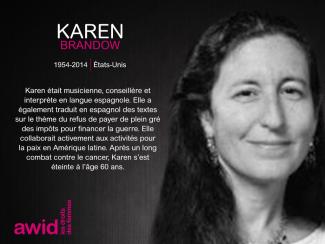
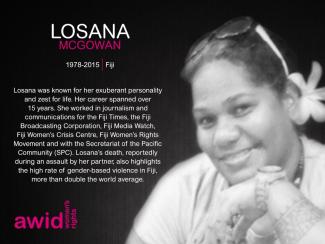
L’hommage se présente sous forme d’une exposition de portraits d’activistes du monde entier qui ne sont plus parmi nous qui ont lutté pour les droits des femmes et la justice sociale.
En 2020, nous adoptons une démarche légèrement différente
Cette année, tout en continuant à convoquer la mémoire de celleux qui ne sont plus parmi nous, nous souhaitons célébrer leur héritage et souligner les manières par lesquelles leur travail continue à avoir un impact sur nos réalités vécues aujourd’hui.
49 nouveaux portraits de féministes et de défenseur·e·s viennent compléter la gallerie. Bien que de nombreuses des personnes que nous honorons dans cet hommage sont décédé·e·s du fait de leur âge ou de la maladie, beaucoup trop d’entre iels ont été tué·e·s à cause de leur travail et de qui iels étaient.
Les histoires des activistes à l'honneur dans cet Hommage font vivre leur héritage et continuent d'inspirer le travail et l’action de nos mouvements.
Les portraits de l'édition 2020 ont été illustrés par Louisa Bertman, artiste et animatrice qui a reçu plusieurs prix.
L’AWID tient à remercier nos membres, les familles, les organisations et les partenaires qui ont contribué à cette commémoration. Nous nous engageons auprès d’elleux à poursuivre le travail remarquable de ces féministes et défenseur·e·s et nous ne ménagerons aucun effort pour que justice soit faite dans les cas qui demeurent impunis.
« Ils ont essayé de nous enterrer. Ils ne savaient pas que nous étions des graines » - Proverbe mexicain
L'Hommage a été inauguré en 2012
Le premier hommage aux défenseur-e-s des droits humains a pris la forme d’une exposition de portraits et de biographies de féministes et d’activistes disparu·e·s lors du 12e Forum international de l’AWID en Turquie. Il se présente maintenant comme une gallerie en ligne, mise à jour chaque année.
Depuis, 467 féministes et défenseur-e-s des droits humains ont été mis·es à l'honneur.
Mena Mangal était une éminente journaliste de télévision, défenseure des droits des femmes et conseillère culturelle du Wolesi Jirga, la chambre basse du parlement national afghan.
Pendant plus d’une décennie, Mena a travaillé pour Ariana TC, la chaîne en pashto Lamar de Tolo TV et la chaîne de télévision nationale privée Shamshad TV. Mena était principalement présentatrice d’émissions sur les droits des femmes et la culture.
« La défenseure des droits des femmes Wazhma Frogh a dit que Mangal « se faisait entendre » et s’exprimait ouvertement en faveur de la défense de son peuple. »
Loin des écrans, elle dirigeait également des plateformes sur les réseaux sociaux, promouvant les droits à l’éducation et au travail des filles et femmes afghanes. Sur le plan de sa vie privée, Mena a longuement écrit sur le mariage arrangé qu’elle a été forcée d’accepter en 2017, et le long processus qui s’en est suivi pour finalement obtenir le divorce.
Dans un post sur Facebook, Mena avait écrit qu’elle recevait des menaces de mort de sources inconnues, mais qu’elle continuerait néanmoins son travail.
Elle a été attaquée le 11 mai 2019 par des hommes armés inconnus et tuée en plein jour et dans un espace public, dans le sud-est de Kaboul.
« La situation nous inquiète, car elle a un impact direct sur les femmes qui travaillent en dehors de la maison... Les femmes journalistes changent de profession du fait de l’augmentation des risques auxquels elles sont confrontées. » - Robina Hamdard, défenseure des droits des femmes à Kaboul
Snippet - Title WCFM Landing - EN
Who Can Fund Me?
Reclaim Power to #FreezeFascisms: Resources for Feminists to Survive & Thrive
Feminist and gender justice movements continue to be chronically underfunded in the face of global funding cuts and freezes. Particularly in Global South regions with shrinking civic spaces, resource scarcity has impacted the most vulnerable communities.
In the face of these setbacks, AWID has updated the Who Can Fund Me? Database - an easy-to-use, practical tool for movements looking for funders from philanthropic foundations, multilateral funders to women’s and feminist funds to support vital lifesaving efforts.
Pour toutes questions liées à l’Appel aux propositions d'activités, merci de nous contacter via notre formulaire de contact en choisissant « Proposition d'activité » comme sujet de votre message.
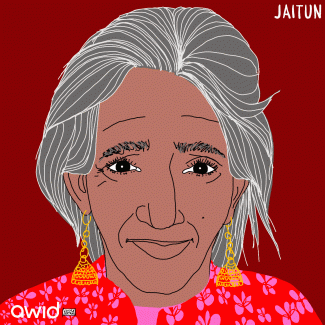
Jaitun, commonly referred to as ‘Amma’, was committed to ensuring the reproductive rights of women and girls in India. She was particularly dedicated to advocating for those living in poverty and who are most marginalized, including Dalit and Muslim women and girls.
Jaitun was the vital force behind the case Jaitun v Janpura Maternity Home & Ors. Her perseverance for justice led to a ground-breaking judgment issued by the High Court of Delhi, holding the Indian government accountable for failing to deliver a number of its legally-binding obligations such as reproductive health care and the right to food.
Her daughter Fatema who was living under the poverty line was denied reproductive services and had to deliver her child in public, under a tree. At the time, both Jaitun and Fatema were homeless as a result of their home being demolished by the government as part of redevelopment and gentrification in New Delhi.
“The judgment has since been used by countless lawyers and activists globally, including the Former United Nations Special Rapporteur on the Right to Health, not only as a source of inspiration but as a solid springboard to further justice.” - Jameen Kaur
Jaitun has inspired many other women living in poverty to claim their rights. She passed away in 2017.
“In Jaitun’s death, we have now lost an inimitable warrior for justice, but her spirit of defiance lives on.” - Jameen Kaur
“In my 18 years as a human rights advocate, I have not met a woman that has inspired and moved my spirit in the same way Amma did. Her roaring courage; her imitable humour - we used to compare her to the Bollywood actress Hema Melini - as she would be upset we had spent so much time away from her - she would say, with a twinkle in her eye, ‘You have forgotten Amma, Amma is not speaking to you’ and then with great dramatics turn her back, only to turn around laughing and stretching her arms out for a hug. Her kindness and ultimately her love and joy for love and the right for all of us to live with dignity. I miss her terribly.” - Jameen Kaur
Snippet - WCFM getting the money we need - En
Getting the Money We Need | A 101 Guide on Fundraising for Small Grassroots Organizations
From building prospect funders lists with *templates*, to understand how to write a solid grant proposal, with ‘Getting the Money we Need’ Guide really we don't have to figure this out alone anymore
Cette information ne sera disponible qu’à l’ouverture de l’inscription.
Clone of Snippet FEA Environments Of Shelter (EN)
Metzineres provides the following kinds of support, known as
Environments of Shelter:
The Cover
Care and healing environment
The Powerful
Self-protection and strengthening
The Ivy
Community and neighborhood
The Howl
Participation and activism
The Bold
Production and entrepreneurship
Artisana
Art and creativity
About the AWID International Forum
More than an event!
The AWID International Forum is a truly global space that gives participants an opportunity to network, build alliances, celebrate, and learn in a stimulating, emotive and safe atmosphere.
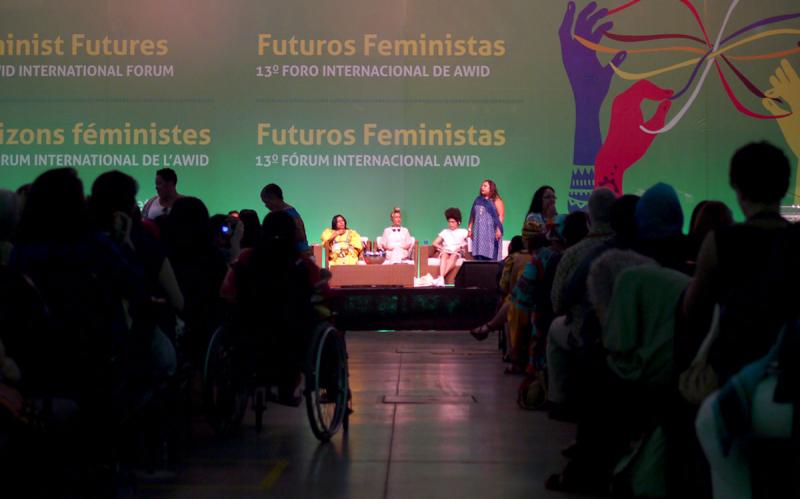
AWID International Forum in Costa de Sauipe, Brazil, 2016
More and more, we are trying to bring the Forum process outside of the convening’s borders. Engaging with partners and deepening relationships all year round, connecting with local movements to better understand problems and co-create solutions. The Forum event itself, held every three to four years in a different region of the world, is just a crystallization of all these alliances that we are building as part of our work.
The AWID Forum dissolves our inner and external boundaries, fosters deep discussion, personal and professional growth, and strengthens our movements for gender justice and women’s rights.
As a convening, it is a response to the urgency to promote stronger and more coordinated engagement and action by feminists, women’s rights and other social justice advocates, organizations and movements. We also believe that the Forum is more than just an event – it can facilitate a process to influence thinking and set agendas for feminist movements and other related actors.
Evolving from a national conference of around 800 people, the event now brings together around 2000 feminists, community leaders, social justice activists, and donor agencies from around the world.
The 14th AWID International Forum will take place 11-14 January 2021 in Taipei, Taiwan.
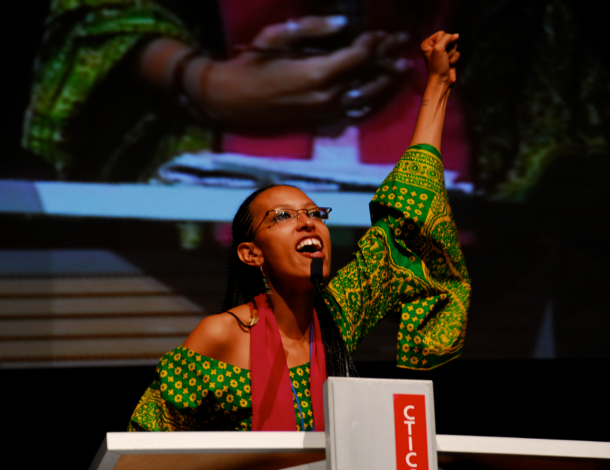
2016 - Feminist Futures: Building Collective Power for Rights and Justice (Costa de Sauipe, Brazil)
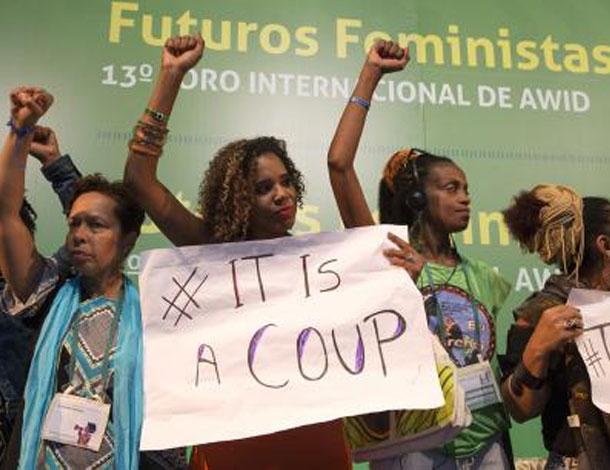
Participants at the Black Feminisms Forum in Brazil, 2016
Given the complex world that we face today, the 2016 AWID Forum did not focus on a particular “issue”, but rather on creating more effective ways of working together!
Despite the challenging contexts in which the 2016 Forum took place (the Zika epidemic, a strike by Brazilian foreign-service workers, the impeachment of President Dilma Rousseff and subsequent turmoil), it succeeded in bringing together over 1800 participants from 120 countries and territories across all regions of the world.
What happened at the 13th AWID international Forum:
For 96% of participantswho responded to the post Forum evaluation survey, the Forum was a major source of inspiration and energy.
98% of participants considered it an important convening space for feminist movements and expressed hope that AWID continues to organize forums.
59% of Forum evaluation survey respondents declared to be very satisfied with the Forum and 34% somewhat satisfied.
Over 150 sessions were delivered in different formats on a variety of topics ranging from bodily integrity and freedoms, to gender-based violence in the workplace, to strategies for building collective power.
The first-time Black Feminisms Forum (BFF), held just before the main AWID Forum, brought together 250 Black feminists from all over the world to co-create a powerful space to build and strengthen ongoing, intergenerational, transnational connections
Read more about what the 2016 AWID Forum achieved:
2012 - Transforming Economic Power to Advance Women's Rights and Justice (Istambul, Turkey)
AWID International Forum, in Cape Town, South Africa, 2008
The 12th AWID Forum was the largest and most diverse AWID Forum to date, bringing together 2239 women’s rights activists from 141 countries. Of these participants, around 65% were from the Global South and close to 15% were young women under 30, and 75% attended an AWID Forum for their first time.
The Forum program focused on transforming economic power to advance women’s rights and justice and featured over 170 different kinds of sessions including feminist economics toolbox skills-building sessions, breakout sessions representing all 10 Forum themes, in-depth sessions, and solidarity roundtables.
Building on the momentum of the 2012 Forum, we transformed the website into a resource and learning Hub, which builds on the content generated by participants by featuring multi-media resources on all Forum components.
Isabel Cabanillas de la Torre fue una activista joven y una artista feminista muy querida de Ciudad Juárez, México, conocida por sus hermosos diseños evocadores de indumentaria pintada a manoen los que los ojos eran una característica emblemática de su trabajo. Sus murales transformaron los edificios abandonados y vacíos del centro de Ciudad Juárez, al sumarles vida y crítica política a sus paredes.
A través de su arte y de su activismo político, Isabel buscó llamar la atención sobre la violencia de género que se extendía por su ciudad natal. Colaboró como voluntaria con la red Mesa de Mujeres en el proyecto «Observatorio Ciudadano de Género», que monitoreaba la actuación de jueces, fiscales y defensorxs públicxs en casos de femicidios y otras violaciones a los derechos basadas en el género. Integró también «Hijas De Su Maquilera Madre», una colectiva feminista cuyo nombre alude a las hijas de madres que son trabajadoras de la maquila. Algunas de estas madres fueron las primeras víctimas de femicidio en Ciudad Juárez.
El último proyecto de Isabel (todavía en curso) fue una instalación artística para protestar contra una compañía canadiense que quería extraer cobre de los Médanos de Samalayuca.
El 18 de enero de 2020 Isabel fue atacada a balazos mientras volvía a su casa del centro de Ciudad Juárez en bicicleta, víctima, aparentemente, de un asesinato selectivo. Su cuerpo fue encontrado junto a su bicicleta.
El asesinato de Isabel desató una nueva ola de indignación contra los femicidios de la región: cientos de personas marcharon hacia el puente de la frontera entre EEUU y México, y lo bloquearon durante horas mientras cantaban «Ni una más», que es la protesta continua de las colectivas feministas contra los asesinatos de las mujeres en todo México. Solamente en 2019, 3.142 mujeres y niñas fueron asesinadas en el país; muchas de ellas fueron atacadas específicamente por su género.
Amaba andar en bicicleta.
«La bicicleta era un símbolo de libertad para ella. Simbolizaba ser libre en las calles.» - Marisol, amiga de Isabel
Snippet - WITM Infographic annual budget 2 in 4- EN
Ever Wondered What Budgets for Feminist Organizations Look Like?
A closer look at actual budgets reveals major income diversity and inequality.
En quelles langues les informations seront-elles disponibles sur le Forum ?
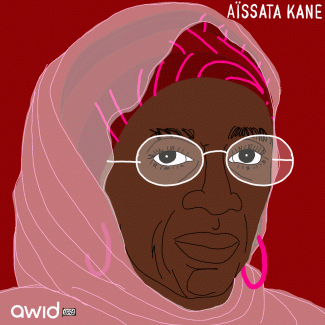
Aïssata Kane, surnommée affectueusement “Yaye Kadia” (Mère Kadia), a de tout temps été une féministe engagée dans la défense des droits des femmes africaines, et particulièrement mauritaniennes.
Au cours de sa carrière politique, en 1975, elle fut nommée ministre de la protection de la famille et des affaires sociales et travailla avec ardeur à l’amélioration du statut des femmes dans son pays; c’était la première fois qu'une femme occupait un tel poste.
Ce travail consista notamment à promouvoir l’éducation des filles et des femmes, à lutter contre la pratique du gavage sur les jeunes femmes, à faire pression pour l’inclusion d’une disposition sur les droits maritaux et à plaider en faveur de la création d’un quota de représentation féminine au Parlement.
“[Aïssata] a réalisé toutes ses passions avec humilité, courage et détermination. Elle ne voulait déranger personne avec ce combat qu’elle menait sur tous les fronts à la fois.” Ball Halimata Dem, la nièce d’Aïssata
Ayant fondé l'Union nationale des femmes de Mauritanie (UNFM), elle avait cocréé et publié pour elles le magazine Marienou, dédié à l’émancipation des femmes mauritaniennes. Aïssata dirigea également plusieurs organisations sous-régionales et locales, notamment en tant que présidente de l'Association internationale des femmes francophones (AIFF) et, en écologiste résolue, fut présidente de l'Association pour la protection de l'environnement en Mauritanie (APEM).
En 2018, on lui décerna le Prix de la Femme africaine pionnière. Ce prix honore son engagement à faire progresser le statut de la femme en Mauritanie et reconnaît son grand leadership et son sens de l'innovation.
Aïssata est décédée le 10 août 2019.
WITM - Refreshed INFOGRAPHIC 3 FR
Comment les féministes s’autofinancent ?
Les organisations féministes et de défense des droits des femmes ne dépendent pas uniquement des financements institutionnels, elles s’autofinancent. Nos mouvements sont animés par la passion, la solidarité, l’engagement politique et le soin collectif.
Ces ressources autonomes et autogénérées sont souvent invisibles dans les budgets, mais elles sont le pilier de notre action collective.
Les propositions d’activité seront initialement présélectionnées par l’équipe de l’AWID
Les organisateurs·trices des propositions retenues seront ensuite invité·e·s à voter pour choisir les activités finales. Celles qui auront obtenu le plus de votes seront incluses au programme du Forum. L'AWID pourra procéder à quelques ajustements à la sélection finale pour s'assurer que notre programme présente un équilibre adéquat entre les régions, les groupes d'intérêt, les enjeux et les méthodologies.
Notre Comité contenu et méthodologie du Forum prendra contact avec les organisateurs·trices des propositions sélectionnées pour les aider à développer davantage leurs activités.
Nous mettrons le site à jour avec les informations pertinantes le moment venu.