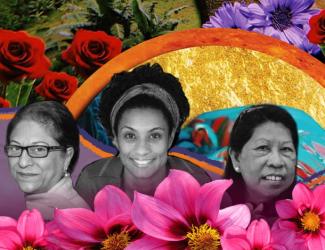
La mémoire comme forme de résistance : un hommage
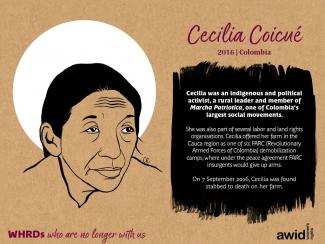
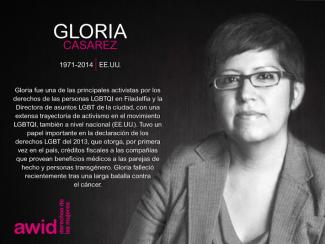
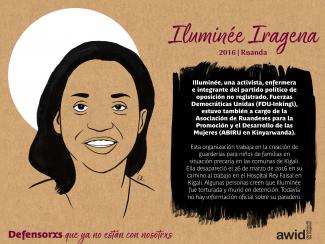
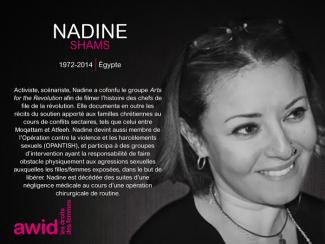
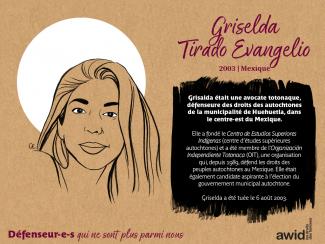
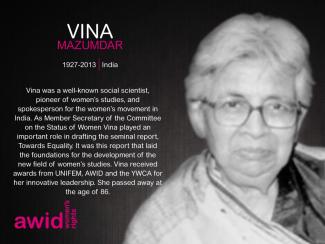
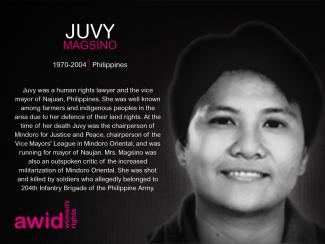
L’hommage se présente sous forme d’une exposition de portraits d’activistes du monde entier qui ne sont plus parmi nous qui ont lutté pour les droits des femmes et la justice sociale.
En 2020, nous adoptons une démarche légèrement différente
Cette année, tout en continuant à convoquer la mémoire de celleux qui ne sont plus parmi nous, nous souhaitons célébrer leur héritage et souligner les manières par lesquelles leur travail continue à avoir un impact sur nos réalités vécues aujourd’hui.
49 nouveaux portraits de féministes et de défenseur·e·s viennent compléter la gallerie. Bien que de nombreuses des personnes que nous honorons dans cet hommage sont décédé·e·s du fait de leur âge ou de la maladie, beaucoup trop d’entre iels ont été tué·e·s à cause de leur travail et de qui iels étaient.
Les histoires des activistes à l'honneur dans cet Hommage font vivre leur héritage et continuent d'inspirer le travail et l’action de nos mouvements.
Visiter notre exposition virtuelle
Les portraits de l'édition 2020 ont été illustrés par Louisa Bertman, artiste et animatrice qui a reçu plusieurs prix.
L’AWID tient à remercier nos membres, les familles, les organisations et les partenaires qui ont contribué à cette commémoration. Nous nous engageons auprès d’elleux à poursuivre le travail remarquable de ces féministes et défenseur·e·s et nous ne ménagerons aucun effort pour que justice soit faite dans les cas qui demeurent impunis.
« Ils ont essayé de nous enterrer. Ils ne savaient pas que nous étions des graines » - Proverbe mexicain
L'Hommage a été inauguré en 2012
Le premier hommage aux défenseur-e-s des droits humains a pris la forme d’une exposition de portraits et de biographies de féministes et d’activistes disparu·e·s lors du 12e Forum international de l’AWID en Turquie. Il se présente maintenant comme une gallerie en ligne, mise à jour chaque année.
Depuis, 467 féministes et défenseur-e-s des droits humains ont été mis·es à l'honneur.
Contenu lié
Ȃurea Mouzinho
Ȃurea Mouzinho is a feminist economic justice organizer from Luanda, Angola, with a 10-year career in research, grant-making, advocacy, and movement-building for women's rights and economic justice across Africa and the global south. Currently the Program Manager for Africa at Thousand Currents, she also serves on the Feminist Africa Editorial Board and is a member of Ondjango Feminista, a feminist collective she co-founded in 2016. A new mom to a Gemini boy, urea enjoys slow days with her young family and taking long strolls by the beach.
She occasionally tweets at @kitondowe.
Forum 2024 - FAQ - Will you be opening CFA - EN
Yes! Please read the Call for Activities and apply here. Deadline is 15 January 2024
Zuhour Mahmoud | Snippet AR

زهور محمود، منسّقة التواصل لمجلّة كحل. هي كاتبة ومحرّرة ودي جاي مقيمة في برلين. تركّز في عملها على مقاربات نقدية بين الثقافة والتكنولوجيا والسياسة، ودورة حياتهم في العالم الرقمي.
Paola Barraza
Simone Jagger
Simone a 20 ans d’expérience dans le soutien à la gestion et l’administration dans des organisations à but non lucratif, en particulier dans l’enseignement médical post universitaire et la formation aux Technologies de l'Information et de la Communication. Elle possède des qualifications en soutien à la gestion et en études parajuridiques. Elle est basée en Afrique du Sud, aime voyager et agit en tant que généalogiste amatrice.
Maya Angelou
What criteria are you using to select the activities?
Please refer to the Call for Activities for this information, including the section “What you need to know”.
Mariam Mekiwi | Snippet ES

Mariam Mekiwi es una cineasta y fotógrafa de Alejandría. Vive y trabaja en Berlín.
Emilsen Manyoma
Related Content
Front Line Defenders: Emilsen Manyoma Killed
ReliefWeb: A human rights defender killed every other day in 2017 in Colombia (between 1 and 23 January 2017)
Global Witness: Defenders of the Earth (2016 Report)
okayafrica.: Who is Killing Colombia's Black Human Rights Activists?
PBI Colombia: We will always accompany your work
Bitch Media: Don’t Touch My Crown: The failure of decapitation and the power of black women’s resistance
Nana Abuelsoud
Nana is a feminist organizer and a reproductive rights and population policy researcher based in Egypt. She is a member of Realizing Sexual and Reproductive Justice (RESURJ), a member of the Advisory Board of the A Project in Lebanon, and a member of the Community Committee of Mama Cash. Nana holds an MSc in Public Health from KIT Institute and Vrije University in Amsterdam. In her work, she follows and contextualizes national population policies while building evidence that addresses modern eugenics, regressive international aid, and authoritarianism. Previously, she was part of the Geneva Foundation for Medical Education and Research, the Egyptian Initiative for Personal Rights, and Ikhtyar Feminist Collective in Cairo.
Clotil Walcott
Disintegration | Small Snippet ES
Miroslava Breach Velducea
Contenido relacionado
Norte Digital de Ciudad Juárez: Cerramos en protesta
La Jornada: Brazo del ‘cártel’ de Sinaloa ordenó asesinar a Miroslava Breach: FGE
BBC: Miroslava Breach, la periodista “incómoda” asesinada en México cuando llevaba a su hijo a la escuela
What is AWID?
The Association for Women's Rights in Development (AWID) is an international feminist membership organization.
We work to achieve gender justice and women’s human rights by strengthening the collective voice, impact and influence of global women’s rights advocates, organizations and movements.
Lieutenant Nigar
Hospital | Content Snippet EN
“Now might be a good time to rethink what a revolution can look like. Perhaps it doesn’t look like a march of angry, abled bodies in the streets. Perhaps it looks something more like the world standing still because all the bodies in it are exhausted—because care has to be prioritized before it’s too late.”
- Johanna Hedva (https://getwellsoon.labr.io/)
Hospitals are institutions, living sites of capitalism, and what gets played out when somebody is supposed to be resting is a microcosm of the larger system itself.
Institutions are set out to separate us from our care systems – we find ourselves isolated in structures that are rigidly hierarchical, and it often feels as if care is something done to us rather than given/taken as part of a conversation. Institutional care, because of its integration into capitalist demand, is silo-ed: one person is treating your leg and only your leg, another is treating your blood pressure, etc.
Photographer Mariam Mekiwi had to have surgery last month and documented the process. Her portraits of sanitized environments – neon white lights, rows after rows of repetitive structures – in a washed-out color palette reflect a place that was drained of life and movement. This was one of the ways Mariam kept her own spirit alive. It was a form of protest from within the confines of an institution she had to engage with.
The photos form a portrait of something incredibly vulnerable, because watching someone live through their own body’s breakdown is always a sacred reminder of our own fragility. It is also a reminder of the fragility of these care systems, which can be denied to us for a variety of reasons – from not having money to not being in a body that’s considered valuable enough, one that’s maybe too feminine, too queer or too brown.
Care experienced as disembodied and solitary, that is subject to revocation at any moment, doesn’t help us thrive. And it is very different from how human beings actually behave when they take care of each other. How different would our world look like if we committed to dismantling the current capitalist structures around our health? What would it look like if we radically reimagined it?
¿AWID es una organización feminista?
Sakine Cansiz
CREDITS | Content Snippet EN
Credits
|
Editorial Team Design and Illustration Communications Strategist
Translation Manager AWID’s Team |
Arabic Translators English to Spanish Proofreaders Proofreaders Portuguese to English Proofreader |