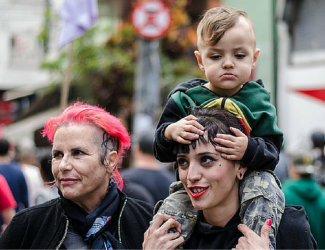
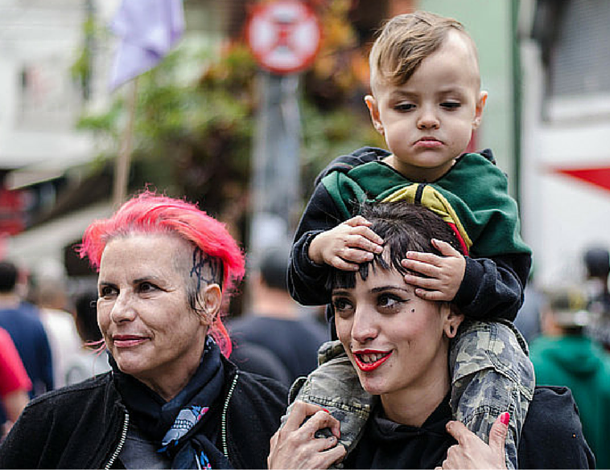
Flickr/Leonardo Veras (CC BY 2.0)

Analyses Spéciales

L´AWID est une organisation féministe mondiale qui consacre ses efforts à la justice de genre, au développement durable et aux droits humains des femmes

Protection de la famille

Contexte

Au cours des dernières années, nous avons observé une nouvelle tendance inquiétante dans les espaces internationaux consacrés aux droits humains. Les discours axés sur « la protection de la famille » sont en effet utilisés pour défendre des violations des droits de membres de la famille, pour renforcer et justifier l’impunité des auteurs de ces violations et pour restreindre l’égalité des droits au niveau de la vie familiale. 

La campagne en faveur de la « Protection de la famille » est motivée par une volonté conservatrice d’imposer des conceptions « traditionnelles » et patriarcales de la famille et de priver les membres de la famille de leurs droits pour les transférer à « l’institution familiale ».

Les initiatives visant à la « Protection de la famille » reposent sur :

  • la montée du traditionalisme,
  • la montée du conservatisme culturel, social et religieux,
  • l’existence d’une hostilité vis-à-vis des droits humains des femmes, des droits sexuels, des droits des enfants et enfin des droits des personnes dont l’identité de genre et l’orientation sexuelle ne sont pas conformes aux normes.

Depuis 2014, un groupe d’Etats travaille de front dans les espaces dédiés aux droits humains sous le nom de « Group of Friends of the Family » (Groupe des ami-e-s de la famille) ; des résolutions sur la « Protection de la famille » ont été adoptées chaque année depuis 2014.

Ce programme s’est propagé au-delà du Conseil des droits humains. Nous avons observé l’introduction d’un discours régressif autour de la « famille » à la Commission sur la condition de la femme, ainsi que des tentatives d’introduction dans les négociations sur les Objectifs de développement durable.


Notre approche

L’AWID travaille avec des partenaires et des allié-e-s pour s’opposer ensemble à la « Protection de la famille » et à d’autres programmes régressifs et défendre l’universalité des droits humains.

En réponse à l’influence croissante d’acteurs régressifs au sein des espaces dédiés aux droits humains, l’AWID a rejoint des allié-e-s afin de créer l’Observatoire sur l'Universalité des droits (OURs) (site en anglais). L’OURs est un projet de collaboration qui surveille, analyse et diffuse les informations concernant les initiatives anti-droits telles que la « Protection de la famille ».

Le premier rapport de l’OURs, Nos droits en danger, trace une cartographie des acteurs et actrices qui constituent le lobby mondial anti-droits et identifie leur réthorique et stratégies clés ainsi que leur impact sur les droits humains.  

Le rapport précise que le programme de « Protection de la famille » a développé une collaboration entre un large éventail d’acteurs régressifs aux Nations Unies, qu’il décrit comme « un cadre stratégique abritant des positions anti-droits et patriarcales multiples, où le cadre vise entre autres à légitimer et institutionnaliser ces positions. »
Contenu lié

Mariam Uy Acob

Mariam was a paralegal at the Kawagib Moro Human Rights Alliance. 

Mariam was a staunch critic of militarization in Moro communities, and consistently denounced aerial bombardment and encampment. She had to seek sanctuary after exposing and calling out the injustices committed against Muslim communities in the Philippines.

She is believed to have been killed by suspected military agents because of her work as a WHRD. The assailants who killed Mariam waited for her, caught up with the vehicle she was using and shot her seven times. 


Mariam Uy Acob, Philippines

AWID IN 2015: Building Collective Impact

In 2015 AWID grew and diversified.

We ramped up preparations for the 13th AWID international Forum, focused a lot of energy on the Post 2015 Development Agenda and Financing for Development processes, and continued the core work of our priority areas:


A sneak peak inside the report

The context

  • We continue witnessing the rapid breakdown in democracy and democratic institutions, with spaces for dissent shrinking.
  • Multiple and concurrent systemic crises (energy, food, finance and climate) continue to deepen inequalities and pose major challenges.
  • Corporations are a leading power in determining the development agenda.
  • Violence against WHRDs remains an urgent problem.
  • Religious fundamentalisms are pervasive and increasingly powerful.
  • New forms of online gender-based violence have emerged.

In response, we are moving out of our silos.

Increasingly, women’s rights and other movements worldwide are articulating the systemic and intersectional nature of these and other problems. We are making better connections with the agendas of other social and environmental movements for solidarity, alliance building and collective responses. We are also seeing greater visibility of these movements fighting for justice on the ground.


Our Impact

  • For effective strategizing and advocacy, we need facts
  • To exchange knowledge and join hands in solidarity, we need  a strong online community
  • To build our collective power, we need to work together
  • To influence international processes,  we need to increase our access and voice
  • To reposition power we need to give visibility and emphasize  the important role that feminist and women’s rights movements  are already playing
     

Our Members

As at 31st December, 2015 we had:


Read the full report


Snippet FEA Otras Union meetings and demonstrations (ES)

Reuniones y protestas del Sindicato OTRAS

O meu idioma não é um dos oficiais do inquérito, e estou a ter dificuldades a preencher o mesmo. O que posso fazer?

A AWID compromete-se a alcançar a justiça linguística e lamentamos que, neste momento, não seja viável disponibilizar um inquérito do WITM em mais idiomas. No entanto, caso precise de apoio com traduções ou queira preencher o inquérito em qualquer outro idioma, entre em contacto connosco através de witm@awid.org.

Our values - esponsibility, Accountability, and Integrity

Responsabilidad, rendición de cuentas e integridad

Nos esforzamos por ser transparentes, por utilizar nuestros recursos en forma responsable, por ser equitativxs en nuestras colaboraciones, y por ser responsables e íntegrxs con nuestrxs afiliadxs, contrapartes y donantes, y con los movimientos con los que trabajamos y en los que participamos. Estamos comprometidxs a reflejar nuestras experiencias, a compartir abiertamente nuestrxs aprendizajes, y a esforzarnos por cambiar nuestras prácticas en consecuencia.

Our arepa: Resistance from the Kitchen


by Alejandra Laprea, Caracas, Venezuela (@alejalaprea)

I live in a country of the impossible, where there are no bombs yet we are living in a war.

A war that exists only for those of us living in this territory.

I live in a country no one understands, which few can really see, where various realities co-exist, and where the truth is murdered time and again.

I live in a country where one has to pay for the audacity of thinking for oneself, for taking on the challenge of seeing life another way.

I live in a country of women who have had to invent and reinvent, time and again, how they live and how to get by.

I live in Venezuela, in a time of an unusual and extraordinary threat.

Since 2012 my country has been subjected to an unconventional war. There are no defined armies or fire power. Their objective is to dislocate and distort the economy, affecting all households, daily life, the capacity of a people to dream and build a different kind of politics, an alternative to the patriarchal, bourgeois, capitalist democracy.

Venezuelan women are the primary victims of this economic war. Women who historically and culturally are responsible for providing care, are the most affected and in demand. However, in these years of economic and financial embargo, Venezuelan women have gone from being victims to the protagonists on the front lines defending our territory.  

Battles are fought from the barrios, kitchens, and small gardens. We defend the right of girls and boys to go to school, and to be given something so simple as some arepas for breakfast.

Arepas are a kind of corn cake that can be fried, roasted or baked and served sweet or savoury as a side or main dish. It is a staple in the diet of all Venezuelans.

In Venezuela, arepas mean culture, family, food sovereignty, childhood nostalgia, the expert hands of grandmothers molding little balls, the warmth that comforts you when recovering from illness.

Arepas connect us as a people with the pre-Colombian cultures of corn, a resistance that has endured for more than five centuries. They are the Caribbean expressed differently on firm ground.

They are an act of resistance.

When my mother was a girl, they would start grinding the dry corn early in the morning to make arepas. The women would get up and put the kernels of corn in wooden mortars and pound it with heavy mallets to separate the shells. Then they would boil, soak, and grind the corn to make dough, and finally they would mold it into round arepas. The process would take hours and demand a lot of physical effort.   

In the mid-20th century a Venezuelan company industrialized the production of corn meal. For an entire generation that seemed like an act of liberation, since there was now a flour that you could simply add water to and have hot arepas in 45 minutes time.

But that also meant that the same generation would lose the traditional knowledge on how to make them from scratch. My grandmother was an expert arepa maker, my mother saw it as a girl, and for me the corn meal came pre-packaged.

In the war with no military, the pre-cooked corn meal came to be wielded as an instrument of war by the same company that invented it, which was not so Venezuelan anymore: today the Polar group of companies is transnational.

We women began to recuperate our knowledge by talking with the eldest among us. We searched in the back of the closets for our grandmothers’ grinders, the ones we hadn’t thrown away out of affection. Some families still prepared the corn in the traditional way for important occasions. In some towns there were still communal grinding stations which had been preserved as part of local history or because small family businesses refused to die. All of these forms of cultural resistance were activated, and we even went so far as to invent new arepas.

Today we know that in order to resist we cannot depend on one food staple. Although corn arepas continue to be everyone’s favourite, we have invented recipes for arepas made of sweet potato, cassava, squash, and celery root.

We have learned that we can use almost any root vegetable to make arepas. Cooperative businesses have developed semi-industrial processes to make pre-cooked corn meal. In other words, we have recuperated our arepas and their preparation as a cultural good that belongs to all.


“Entretejidas” [Interwoven women]

by Surmercé, Santa Marta (@surmerce)

My artivism aims to decolonize our senses in everyday life. I like to create spaces that communicate how we weave together our different struggles, and that render visible dissident (re)existences, other possible worlds, and living bodies here in the SOUTH.


“We carry one another towards the future”

by Marga RH, Chile, UK (@Marga.RH)

Let's take care of one another

As we continue to fight in our struggles, let us remember how essential it is that we support each other, believe each other, and love ourselves and our sisters. When this system fucks us over, we must take time to look after our (physical and mental) health, that of our sisters, and to understand that each one of us carries unique stories, making us fighters in resist

Marga RH (@Marga.RH)

Until dignity becomes a habit

These portraits are inspired by the voices of resistance and protest movements in Latin America, especially by the key role that feminised bodies play in these struggles. It is a tribute to the grassroots feminist movements in resistance.


Florence Adong-Ewoo

Florence fue una activista por los derechos de las personas con discapacidad que trabajó con varias organizaciones de mujeres con discapacidad en Uganda.

También ocupó la Dirección del Distrito de Lira de la Asociación de Mujeres con Discapacidad, así como del foro de Consejeras Mujeres del Distrito de Lira. Formada como consejera para personas con discapacidad y para madres y padres de niñxs con discapacidad, apoyó muchos proyectos que reclamaban mayor representación de las personas con discapacidad.

Murió en un accidente de motocicleta.


Florence Adong-Ewoo, Uganda

Annual Report 2010

AWID 2010 Annual Report Cover

Our 2010 Annual Report highlights the major accomplishments of each of our strategic initiatives during the year.

Along with activity highlights, we include a brief analysis of the impact of our initiatives as well as reflections from our members and partners that further illustrate the relevance of AWID’s work and its connection to broader women’s rights movements. 

This interactive document is complete with links to our websites and recent publications with in-depth information on the issues we address in the report.

Read online

Snippet FEA Union Otras Photo 5 (FR)

Photo de personnes assises sur des chaises rouges dans une salle de conférence

لم تتلق مجموعتنا التمويل بشكل متواصل بين الأعوام 2021-2023. هل علينا تعبئة الاستطلاع؟

نعم. نريد السماع منكم/ن دون أي علاقة ان حصلتم/ن على تمويل لثلاثة أعوام أو عامين أو عام واحد في السنوات 2021-2023.

14th AWID international Forum is cancelled (forum page)

Le Forum international de l’AWID est annulé

Étant donnée la situation mondiale, notre Conseil d’administration a pris la décision difficile d’annuler le Forum, qui devait avoir lieu en 2021 à Taipei. 

Lire le communiqué

Exposición en el Jardín de los Placeres

Estas obras son un trabajo colaborativo de fotografías e ilustraciones realizadas por Siphumeze y Katia durante el confinamiento. Muestran narrativas negras queer de sexo y placer, bondage, sexo seguro, juguetes, salud mental y sexo, y mucho más. Fueron creadas para acompañar la antología Touch.

Mental Health
“Mental Health” [«Salud mental»]
Sex and Spirtuality
“Sex and Spirituality” [«Sexo y espiritualidad»]
Orgasm
“Orgasm” [«Orgasmo»]

About the Artists:

Siphumeze Khundayi portrait
Siphumeze Khundayi es una creadora de arte, fotógrafa y facilitadora interesada en las formas creativas de unir el diálogo y la práctica artística en relación con la identidad queer africana.
 
Es directora creativa de HOLAAfrica!, una colectiva en línea mujerista panafricanista.
 
Sus trabajos de performance individual y en colaboración han sido presentados en numerosos festivales y espacios teatrales, tales como el Ricca Ricca Festival de Japón.
 
En 2017 y 2018 dirigió dos producciones que fueron nominadas a los Naledi Theatre Awards y, en 2020, obtuvo un premio Standard Bank Ovation.
 
Como fotógrafa, participó en Italia en una exposición grupal titulada Flowers of my Soul, organizada por The Misfit Project. Produjo tres publicaciones para HOLAAfrica!, y sus trabajos fueron publicados dentro y como tapa del Volume Two: As You Like de las Gerald Kraak Anthologies.
katia portrait
Katia Herrera es una artista visual digital de 21 años, de la ruidosa ciudad de Santo Domingo, en la República Dominicana. A pesar de que se autodefine como introvertida, su obra es notablemente estruendosa en un mundo que intenta acallar las voces negras. Con títulos como “Black Woman” [«Mujer Negra»], “You Own the Moon” [«La Luna es Tuya»], “Earth Goddess” [«Diosa de la Tierra»], “Forever” [«Por Siempre»] y “Universe Protector” [«Protectora del Universo»], el legado de Herrera estará marcado por su pasión por poner de manifiesto la resistencia y la perseverancia de las personas negras del pasado y del presente, en contraposición a la narrativa de que la piel negra debería solamente ser asociada con la esclavitud.
 
Una de sus obras más hermosas y vivazmente tituladas, “Universe Protector”, representa al alma negra como una entidad divina plena de fortaleza, poder y grandeza. En su juventud, su amor por el diseño gráfico se vio estimulado por el talento artístico de su madre y su padre, y por el programa Photoshop que habían descargado en su computadora para su trabajo profesional de fotografía.

Nadine Ramaroson

Son soutien aux femmes et aux personnes les plus vulnérables de sa communauté a fait que Nadine était un modèle pour beaucoup. Elle était déterminée à aider les pauvres et les sans-abri en particulier.

Bien que sa mort ait été déclarée comme étant accidentelle, la famille Ramaroson, sur l’initiative de son père André Ramaroson, a mené une enquête qui a mis en évidence des preuves de son assassinat. Elle serait décédée dans un accident mortel survenu entre Soanierano - Ivongo et Ste Marie - une histoire qui a été réfutée par sa famille. Elle avait reçu de nombreuses menaces de mort pour ses positions politiques résolues. L’affaire est toujours en cours auprès des tribunaux à Antananarivo (la capitale de Madagascar).


Nadine Ramaroson, Madagascar

Demo article

Snippet FEA Principles of work Transparency (EN)

A pink umbrella

TRANSPARENCY

Я не хочу делиться названием организации и контактной информацией с AWID – могу ли я пройти опрос?

Безусловно, эти вопросы являются необязательными, мы ценим ваше право сохранять конфиденциальность. Пожалуйста, заполните опрос независимо от того, указываете вы название вашей группы, организации и/или движения и контактные данные или нет.

Contributors of toolkit (WITM landing page)

We would like to thank the contributors and advisors of this toolkit:

  • Angelika Arutyunova
  • Cindy Clark
  • Kamardip Singh
  • Martin Redfern
  • Pei Yao Chen
  • Srilatha Batliwala
  • Veronica Vidal

    Download the Toolkit in PDF