Advancing Universal Rights and Justice
Uprooting Fascisms and Fundamentalisms
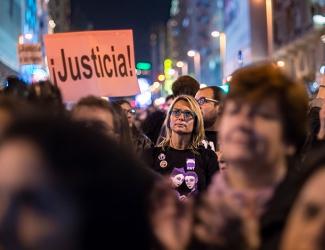
Across the globe, feminist, women’s rights and gender justice defenders are challenging the agendas of fascist and fundamentalist actors. These oppressive forces target women, persons who are non-conforming in their gender identity, expression and/or sexual orientation, and other oppressed communities.
Discriminatory ideologies are undermining and co-opting our human rights systems and standards, with the aim of making rights the preserve of only certain groups. In the face of this, the Advancing Universal Rights and Justice (AURJ) initiative promotes the universality of rights - the foundational principle that human rights belong to everyone, no matter who they are, without exception.
We create space for feminist, women’s rights and gender justice movements and allies to recognize, strategize and take collective action to counter the influence and impact of anti-rights actors. We also seek to advance women’s rights and feminist frameworks, norms and proposals, and to protect and promote the universality of rights.
Our actions
Through this initiative, we:
- Build knowledge: We support feminist, women’s rights and gender justice movements by disseminating and popularizing knowledge and key messages about anti-rights actors, their strategies, and impact in the international human rights systems through AWID’s leadership role in the collaborative platform, the Observatory on the Universality of Rights (OURs)*.
- Advance feminist agendas: We ally ourselves with partners in international human rights spaces including, the Human Rights Council, the Commission on Population and Development, the Commission on the Status of Women and the UN General Assembly.
- Create and amplify alternatives: We engage with our members to ensure that international commitments, resolutions and norms reflect and are fed back into organizing in other spaces locally, nationally and regionally.
- Mobilize solidarity action: We take action alongside women human rights defenders (WHRDs) including trans and intersex defenders and young feminists, working to challenge fundamentalisms and fascisms and call attention to situations of risk.
Related Content
2003: First High-level Dialogue is held
First High-level Dialogue on Financing for Development, 29-30 October 2003
One of the follow up mechanisms to the Monterrey conference are the UN General Assembly High-level Dialogues on Financing for Development held every two years. In total eight roundtable meetings took place following the Dialogue on various issues including agricultural subsidies, trade, debt relief and funding of the MDGs. All the discussions focused on dealing with the structural hindrances on these issues that disadvantaged ‘developing’ nations.
Other follow up mechanisms to Monterrey included:
- The UN Economic and Social Council (ECOSOC) special high-level meeting, held annually, with the leadership of the World Bank, the International Monetary Fund, the World Trade Organization and UNCTAD on the follow-up to the Monterrey Consensus. ECOSOC also devotes up to two days to deliberate the FfD agenda item during its substantive session.
- Committee of Experts on International Cooperation in Tax Matters, the specialized United Nations tax body, addresses the various tax policy issues identified in the Monterrey Consensus and provides a framework for dialogue with a view to enhancing and promoting international tax cooperation among national tax authorities.
Snippet - WITM about research - EN
About Where is the Money? research
The global survey is a key pillar of the third iteration of our action-oriented research: “Where is the Money for Feminist Organizing?” (in short, Where is the Money or WITM). The results of the survey will be further elaborated and explored through in-depth conversations with activists and funders and cross-referenced with other existing analysis and research on the state of funding for feminists and gender equality globally.
The full “Where is the Money for Feminist Organizing” report will be published in 2026.
 To learn more how AWID has been shining a light on money for and against feminist movements check out the work of our Resourcing Feminist Movements Initiative here.
What is at stake for women’s rights?
Development financing has specific threats and opportunities for women's and all people’s human rights. Transformative development financing and policies can make an important contribution to the systemic changes that are needed to ensure the respect, protection and fulfillment of women’s human rights.
2015 is an important year for the FfD process. The Third International Conference on FfD took place from 13-16 July 2015 in Addis Ababa, Ethiopia and governments are finalising the post-2015 development agenda including agreements on how the new Sustainable Development Goals will be financed.
The current stage of the FfD process is an important opportunity to establish a financing framework that will ensure effective financing for the implementation of the post 2015 agenda and the Sustainable Development Goals (SDGs). It is also an opportunity to address the structural conditions, and systemic changes needed, for the full implementation of other agendas and commitments such as Human Rights Conventions, and the Beijing Platform for Action.
Over the last 13 years, women’s rights and feminist organizations have actively engaged in the FfD process.
Our group, organization and/or movement has not taken or mobilized funding from external funders, should we take the survey?
Yes! We recognize and appreciate different reasons why feminists, in their respective contexts, don’t have external funding: from being ineligible to apply for grants and/or receive money from abroad, to relying on resources generated autonomously as a political strategy in its own right. We want to hear from you regardless of your experience with external funding.
My question isn’t answered here
For additional questions, please use our contact form, and select “14th AWID Forum" from the dropdown menu.
Why are you asking for the name of the group, organization and/or movement completing the survey and our contact information?
We are asking for this data to facilitate the review of responses, avoid duplication and be able to contact your group in case you have been unable to complete the questionnaire and/or you have doubts or further questions. You can learn more about how we use the personal information we collect through our work here.
Snippet - WITM why - AR
لماذا عليّ تعبئة الاستطلاع؟
Snippet - WITM To Strengthen - AR
لتقوية صوتنا وقوتنا الجماعية لنصل لتمويل أكبر وأفضل للتنظيمات النسائية والنسوية وحركات الميم - عين وحلفائها/يفاتها عالمياً
Snippet - WITM about research - PT
Sobre o inquérito WITM
O inquérito global do WITM é um pilar fundamental da terceira edição da nossa investigação orientada para a ação: "Onde está o dinheiro para a organização feminista" (abreviado, "Onde está o dinheiro" ou WITM). Os resultados do inquérito serão aprofundados e explorados através de conversas profundas com ativistas e financiadores, e comparados com outras análises e investigações existentes sobre o estado do financiamento para feministas e para a igualdade de género globalmente
O relatório completo "Onde está o dinheiro para a organização feminista" será publicado em 2026.
Para mais informações sobre como a AWID tem chamado a atenção para o dinheiro a favor de e contra os movimentos feministas, consulte a nossa história do WITM e os nossos relatórios anteriores aqui.
ما هو الهدف من استطلاع "أين المال"؟
الهدف الأساسي من وراء استطلاع "أين المال" هو تسليط الضوء على على وقائع التمويل المتنوّعة والمركّبة للحركات النسوية، حركات النساء، حركات العدالة الجندرية وحركات مجتمع الميم - عين والحركات الحليفة لها على المستوى العالمي. بناءاً على هذا، وبناءً على ذلك - تعزيز قضية تحويل أموال أكثر وأفضل وتحويل السلطة باتجاه الحركات النسوية.
Courageous WHRDs in the Media
These 21 Women Human Rights Defenders (WHRDs) worked as journalists and more widely in the media sector in Mexico, Colombia, Fiji, Libya, Nepal, United States, Nicaragua, Philippines, Russia, Germany, France, Afghanistan, and the United Kingdom. 17 of them were murdered and in one case the cause of death is still unclear. On this World Press Freedom Day, please join us in commemorating the life and work of these women by sharing the images below with your colleagues, friends and networks using the hashtags #WPFD2016 and #WHRDs.
The contributions of these women were celebrated and honoured in our Tribute to Women Human Rights Defenders (WHRDs) Who Are No Longer With Us.
Please click on each image below to see a larger version and download as a file


Мы распределяем деньги среди наших грантополучающих партнерок(-ров) и являемся феминистским и/или женским фондом – можем ли мы участвовать в опросе?
Нет, мы высоко ценим вашу работу, но в данный момент мы не просим откликов от женских и феминистских фондов. Мы будем рады, если вы поделитесь информацией об опросе со своими партнерками(-рами) и контактами внутри феминистской сети.
Research methology
Over eight years, we did four global surveys and built a research methodology.
In 2013, we published three global reports. These reports confirm that women’s rights organizations are doing the heavy lifting to advance women’s rights and gender equality by using diverse, creative and long-term strategies, all while being underfunded.
Our 2010 global survey showed that the collective income of 740 women’s organizations around the world totaled only USD 104 million. Compare this with Greenpeace International, one organization with a 2010 budget of USD 310 million1. Imagine the impact these groups could have if they were able to access all the financial resources they need and more?
AWID’s WITM research has catalyzed increased funding for women’s rights organizing. WITM research was a driving force behind the Catapult crowdfunding platform, which has raised USD 6.5 million for women’s rights. The Dutch Government cited WITM research as a reason for its unprecedented MDG 3 Fund of EU 82 million. WITM research has also led to the creation of several new funds: FRIDA – The Young Feminist Fund, the Indigenous Women’s Fund, Fundo Elas, the Mediterranean Women’s Fund and the Rita Fund.
Funding trends analyses
While the WITM research has shed important light on the global funding landscape, AWID and partners have identified the need to dig deeper, to analyze funding trends by region, population and issue. In response, organizations are now using AWID’s WITM research methodology to do their own funding trends analyses. For example, in November 2013, Kosova Women’s Network and Alter Habitus – Institute for Studies in Society and Culture published Where is the Money for Women’s Rights? A Kosovo Case Study.
At the same time, AWID continues to collaborate with partners in Where is the Money for Indigenous Women’s Rights (with International Indigenous Women’s Forum and International Funders for Indigenous Peoples) and our upcoming Where is the Money for Women’s Rights in Brazil? (with Fundo Elas).
Several organizations have also conducted their own independent funding trends research, deepening their understanding of the funding landscape and politics behind it. For example, the South Asian Women’s Fund was inspired by AWID’s WITM research to conduct funding trends reports for each country in South Asia, as well as a regional overview. Other examples of research outside of AWID include the collaboration between Open Society Foundations, Mama Cash, and the Red Umbrella Fund to produce the report Funding for Sex Workers Rights, and the first-ever survey on trans* and intersex funding by Global Action for Trans* Equality and American Jewish World Service.