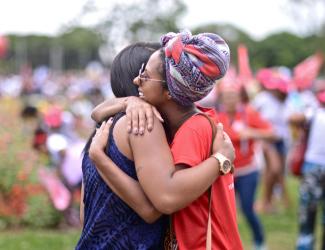
Sabriya Simon
Marcha da Mulheres Negras 2016

Priority Areas

Supporting feminist, women’s rights and gender justice movements to thrive, to be a driving force in challenging systems of oppression, and to co-create feminist realities.

Co-Creating Feminist Realities

While we dream of a feminist world, there are those who are already building and living it. These are our Feminist Realities!

What are Feminist Realities?

Feminist Realities are the living, breathing examples of the just world we are co-creating. They exist now, in the many ways we live, struggle and build our lives.

Feminist Realities go beyond resisting oppressive systems to show us what a world without domination, exploitation and supremacy look like.

These are the narratives we want to unearth, share and amplify throughout this Feminist Realities journey.

Transforming Visions into Lived Experiences

Through this initiative, we:

  • Create and amplify alternatives: We co-create art and creative expressions that center and celebrate the hope, optimism, healing and radical imagination that feminist realities inspire.

  • Build knowledge: We document, demonstrate & disseminate methodologies that will help identify the feminist realities in our diverse communities.

  • Advance feminist agendas: We expand and deepen our collective thinking and organizing to advance just solutions and systems that embody feminist values and visions.

  • Mobilize solidarity actions: We engage feminist, women’s rights and gender justice movements and allies in sharing, exchanging and jointly creating feminist realities, narratives and proposals at the 14th AWID International Forum.


The AWID International Forum

As much as we emphasize the process leading up to, and beyond, the four-day Forum, the event itself is an important part of where the magic happens, thanks to the unique energy and opportunity that comes with bringing people together.

We expect the next Forum to:

  • Build the power of Feminist Realities, by naming, celebrating, amplifying and contributing to build momentum around experiences and propositions that shine light on what is possible and feed our collective imaginations

  • Replenish wells of hope and energy as much needed fuel for rights and justice activism and resilience

  • Strengthen connectivity, reciprocity and solidarity across the diversity of feminist movements and with other rights and justice-oriented movements

Learn more about the Forum process

We are sorry to announce that the 14th AWID International Forum is cancelled

Given the current world situation, our Board of Directors has taken the difficult decision to cancel Forum scheduled in 2021 in Taipei. 

Read the full announcement

Find out more!

Related Content

Louise Malherbe | Title Snippet EN

About the authors

Portrait of Louise Malherbe

Louise Malherbe is a film programmer/curator and a film critic based in Berlin. She worked as a film programmer for the Metropolis Cinema Association in Beirut and is now coordinating the Reel Streams project aiming at supporting the dissemination of independent cinema in the Arab region. She is Head of Programming for Soura Film Festival, a queer film festival focusing on the S.W.A.N.A. region, writes film critics for Manifesto XXI, and recently started curating films and festivals for Cinema Akil.

Membership why page - Loyiso Lindani

I believe empowered women empower women and that is why I’ve had an incredible time being an AWID member. My knowledge and understanding of Feminism and intersectionality has been broadened by the exposure I received being part of the AWID Community Street Team. I hope more women join and share topics and ideas that will help other women.

- Loyiso Lindani, South Africa.

Ester Lopes | Snippet

Ester Lopes Portrait

Ester Lopes is a dancer and writer whose research focuses on the body, gender, race, and class relations. She is a Pilates instructor and art educator. Ester graduated in Contemporary Theater – Creative Processes (at FAINC) and in Dance and Body Consciousness (at USCS). Her musical specialization includes popular singing and percussion. She received training in Novos Brincantes with Flaira Ferro, Mateus Prado, and Antonio Meira at Brincante Institute in 2015 and 2016.

Snippet - Resources to rally - EN

Resources to rally through CSW69 with

Embodying Trauma-Informed Pleasure | Small Snippet EN

Embodying Trauma-Informed Pleasure

Trauma is not the event; it is how our bodies respond to events that feel dangerous to us. It is often left stuck in the body, until we address it. There’s no talking our body out of this response – it just is.

Read more


Snippet - WCFM Airtable iFrame - EN

Explore the Database now!

Don't know where to start? Let's try understanding the filters.


Snippet Kohl - Plenary: The revolution will be feminist | AR

جلسة عامة | ستكون الثورة نسوية وإلّا لن تكون ثورة

جلسة عامة | ستكون الثورة نسوية وإلّا لن تكون ثورة 
مع منال التميمي وبوبولينا مورينو وكارولينا فيكيفيتش وأنووليكا نوجوزي أوكونجو

YOUTUBESOUNDCLOUD

Snippet - WCFM Contact us- En

Contact Us

If your funding institution is already a part of the Database and you would like to contact us to update your record, or if you would like to leave some feedback for us, please use the form above.

#7 - Sexting like a feminist Tweets Snippet AR

أداؤك في المضاجع مهاراتك في ضبط المراجع…

You want this pussy? Let me see that paper. (Seriously, where are your test results? Digital copy is fine.)

منجزاتك الأكاديمية جسر عبور نحو شهوتك الجنسيّة (جدّيًا، سلِّم الأوراق المطلوبة، الكترونية كانت أم ورقيّة)

Clone of Snippet - Intro WITM - EN

Where is the Money for Feminist Organizing? Survey Results

Thanks to our global feminist community! From May to August 2024, nearly 1,200 organizations working for Women's rights, gender justice, and LBTQI+ equality shared their experiences in the WITM survey. The results offer a unique picture of how feminist movements are resourced and where gaps remain.

Stay tuned for the upcoming report for more analysis!
 

Learn more about the insights

Beijing Unfettered: the Power of Young Feminist Movements

In partnership with young feminist activists and youth-led organizations, AWID co-organized Beijing Unfettered in parallel to and independently from Beijing+25. 

Learn more

Snippet - COP30 - Resistance Hubs Section Column 1 - EN

As world leaders gather in Brazil, it’s vital that feminist movements especially from the Global Majority have autonomous spaces to gather, strategize, and disrupt.

These Hubs challenge the elitism of climate talks, center lived experiences, and aim to build collective power across borders. They offer a critical counterbalance to top-down, often exclusionary international negotiations. The Hubs aim to foster community-driven solutions, amplify feminist demands, and ensure that feminist principles of care and solidarity shape the climate agenda. It’s not just about being present at COP30, it’s about reshaping the conversation on climate justice on feminist terms.

Snippet "un"Inclusive Feminism_Fest (EN)

"un"Inclusive Feminism:
The voiceless girls in the Haitian feminist movement

Naike Ledan
Semi Kaefra Alisha Fermond, Trans Rights Activist ACIFVH
Natalie Desrosiers
Fédorah Pierre-Louis

watch panel

divider

WITM - Refreshed Intro Text (FR)

Où est l’argent ? Un plaidoyer documenté pour soutenir les organisations féministe

Ce rapport révèle la réalité du financement des organisations féministes et de défense des droits des femmes dans un contexte de bouleversements politiques et financiers. S’appuyant sur plus de dix ans d’analyse depuis la dernière étude Où est l’argent ? de l’AWID (Arroser les feuilles, affamer les racines), il dresse un bilan des progrès réalisés, des lacunes persistantes et des menaces croissantes dans le domaine du financement féministe.

Le rapport salue le pouvoir des initiatives menées par les mouvements pour façonner le financement selon leurs propres conditions, tout en alertant sur les coupes massives dans l’aide au développement, le recul de la philanthropie et l’escalade des offensives anti-droits. 

Il appelle les bailleurs de fonds à investir massivement dans l’organisation féministe, infrastructure essentielle pour la justice et la libération, et invite les mouvements à réimaginer des modèles de financement audacieux et autodéterminés, fondés sur le soin, la solidarité et le pouvoir collectif.

Le rapport sera bientôt disponible

Women Human Rights Defenders

WHRDs are self-identified women and lesbian, bisexual, transgender, queer and intersex (LBTQI) people and others who defend rights and are subject to gender-specific risks and threats due to their human rights work and/or as a direct consequence of their gender identity or sexual orientation.

WHRDs are subject to systematic violence and discrimination due to their identities and unyielding struggles for rights, equality and justice.

The WHRD Program collaborates with international and regional partners as well as the AWID membership to raise awareness about these risks and threats, advocate for feminist and holistic measures of protection and safety, and actively promote a culture of self-care and collective well being in our movements.


Risks and threats targeting WHRDs  

WHRDs are exposed to the same types of risks that all other defenders who defend human rights, communities, and the environment face. However, they are also exposed to gender-based violence and gender-specific risks because they challenge existing gender norms within their communities and societies.

By defending rights, WHRDs are at risk of:

  • Physical assault and death
  • Intimidation and harassment, including in online spaces
  • Judicial harassment and criminalization
  • Burnout

A collaborative, holistic approach to safety

We work collaboratively with international and regional networks and our membership

  • to raise awareness about human rights abuses and violations against WHRDs and the systemic violence and discrimination they experience
  • to strengthen protection mechanisms and ensure more effective and timely responses to WHRDs at risk

We work to promote a holistic approach to protection which includes:

  • emphasizing the importance of self-care and collective well being, and recognizing that what care and wellbeing mean may differ across cultures
  • documenting the violations targeting WHRDs using a feminist intersectional perspective;
  • promoting the social recognition and celebration of the work and resilience of WHRDs ; and
  • building civic spaces that are conducive to dismantling structural inequalities without restrictions or obstacles

Our Actions

We aim to contribute to a safer world for WHRDs, their families and communities. We believe that action for rights and justice should not put WHRDs at risk; it should be appreciated and celebrated.

  • Promoting collaboration and coordination among human rights and women’s rights organizations at the international level to  strengthen  responses concerning safety and wellbeing of WHRDs.

  • Supporting regional networks of WHRDs and their organizations, such as the Mesoamerican Initiative for WHRDs and the WHRD Middle East and North Africa  Coalition, in promoting and strengthening collective action for protection - emphasizing the establishment of solidarity and protection networks, the promotion of self-care, and advocacy and mobilization for the safety of WHRDs;

  • Increasing the visibility and recognition of  WHRDs and their struggles, as well as the risks that they encounter by documenting the attacks that they face, and researching, producing, and disseminating information on their struggles, strategies, and challenges:

  • Mobilizing urgent responses of international solidarity for WHRDs at risk through our international and regional networks, and our active membership.

Related Content

Body

Snippet FEA Georgia's minimum wage (ES)

El salario mínimo de Georgia se encuentra en un porcentaje inferior al de todos los países del mundo. Esta realidad afecta mayoritariamente a las mujeres.

El país no solo tiene una brecha salarial de género significativa, sino que las mujeres también trabajan más horas y más horas no reguladas antes de irse a casa para ocuparse de las tareas domésticas y de sus familias. No hay licencia por maternidad, no hay aumentos de salario por horas extras, no hay seguro de desempleo, y no hay licencias por enfermedad u otra protección social. Presionados por organizaciones occidentales, los partidos políticos oligárquicos georgianos han estado implementando reformas que están destruyendo el estado de bienestar, aumentando las medidas de austeridad y empeorando la explotación de lxs trabajadorxs, todo para los beneficios de grandes corporaciones que aplauden al país por su "facilidad para hacer negocios". Los medios de comunicación, cooptados por intereses privados y corporativos, están sesgados sobre estos temas o los silencian. La organización sindical sigue siendo una de las pocas opciones para luchar por los derechos humanos básicos y para hacer que el Estado y las empresas rindan cuentas ante las violaciones y persecuciones diarias y generalizadas contra lxs trabajadorxs, especialmente contra las mujeres.

Fuentes: Minimum-Wage y entrevista con Sopo Japaridze en Democracia Abierta

Snippet - WITM Why now_col 2 - AR

توفير الموارد للحركات النسوية هو أمر أساسي لتوفير حاضر أكثر سلماً وعدالة ومستقبل أكثر تحرراً.

في العقد الأخير، خصّص الممولون/ات أموال أكبر للمساواة الجندرية، لكن فقط 1% من التمويل الخيري والتنموي تحرك بشكل مباشر لتمويل حركات التغيير الاجتماعي بقيادة نسوية.

كي نسعى إلى الوفرة، والخروج من هذه الندرة المزمنة، يدعو استطلاع "أين المال" المناصرات/ين النسويات/ين ومناصرات/ين العدالة الجندرية بمشاركتنا في مشوار جمع الإفادات وبناء القضايا لحشد أموال أكثر وأفضل كي نغيرّ موازين القوى في المناخ التمويلي القائم اليوم. يتضامن استطلاع "أين المال" مع الحركات التي يستمر إخفاءها وتهميشها والتي لا يتاح لها تمويلا أساسيا، مرن وطويل الأمد مبن على الثقة. ويسلّط استطلاع "أين المال؟" الضوء على وضع التمويل، يتحدّى الحلول الزائفة ويُظهر كيف تحتاج نماذج التمويل أن تتغير كي تزدهر الحركات وتتعامل مع تحديات الزمن المركبة.

María Cecilia Alfaro Quesada

María Cecilia dedicó la mayor parte de su vida a la incorporación de una perspectiva feminista y de género en el trabajo institucional y organizacional y en el de capacitación. 

De niña, demostraba fuerte interés en el arte, la comunicación, la naturaleza, la literatura y el logro de la justicia, especialmente para las mujeres y los grupos marginados. 

Estaba comprometida con los derechos sexuales y reproductivos y fue parte de la Junta Nacional para la Educación Integral en Sexualidad. Sus seres queridxs la recuerdan como «una luchadora apasionada e incansable» con un profundo compromiso con los derechos de las mujeres y lxs niñxs.


María Cecilia Alfaro Quesada, Guatemala

Key impacts on the international human rights system

Anti-rights actors have had a substantive impact on our human rights framework and the progressive interpretation of human rights standards, especially rights related to gender and sexuality.

When it comes to the impact of conservative actors in international policy spaces, the overall picture today is of stasis and regressions.


We have witnessed the watering down of existing agreements and commitment; deadlock in negotiations; sustained undermining of UN agencies, treaty review bodies and Special Procedures; and success in pushing through regressive language in international human rights documents.

Commission on the Status of Women (CSW)

The CSW, held annually in March, has long been one of the most contested sites in the UN system. In March 2015, conservative efforts set the tone before events or negotiations even began; the outcome document of the Commission was a weak Declaration negotiated before any women’s rights activists even arrived on the ground.

At 2016’s CSW, the new Youth Caucus was infiltrated by large numbers of vocal anti-abortion and anti-SRHR actors, who shouted down progressive youth organizations. Again, intensive negotiations resulted in a lacklustre text, which included regressive language on ‘the family.’

Precisely when addressing women’s human rights is of urgent importance, the CSW has been rendered a depoliticized and weakened space. Using it to advance rights has become harder and harder since progressives’ energy is taken up trying to hold the ground against conservative backlash.

Human Rights Council (HRC)

As the intergovernmental body responsible for the promotion and protection of human rights around the globe, the HRC is a key entry point for conservative actors. In recent years, this mechanism has been the scene for a number of damaging anti-human rights moves.

In conversation with other anti-rights actors, one strategy of conservative states, and blocs of states, is to aggressively negotiate out positive language and to introduce hostile amendments to resolutions, most often resolutions focusing on rights related to gender and sexuality.

To take one example, during the June 2016 session of the HRC, opposition was mounted towards a resolution on discrimination against women by the member states of the Organization of Islamic Cooperation (OIC) and allies. During contentious negotiations, multiple provisions were removed, including women’s and girls’ right to have control over their sexuality, sexual and reproductive health, and reproductive rights; and the need to repeal laws which perpetuate the patriarchal oppression of women and girls in families, and those criminalizing adultery or pardoning marital rape.

The HRC has also been the site of pernicious conservative initiatives to co-opt human rights norms and enact conservative “human rights” language, such as that of the Russia-led “traditional values” resolutions, and more recently the “Protection of the Family” agenda.

Human Rights Committee

In 2015, moving their sights to another front, a number of religious right organizations began to target the Human Rights Committee, the treaty monitoring body for the International Covenant on Civil and Political Rights (ICCPR), a pivotal human rights instrument.

Anti-human rights groups mobilized in hopes of cementing their anti-abortion rhetoric into the treaty.

When the Committee announced it was drafting a new authoritative interpretation of the right to life, over 30 conservative non-state actors sent in written submissions, advocating their misleading discourse on ‘right to life’ - that life begins at conception and that abortion is a violation of the right - be incorporated in the Committee’s interpretation of article 6.

Conservative groups targeting the Human Rights Committee was a shift considering that historically anti-human rights actors have repeatedly attempted to undermine and invalidate the essential work of the treaty monitoring bodies, including the Human Rights Committee.

SDG negotiations and Agenda 2030

Anti-human rights actors were involved in lobbying towards the development of the new Sustainable Development Goals (SDGs) in 2015, focusing again on rights relating to gender and sexuality. These efforts had limited traction in their attempts to embed regressive language in Agenda 2030.

However, after successfully pushing back against progressive language in the final text, conservative actors then pivoted to another strategy. In an attempt to evade state accountability and undermine the universality of rights, several states have repeatedly made reservations to the Goals.

On behalf of the African Group, Senegal claimed that African states would only “implement the goals in line with the cultural and religious values of its countries.”

The Holy See also made a number of reservations, stating it was “confident that the related pledge ‘no one will be left behind’ would be read” as meaning “the right to life of the person, from conception until natural death.”

Saudi Arabia went one step further, declaring that the country would not follow any international rules relating to the SDGs that reference sexual orientation or gender identity, describing them as running “counter to Islamic law.”

General Assembly (GA)

Anti-rights actors have made increasing headway at the UN General Assembly (GA).  Most recently, during the 71st session in 2016, the GA was the scene of feverish anti-rights organizing in opposition to the new mandate created by the Human Rights Council resolution on sexual orientation and gender identity in June 2016: the Independent Expert on SOGI. Four separate attempts were made to undercut the mandate in GA spaces.

One approach was to introduce a hostile resolution at the Third Committee[1], led by the African Group, which in essence aimed to indefinitely defer the new mandate. While this approach was not successful, such an attempt in the GA to retroactively block the creation of a mandate brought forward by the Human Rights Council represented a new and troubling tactic - anti-right actors are now working to directly undermine the HRC’s authority respective to the General Assembly.

Another approach targeted the Fifth Committee (responsible for administration and budgetary matters) as an entry point to attack the mandate. In an unprecedented move a number of States attempted (again, unsuccessfully) to block the funding of UN human rights experts, including the new IE on SOGI[2],.

While these multiple efforts were unsuccessful in blocking the creation and continuation of the new mandate, the significant support they received, the novel strategizing employed, and the strong alliances built along regional lines through negotiations point to difficulties ahead.


[1] The Third Committee of the GA deals with agenda items relating to a range of social, humanitarian affairs, and human rights issues.  Each year it discusses and issues resolutions on issues including the advancement of women, the protection of children, family, and youth.

[2] While UN Special Procedures experts (i.e. Special Rapporteurs, Working Group members and Independent Experts) work pro bono, some funds are generally allocated to facilitate country visits on the invitation of the national government, and support staff.


Other Chapters

Read the full report

Body

Voulez-vous vous inspirer des stratégies de résistance créatives des féministes du monde entier ? Souhaitez-vous découvrir des initiatives féministes qui nous montrent comment nous pouvons tou.te.s vivre dans un monde plus juste ? Voulez-vous en savoir plus sur les modèles de soins et de guérison féministes à apporter à votre propre communauté ? Est-ce un oui retentissant que nous entendons ? OUI!

Alors consultez Crear | Résister | Transform : un festival pour les mouvements féministes. Ce festival s'est déroulé virtuellement tout au long du mois de septembre 2021 sur toutes les plateformes de l'AWID, et vous pouvez désormais en faire l'expérience à votre rythme.

Les sessions ci-dessous sont pour vous et tou.te.s les incroyables militant.e.s féministes et de justice sociale que vous connaissez. Rassemblons-nous pour partager nos stratégies de résistance, co-créer de la magie féministe et transformer ce monde ensemble.

Snippet FEA collaborator and allies Photo 4 (FR)

La photo représente Sopo prenant la parole lors d'un événement public à l'intérieur. Elle tient le micro tout en lisant ses notes et est assise sur une chaise entre trois autres personnes qui sont soit des orateur.trice.s, soit des modérateur.ice.s.

Snippet - WITM RESOURCES - PT

Recursos

(Disponível em inglês)

Peni Moore

Philosophe féministe radicale, Peni était aussi poète, écrivaine, dramaturge et compositrice.

Première coordinatrice du Fiji Women’s Rights Movement (Mouvement pour les droits des femmes aux Fidji), elle a laissé un héritage empreint de sa profonde préoccupation pour les droits fondamentaux des femmes, la justice et la paix. L’engagement de Peni en faveur de la justice sociale, économique et écologique et son travail remarquable lui a valu le respect de la communauté locale et internationale. Au sein des mouvements féministes traditionnels des Fidji, elle a été l’une des premières à travailler avec et aux côtés des personnes LGBTQI et a fourni une assistance concrète au mouvement des travailleurs et des travailleuses du sexe lorsqu’il s’est constitué aux Fidji.

Ses collègues l'ont décrite comme une personne formidable et une leader visionnaire du changement. Elle a inspiré beaucoup de personnes par sa créativité et son courage. Son travail a permis à de nombreuses personnes de se faire entendre, d’acquérir de nouvelles compétences et d’ouvrir de nouvelles voies, tant au niveau personnel que communautaire.


Peni Moore, Fiji

Sala de prensa

AWID en los medios

Compilación de noticias sobre la organización y/o el trabajo de AWID


Notas de prensa

Notas de prensa, dosieres y kits


Kits de social media

Contacto para medios

Email de contacto

+1 416 594 3773

Body

Snippet FEA lines of work Against (EN)

Illustration of a pink book that says “labor rights” and has a red X on it,

LABOR RIGHT VIOLATIONS

Annual Report 2013

Our 2013 Annual Report provides key highlights of our work during the year to contribute to the advancement of women’s rights and gender equality worldwide.

2013 marked the beginning of our 2013-2016 Strategic Plan, developed in response to the current global context. This report provides highlights of our analysis of the global context, how we position ourselves as a global feminist membership organization in this context, the outcomes we seek to achieve, and how our work is organized to achieve these outcomes.

Stephanie Bracken

Biography

Stephanie Bracken is a feminist who is dedicated to building and supporting strong systems that meet the needs of the moment and the people who interact with them, and serve principles of justice. She holds a Master of Human Rights from the University of Sydney and a BA in Gender Studies, History, and Philosophy from McGill University, and has experience working with feminist and social justice organizations on monitoring, evaluation & learning, strategic work planning, governance, project management, and building operational systems and processes. Stephanie is based in Tiohtià:ke/Montreal, where she enjoys singing with others, camping, fiber arts, and spending time with her kids and community.

Position
Operations Manager
Add to stories
Off