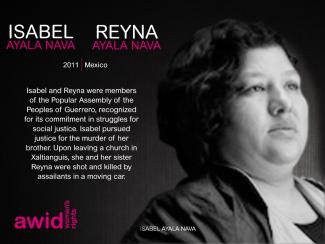
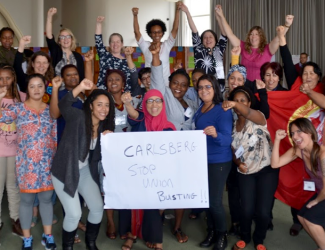
Women human rights defenders (WHRDs) worldwide defend their lands, livelihoods and communities from extractive industries and corporate power. They stand against powerful economic and political interests driving land theft, displacement of communities, loss of livelihoods, and environmental degradation.
Why resist extractive industries?
Extractivism is an economic and political model of development that commodifies nature and prioritizes profit over human rights and the environment. Rooted in colonial history, it reinforces social and economic inequalities locally and globally. Often, Black, rural and Indigenous women are the most affected by extractivism, and are largely excluded from decision-making. Defying these patriarchal and neo-colonial forces, women rise in defense of rights, lands, people and nature.
Critical risks and gender-specific violence
WHRDs confronting extractive industries experience a range of risks, threats and violations, including criminalization, stigmatization, violence and intimidation. Their stories reveal a strong aspect of gendered and sexualized violence. Perpetrators include state and local authorities, corporations, police, military, paramilitary and private security forces, and at times their own communities.
Acting together
AWID and the Women Human Rights Defenders International Coalition (WHRD-IC) are pleased to announce “Women Human Rights Defenders Confronting Extractivism and Corporate Power”; a cross-regional research project documenting the lived experiences of WHRDs from Asia, Africa and Latin America.
We encourage activists, members of social movements, organized civil society, donors and policy makers to read and use these products for advocacy, education and inspiration.
AWID acknowledges with gratitude the invaluable input of every Woman Human Rights Defender who participated in this project. This project was made possible thanks to your willingness to generously and openly share your experiences and learnings. Your courage, creativity and resilience is an inspiration for us all. Thank you!
Nuestro Fondo de Acceso ofrecerá un número limitado de becas para financiar la participación de activistas que de otra manera no podrían asistir y que no tienen relaciones con donantes que puedan cubrir su participación. Por lo tanto, si tienes otras posibilidades, te animamos a explorarlas. Haremos todo lo posible para ofrecer la mayor cantidad de becas y compartiremos más información sobre este proceso y cómo postular a principios de 2024.
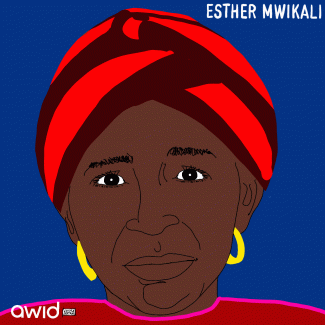
El hogar de Esther Mwikali estaba en la aldea de Mithini, en el condado de Murang'a, Kenya. Esther fue una defensora del derecho a la tierra destacada y valorada que investigó los abusos contra okupas de tierras reclamadas por magnates. La investigación de la que participó Esther incluyó también violaciones del derecho a la tierra cometidas por personas con poder en Makuyu.
Luego de que Esther faltara a una de las reuniones de la aldea, un grupo de búsqueda salió a rastrear a Esther. El 27 de agosto de 2019, dos días después de su desaparición, el cuerpo de Esther fue encontrado en una granja cerca de su casa, con signos de tortura. Esther había sido brutalmente asesinada.
"El trabajo de Esther por evitar el desalojo de lxs integrantes de las comunidades de las tierras reclamadas por magnates era conocido por todxs. Para lxs activistas locales no existía ninguna duda de que su asesinato estaba relacionado con las luchas en la zona por el acceso a la tierra; un trágico recordatorio de la alarmante frecuencia con que se llevan a cabo las ejecuciones extrajudiciales en Kenia."- Global Wittness Report, Julio 2020
"Asociamos la muerte de Mwikali con las luchas locales por el derecho a la tierra, y exigimos al Gobierno que investigue el asunto sin demora." - James Mburu, portavoz de lxs okupas.
"Es necesario tomar medidas con respecto a las personas que presuntamente han amenazado a lxs ocupantes ilegales, incluida la familia de Mwikali". - Alice Karanja, Coalición Nacional de Defensorxs de Derechos Humanos
"El impacto de su trabajo y su tenacidad permanecerán vivos en Kenia durante décadas. El CJGEA consuela a las personas afligidas y pide justicia". - Comunicado de prensa del Centro para la Justicia y la Acción Gubernamental (CJGEA, por sus siglas en inglés), 13 de septiembre de 2019
Rights at Risk: Time for Action
Report:
Rights at Risk: Time for Action
The most recent report from the Observatory on the Universality of Rights unpicks discourses like “gender ideology”, “prenatal genocide”, and “cultural imperialism”. It also digs into CitizenGo, Alliance Defending Freedom, and anti-rights funding flows. You’ll also find analysis on regional human rights systems and successful feminist strategies and wins!
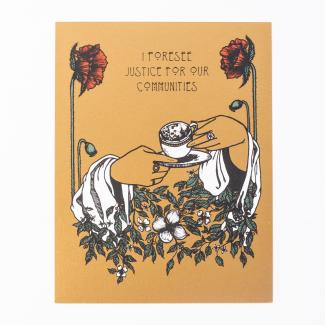
Impression sur papier, sérigraphie 4 couleurs, 8.5x11, 2016
«Tasseography» (Tasséomancie)
La tasséomancie est une méthode de divination qui interprète les motifs dans les feuilles de thé et/ou le marc de café. Il s’agit d’une pratique qui se transmet par les femmes de mon côté arménien et qui m’a été enseignée par ma mère, qui elle-même l’a apprise de sa mère, et ainsi de suite. Lorsque je regardais ma grand-mère lire le marc de café du café arménien préparé pour la famille et les amis, je remarquais que, souvent, elle voyait ce qu'elle avait envie de dire. Ces gravures disent certaines des choses que j’ai envie de voir dans le monde ; j'espère que vous aussi.
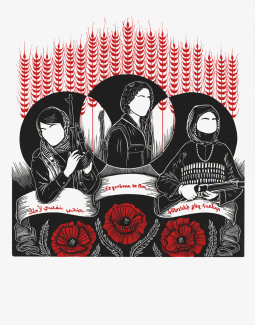
Impression relief sur papier, 11 × 14 in, 2021
«Our Promise» (Notre promesse)
Cette gravure célèbre la résilience, le sacrifice et la force des combattant·e·s de la liberté de l’Asie du Sud-Ouest et de l’Afrique du Nord à travers l'histoire et la solidarité qui existe. Elle a été inspirée à l'origine par un article que j'ai lu sur une exposition organisée à Tatvan, un district de Bitlis, qui mettait en lumière la présence arménienne dans la région. Mes ancêtres sont originaires de Bitlis, se situant aujourd'hui sur le territoire de la Turquie actuelle.
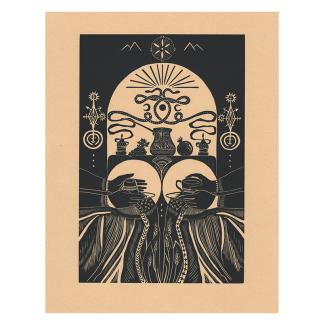
Impression relief sur papier, 8.5 × 11 in, 2020
«Looking at the Cup» (Regarder la tasse)
La tasséomancie (la lecture du marc de café) est une pratique culturelle utilisée par les femmes arméniennes depuis des siècles pour se parler entre elles et les unes aux autres, un langage codé permettant d'entamer des conversations, d'établir des relations et de tisser des liens.
À propos d’Ali Chavez Leeds
Ali Cat Leeds (elle/iel) est une artiste et graveuse qui vit sur les territoires non cédés de Cowlitz, Multnomah et des tribus confédérées de Grand Ronde, au confluent de deux rivières, également connu sous le nom de Portland, Oregon. Elle produit ses œuvres sous le nom de Entangled Roots Press. Ses impressions mêlent le littéral et le métaphorique pour éclairer et commenter le monde qui nous entoure. Les impressions en relief, sérigraphiques et typographiques vont du carnage de la déforestation à la beauté des mouvements des peuples. Les impressions d'Ali s'inspirent d'histoires ancestrales et s'orientent vers des avenirs libérateurs ; elles enchevêtrent les leçons des jardins, les symboles dans le marc de café, les fils tissés d'Arménie et d'Euskal Herria, jusqu'à la page imprimée.
Y aura-t-il des rassemblements régionaux, thématiques ou autres avant le Forum ?
Nous pensons que oui ! Le processus de planification n'en est qu'à ses débuts, alors restez à l'écoute car les plans sont en pleine préparation.
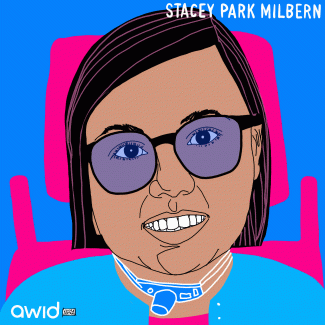
« Je n’y connais pas grand-chose sur la spiritualité ou sur ce qui se passe lorsqu’on meurt, mais ma vie de queer crip coréenne me laisse penser que notre esprit corporel terrestre n’est qu’une petite partie du tout. En ne considérant pas nos ancêtres, nous choisissons de ne voir qu’un aperçu de qui nous sommes. » - Stacey Park Milbern
Stacey Park Milbern s’identifiait comme une femme de couleur, queer, handicapée et précurseure. Leader, mobilisatrice historique et fortement respectée dans le mouvement pour les droits des personnes handicapées et la justice, elle défendait également les droits de nombreuses autres communautés, et non seulement celles auxquelles elle appartenait. L’activisme de Stacey s’appuyait fortement sur ses expériences à l’intersection du genre, du handicap, de la sexualité et de la race.
Stacey a cofondé avec quelques ami·e·s le club de culture sur la justice liée au handicap, un groupe de travail en soutien aux diverses communautés, notamment les plus vulnérables, aidant entre autres les personnes sans-abri à accéder aux ressources durant la pandémie de COVID-19.
Elle a également coproduit une campagne impactante pour le documentaire « Crip Camp » de Netflix. Elle était membre du conseil d’administration de la WITH Foundation et a dirigé plusieurs organisations aux niveaux local, régional et national. Stacey écrivait joliment et vigoureusement :
« Mes ancêtres sont des personnes déchirées de leurs amours par la guerre et les déplacements. C’est grâce à elleux que je connais le pouvoir de construire un foyer avec tout ce que l’on trouve, peu importe l’endroit et les personnes qui sont avec nous. Mes ancêtres sont des queers qui vivaient au Sud américain. Grâce à elleux, j’ai compris l’importance des relations, des lieux et d’une vie vécue en grand, même lorsque cela peut être dangereux. Tou·te·s mes ancêtres connaissent le désir. Ce désir est souvent notre espace de connexion... » - Stacey Park Milbern
Elle est née à Séoul, en Corée, a grandi en Caroline du Nord et continué son parcours dans la région de la baie de San Francisco. Stacey est décédée à la suite de complications chirurgicales le jour de son 33ème anniversaire, le 19 mai 2020.
« Beaucoup de gens le diraient : c’était une leader. Elle couvrait tous les aspects de ce rôle. Vous savez, parfois il y a des conduites de premier rang, de milieu ou de l’arrière. Et elle était d’une certaine façon capable de mener tous ces rangs. » - Andraéa LaVant, activiste pour les droits des personnes handicapées
« Perdre Stacey au moment où nos communautés ont le plus besoin de son leadership est une réelle épreuve, surtout dans un contexte où sa force, sa vision et son cran étaient de plus en plus reconnus dans des milieux autres que ceux du handicap, lui offrant des leviers plus importants pour faire progresser le travail de toute une vie… Nous n’aurons pas la chance de savoir où son leadership charismatique nous aurait mené·e·s. Mais une chose est sûre : ce que Stacey nous a donné, en un temps relativement court, continuera de bénéficier à d’autres dans les prochaines années. » - Disability Rights Education and Defense Fund (Fonds de défense et d’éducation sur les droits liés au handicap)
Animación: ¡Llamando a todas las superheroínas feministas!
Animación:
Llamando a todas las superheroínas feministas!
Sigue a nuestra superheroína mientras se embarca en una misión para recuperar las narrativas capturadas por los actores antiderecho en todo el mundo.
A Film Series on Feminist Realities from the SWANA region
by Esra Ozban
In a product-obsessed world, prioritizing process is a fundamental feminist method. Processes matter, and curation is no exception. While figuring out which of the films from the SWANA region would speak the loudest to the Feminist Realities theme, the global pandemic we are still facing shifted our everyday lives tremendously. Even to think, write, or express myself has become an everyday struggle. I kept missing all of my deadlines and sending apology emails to Kamee Abrahamian, whom I was working with as an independent curator for AWID’s Feminist Film Club. Kamee’s invaluable support, understanding, and suggestions reminded me that even in two different parts of the world, as colleagues who never met in person, we can co-create micro versions of the Feminist Realities for which we live and yearn.
Feminist Realities for me have a lot to do with sisterhoods. Sisterhoods that help womxn clearing mines in Artsakh/Nagorno-Karabakh. Sisterhoods baked in Vegan Inclusive Trans Cake by young trans feminists in Ankara that remind cis-ters that they are not welcomed by the Z generation. Sisterhoods that are growing into the mint on Dragica Alafandi’s rooftop in the Dheisheh Refugee Camp in Occupied Palestine in Sowing seeds of resistance. Sisterhoods that embrace intimate, sexual, and revolutionary proximities in Gezi Park in #resistayol. Sisterhoods that unearth an imagined encounter between two generations of womxn in exile in the streets of Haifa in Your father was born 100 years old and so was the Nakba. Cross-species sisterhoods that build in a fictional (brave) space created by Mounia Akl in Submarine for her rebel character Hala, who refuses to evacuate from a city full of garbage and is left behind with a dog friend.
This selection gathers bits and pieces of many Feminist Realities that have been realized in the SWANA region over the last couple of years. We will continue to imagine, learn, and share feminist embodiments of hope and power. In the meantime, let’s immerse ourselves in the powerful alternatives brought to life by the filmmakers and protagonists of these films. We may co-create every step, every act, and every attempt as we continue to cohabitate this world with others who are living Feminist Realities and continue to dream more of them into existence.
MOTHERLAND
By Emily Mkrtichian& Jesse Soursourian
“With beautiful visuals paired with compelling verité scenes, Motherland is a show of female camaraderie and strength… The film is a testament of women around the world who are willing to work harder to overcome any obstacle they meet.”
- Nosarieme Garrick, award winning filmmaker
“Motherland is an inspiring visualization of solidarity, courage, and grit…”
- Hers is Ours Collective, organizers of the Outsider Moving Art & Film Festival
Emily Mkrtichian on Feminist Realities and Artsakh/NKR: We shot the short film, Motherland, in the Republic of Artsakh in 2018. I was drawn to each of these women for their strength, their resilience and their humor -- despite the context in which they lived. In 2018, that context was the aftermath of a brutal war in the 1990’s, after which their country remained an unrecognized (or, in the international community, disputed) territory that was not given the autonomy and independence so many other countries enjoy. Artsakh was also deeply affected by the consequences we see in almost all places that go through violent conflict -- consequences that so often fall on women to bear: PTSD, high rates of alcoholism, high rates of domestic abuse, less equality and freedoms granted to women, little to no representation of women in politics and civil service. In the face of all these challenges, this film tries to capture the fire and power of the women of Artsakh, one that might not fit the traditional Western feminist paradigm, but one they have created for themselves through deep community ties, care for their families, hard work, and the ability to laugh with eachother through it all. Today, the Republic of Artsakh has been newly devastated by another war that left it without 70% of the lands these women grew up understanding were theirs. Yet, I can promise you that these women, and thousands of others, continue to pull their families, communities, and culture together through the same networks of care, commitment to hard work, and deep riotous laughter in the face of an uncertain future.
SOWING SEEDS OF RESISTANCE
By Baladi-Rooted Resistance
“A timely film to watch after having born witness to the latest bombardment of Gaza by Israeli Defence Forces. A glimpse into the way that women in Palestinian communities survive structural oppression, through the story of a library of traditional seeds.. and the women that sustain them as a form of nourishing rebellion.”
- Jessica Horn, PanAfrican feminst strategist, writer and co-creator of the temple of her skin
“Watching women coming together and working collectively for food autonomy is both therapeutic and empowering for me.”
- Hers is Ours Collective, organizers of the Outsider Moving Art & Film Festival
Baladi-Rooted Resistance Team on Feminist Realities: How to talk about Feminist Realities when you live in Deheisheh, a Palestinian refugee camp, built 70 years ago to serve 3000 refugees, but now home to 15000 people, in the occupied West Bank? Or when the land you farm is under constant threat by illegal settlers.
If you’re a woman in occupied Palestine you will have to struggle not only against patriarchy but also against colonialism and a brutal military occupation.
Dragiča and Vivien are fighting these multiple systems of domination in their own way.
Vivien uses native seeds to help Palestinians maintain their identity. Growing traditional food in traditional ways has great significance: “If you’re not a producer anymore, you’re a consumer, and what better way to enslave someone than turning them into your consumer. This is happening all around the world, but here you have it doubled with the military occupation.”
31.5% of households in the West Bank are food insecure. Through a rooftop edible garden, Dragiča managed to increase her family’s food autonomy. In the crowded camp, where the Israeli army conducts regular nighttime incursions to arrest and harass residents, Dragiča’s rooftop garden not only nourishes her family, but it especially nourishes her soul.
#RESISTAYOL
By Ruzgar Buski
Ruzgar Buski on Feminist Realities: I don’t know what to say about Feminist Realities but as a trans artist, an activist from Turkey, I know our realities are harsh. We live with violences- physical, emotional, economical, sexual! That is why we have to build our own networks, and co-creating micro realities for each other is a Feminist Reality for me. #resistayol is my first film, and at the beginning I was planning to make a film by/for/with trans people that does not try to convince anyone to the fact that trans people are human or focuses on raising awareness on trans issues. However, Gezi Uprising, one of the biggest uprising in the history of Turkey, happened and the film became something different.
I believe the production process really affects what the film is. We tried very hard for women, trans and non-binary people to work on every step of the film. This film is made by people who gathered with camaraderie and friendship. Kanka Productions is founded on transfeminist comradeship. I want the film to give hope, to heal because we carry a lot of traumas in our bodies- this is what makes us and what bonds us. Healing is a never-ending process and we have to create spaces to breath. #resistayol is an hour of breathing collectively.
Boysan Yakar in #resistayol: Well lubunyas (queers) were sitting in the park, all of a sudden bulldozers arrived and everyone got pissed off. Actually in summary this is it. It's Lubunya's park,and we had thirty days to explain that to this huge city. Everyone acknowledged that at night ibnes (faggots) fuck in that park...LGBTI Block carried our commune there. We already didn't trust the state and police and didn't have any security, we've established our own ways of doing things, our own laws and customs to survive... We carried our law to Gezi rapidly...With an effort to establish some common language and understanding among all these groups, the LGBT language of togetherness spread all through the park. Every day was a Pride march, everyone was continuously saying ‘ayol’. We spruced up the stinky, fusty language of the left. I guess we had such an impact because we've been disowned for all these years. From the most radical ones to the most conservative and nationalist ones, they all needed us, because everyone got used to being confronted with everything. Τhey were not used to such energy, our energy. That’s why it was a great political space for us. Every day, we actualized our biggest and main struggle there, that is, a struggle for visibility and recognition. That’s why we left Gezi with a huge gain.
VEGAN INCLUSIVE TRANS CAKE
By Pembe Hayat
“...a multifaceted statement, showing the joy that exists in the friendships within the queer community in Turkey as a display of rebellion and resistance.”
- Nosarieme Garrick, award winning filmmaker
“...fun, light, and random. In a world constantly marked and scarred by violence against the trans community, nothing, no action, is (unfortunately) deprived of meaning. So to more joy, love, and meaningful randomness!”
Cayan Azadi in Vegan Inclusive Trans Cake: Hello Barbies, Kens, porcelain dolls, Olive Oyls, cabbage dolls. Brides of Chucky, sisters of Chucky, brother-in-laws of Chucky and last but not least, esteemed brother-in-law lovers.
So why did we make this cake.
Now we got the news that a trans woman sex worker has attempted suicide due to the violence from street-guards and police on the street. She’s being kept at a police station now and that’s exactly why we made this cake. This transvestite cake is baked to show that we exist in every part of life, that we exist persistently and this cake shows that won’t be wiped off or ignored in this society.
Yes, there is violence in our lives, yes there is a lot of shade as well but despite all of that, we can still have fun, enjoying life as much as we can. Bon appetit, sis!
YOUR FATHER WAS BORN 100 YEARS OLD AND SO WAS THE NAKBA ابوكي خلق عمره ١٠٠ سنة، زي النكبة
By Razan AlSalah
SUBMARINE
By Mounia Akl
“It is directed as a poem is written… simple, a touch abstract, and moving.”
Esra Ozban: Esra Ozban is a film programmer and filmmaker from Turkey. Their artistic, curatorial, and scholarly work intersects critical archival practices, sex work, pornography, feminist/queer film cultures among others.
Follow us on Social Media to receive news about upcoming events and screenings:
Facebook: @AWIDWomensRights
Instagram: @awidwomensrights
Twitter ENG: @awid
Twitter FR: @awid_fr
Twitter ES: @awid_es
LinkedIn: Association for Women's Rights in Development (AWID)
My question isn’t answered here
For additional questions, please use our contact form. We will keep updating this document based on the queries we receive from you!
Snippet Kohl - Panel | El placer más allá de las fronteras
con Lindiwe Rasekoala, Lizzie Kiama, Jovana Drodevic y Malaka Grant
Snippet - COP30 - Political Education Toolbox - ES
📚 Caja de herramientas de educación política
Denunciar la captura corporativa. Comprender las soluciones falsas. Elaborar alternativas. Todo lo que necesitas para ejecutar la campaña “¿De quién es esta COP?”
![]Ali Chavez Leeds portrait](/sites/default/files/styles/max_325x325/public/2021-10/portrait.jpeg?itok=0yU3PqLe)