Related content
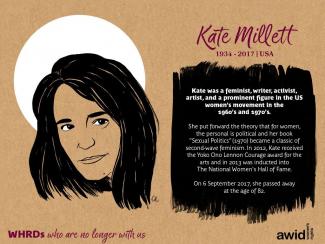
The Guardian: Kate Millett Obituary
New York Times: Kate Millett, Ground-Breaking Feminist Writer, Is Dead at 82
The New Yorker: A Last Interview with Kate Millett
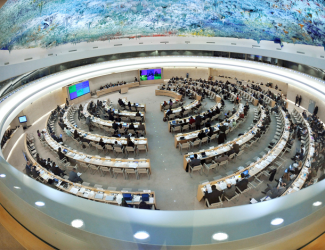
The Human Rights Council (HRC) is the key intergovernmental body within the United Nations system responsible for the promotion and protection of all human rights around the globe. It holds three regular sessions a year: in March, June and September. The Office of the UN High Commissioner for Human Rights (OHCHR) is the secretariat for the HRC.
Debating and passing resolutions on global human rights issues and human rights situations in particular countries
Examining complaints from victims of human rights violations or activist organizations on behalf of victims of human rights violations
Appointing independent experts (known as “Special Procedures”) to review human rights violations in specific countries and examine and further global human rights issues
Engaging in discussions with experts and governments on human rights issues
Assessing the human rights records of all UN Member States every four and a half years through the Universal Periodic Review
AWID works with feminist, progressive and human rights partners to share key knowledge, convene civil society dialogues and events, and influence negotiations and outcomes of the session.
En savoir plus sur les réalités féministes
N'hésitez pas à nous contacter.
Related content
The Guardian: Kate Millett Obituary
New York Times: Kate Millett, Ground-Breaking Feminist Writer, Is Dead at 82
The New Yorker: A Last Interview with Kate Millett
We bring you an inspiring curated collection of powerful stories and images of transformation and resistance created by feminist activists, writers and artists from all over the world.
Чтобы поделиться опытом финансирования в вашей организации
The information contained in this communication is confidential and is intended solely for the addressee.
This communication may contain information proprietary to the Association for Women’s Rights in Development (AWID), and may not be reproduced or disseminated in whole or in part without AWID's written consent.
AWID does not warrant that any information contained herein is complete or correct. This communication is not an offer to enter into any agreement and is not a confirmation of any agreement described herein unless the context clearly indicates the contrary.
AWID is not acting as your adviser in any agreement that may be proposed herein, and this communication does not constitute a recommendation, guidance or proposal to enter into any agreement.
AWID does not guarantee or otherwise assure the expected results of any agreement. This communication may contain views or opinions that are not necessarily those of AWID.
You shall not be entitled to place any reliance on the information contained in this communication for the purposes of entering into any proposed agreement or otherwise.
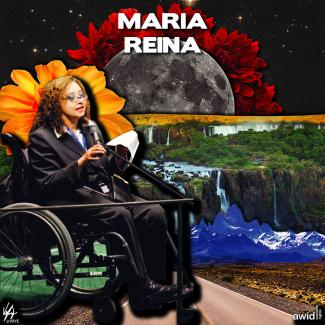
Representó al Consorcio Internacional sobre Discapacidad y Desarrollo (IDDC por su sigla en inglés) durante la negociación de la Convención sobre los Derechos de las Personas con Discapacidad (2001-2006). Su trabajo estaba dedicado a la implementación del objetivo de la Convención: el goce pleno de los derechos humanos universales por, para y con las personas con discapacidades, en pos de un mundo inclusivo, accesible y sostenible.
En sus propias palabras, su liderazgo consistía en «servir a la comunidad de personas con discapacidad, comenzando por aquellas pequeñas tareas que otrxs pueden no querer realizar».
Falleció el 27 de octubre de 2017 en su ciudad natal de Rosario, Argentina.
En esta nota puede leerse más sobre María Verónica Reina, en sus propias palabras.
Comparte tus historias y conoce las de otrxs. Al conectar nuestras experiencias, relatos y propuestas ayudamos a crear en conjunto y amplificar las Realidades Feministas.


O inquérito está disponível em árabe, inglês, francês, português, russo e espanhol!
Our thoughts are with the many people all around the world who are most affected by the repercussions of the global COVID-19 pandemic, especially marginalised communities that are historically oppressed.
This is an invitation for artists and creative activists to join a virtual space to connect, build community, and support each other through these challenging times. For this we have created a new Slack community to safely share insights, learnings, life-hacks, resources, advice, fears and anxieties, hopeful and joyful reminders, and in general chat about how we’re doing.
After filling out the form, we will send you a personal invitation to the community.

For those who are new to Slack, we’ll have orientation sessions and materials available after you sign up.
Since we are working in three languages (English, Spanish, French) we invite you to write in the language you are the most comfortable with and use online translation tools (Google Translate or others) to participate in discussions.
Please refer to the Community Guidelines
The co-creation of our feminist realities starts with ourselves and how we treat each other. We are dedicated to creating and protecting safe and supportive spaces for our communities both online and in person. We also consider that safe and welcoming spaces are co-owned and co-created. We expect our members to act in a manner that is ethical, responsible and consistent with the values of AWID and assume collective responsibility to ensure an atmosphere of mutual respect and solidarity.
As part of our ongoing discussions, we will offer weekly prompts in Slack with the intention to gently facilitate dialogue and inspire art-making processes. This can be an introspective process, but to make the most out of this community, we welcome you to interact with other community members and share thoughts as part of our discussions. The intention is to invite folks to respond freely and gradually by writing or making art in whatever way feels best.
We hope to have relevant and timely discussions with you, so we invite your suggestions and feedback. In general, the themes will center the experiences and perspectives of artists, writers, and creators -- and they will make space for folks to vision into and beyond the current global climate through the lens of feminist realities.
Syndicat OTRAS
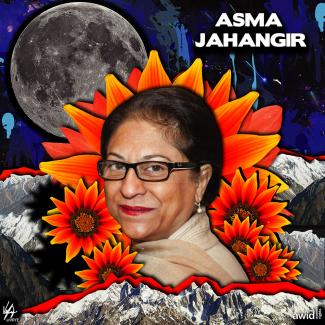
Asma était une militante pakistanaise des droits humains, une critique courageuse de l'ingérence de l'armée dans la politique et une défenseure acharnée de la primauté du droit.
Elle a été la présidente fondatrice de la Commission des droits de l'homme du Pakistan, un groupe indépendant ainsi qu’administratrice de l'International Crisis Group. Elle a remporté des prix internationaux et a été rapporteuse des Nations Unies sur les droits de l'homme et les exécutions extrajudiciaires.
Ses collègues et ami-e-s de l’AWID se souviennent d'elle avec affection
« Grâce à sa vie, Asma a réécrit l'histoire que beaucoup d'entre nous ont racontée en tant que femmes. Asma a changé le monde. Elle l'a changé au Pakistan et elle l'a changé dans notre imaginaire. »
nous estimons que pour être transformateurs et forts, les mouvements féministes doivent continuer à travailler au-delà de leurs similitudes et de leurs différences. Nous devons également interroger le pouvoir et les privilèges, tant au sein qu'à l'extérieur de nos mouvements.