Human Rights Council (HRC)
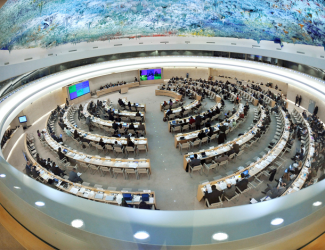
The Human Rights Council (HRC) is the key intergovernmental body within the United Nations system responsible for the promotion and protection of all human rights around the globe. It holds three regular sessions a year: in March, June and September. The Office of the UN High Commissioner for Human Rights (OHCHR) is the secretariat for the HRC.
The HRC works by:
-
Debating and passing resolutions on global human rights issues and human rights situations in particular countries
-
Examining complaints from victims of human rights violations or activist organizations on behalf of victims of human rights violations
-
Appointing independent experts (known as “Special Procedures”) to review human rights violations in specific countries and examine and further global human rights issues
-
Engaging in discussions with experts and governments on human rights issues
-
Assessing the human rights records of all UN Member States every four and a half years through the Universal Periodic Review
AWID works with feminist, progressive and human rights partners to share key knowledge, convene civil society dialogues and events, and influence negotiations and outcomes of the session.
With our partners, our work will:
◾️ Raise awareness of the findings of the 2017 and 2021 OURs Trends Reports.
◾️Support the work of feminist UN experts in the face of backlash and pressure
◾️Advocate for state accountability
◾️ Work with feminist movements and civil society organizations to advance rights related to gender and sexuality.
Related Content
¿AWID proporciona becas para asistir al Foro?
Nuestro Fondo de Acceso ofrecerá un número limitado de becas para financiar la participación de activistas que de otra manera no podrían asistir y que no tienen relaciones con donantes que puedan cubrir su participación. Por lo tanto, si tienes otras posibilidades, te animamos a explorarlas. Haremos todo lo posible para ofrecer la mayor cantidad de becas y compartiremos más información sobre este proceso y cómo postular a principios de 2024.
WITM - Refreshed DATA SNAPSHOTS - ES
Instantáneas de datos
Nuestro poder colectivo, nuestra sabiduría y nuestro compromiso no tienen límites. Pero nuestras cuentas bancarias sí.
Las instantáneas de datos están basadas en las respuestas de 1.174 organizaciones feministas, por los derechos de las mujeres, LGBTQI+ y aliadas (en adelante «organizaciones feministas y por los derechos de las mujeres») de 128 países a ¿Dónde está el dinero para las organizaciones feministas?la encuestade AWID. Estas instantáneas reflejan experiencias de 2021 a 2023, analizadas en el contexto de las tendencias de desfinanciamiento que se han verificado en 2024 y 2025.
Aquí encontrarás lo que necesitas saber sobre el estado actual de la movilización de recursos para las organizaciones feministas.
Rights at Risk: Time for Action
Report:
Rights at Risk: Time for Action
The most recent report from the Observatory on the Universality of Rights unpicks discourses like “gender ideology”, “prenatal genocide”, and “cultural imperialism”. It also digs into CitizenGo, Alliance Defending Freedom, and anti-rights funding flows. You’ll also find analysis on regional human rights systems and successful feminist strategies and wins!
¿Quién puede financiar mi trabajo por los derechos de las mujeres?
Nuestra base de datos de donantes y patrocinadores se encuentra actualmente en revisión. ¡Sabemos que los movientos feministas todavía necesitan y merecen más y mejores recursos!
Únete a nuestra lista de correo para mantenerte al tanto sobre esta actualización.
También puedes afiliarte a AWID y encontrar y crear conexiones con feministas de todo el mundo.
Y aura-t-il des rassemblements régionaux, thématiques ou autres avant le Forum ?
Nous pensons que oui ! Le processus de planification n'en est qu'à ses débuts, alors restez à l'écoute car les plans sont en pleine préparation.
Snippet - COP30 - 6th International Rights of Nature Tribunal - ES
6to Tribunal International por los Derechos de la Naturaleza: Un nuevo compromiso con la Madre Naturaleza
Donde les organizadores de la primera línea de defensa conducen y las corporaciones rinden cuentas.
📅 Martes 11 de noviembre de 2025
📍 En línea y en la Universidade Federal do Pará, Belém
Animación: ¡Llamando a todas las superheroínas feministas!
Animación:
Llamando a todas las superheroínas feministas!
Sigue a nuestra superheroína mientras se embarca en una misión para recuperar las narrativas capturadas por los actores antiderecho en todo el mundo.
Clone of Anuncio: Foro AWID 2024

¡Es hora para el próximo Foro de AWID: en 2024!
Cuando miles de feministas se unen, creamos una fuerza arrolladora de solidaridad que tiene el poder de cambiar el mundo. El Foro de AWID será un momento para que descansemos y nos recuperemos juntas, nos conectemos más allá de las fronteras y descubramos nuevas y osadas direcciones estratégicas.
La fecha y el lugar se anunciarán el próximo año, tan pronto como podamos. Estamos emocionades y sabemos que ustedes también lo están. ¡Manténganse al tanto!
¡Asegúrate de seguirnos en las redes sociales y suscríbete a nuestra lista de correo para mantenerte al día!
Hindia Haji Mohamed
My question isn’t answered here
For additional questions, please use our contact form. We will keep updating this document based on the queries we receive from you!
Snippet - COP30 - Resistance Hubs Section Column 1 - FR
Alors que les dirigeant·es du monde se réunissent au Brésil, il est vital que les mouvements féministes, en particulier les pays de la Majorité globale, aient des espaces indépendants pour se rassembler, mettre au point des stratégies et bouleverser le cours des choses.
Ces pôles remettent en cause l’élitisme des discussions climat, se concentrent sur les expériences vécues et entendent construire le pouvoir collectif au-delà des frontières. Ils constituent un contrepoids critique aux négociations internationales verticales et souvent excluantes. Les pôles visent à encourager des solutions pilotées par la communauté, amplifier les revendications féministes et veiller à ce que les principes féministes de soin et de solidarité façonnent l’agenda climat. Il ne s’agit pas seulement d’être présentes à la COP30, il faut redéfinir la conversation sur la justice climatique, dans des termes féministes.
Snippet Kohl - Panel | El placer más allá de las fronteras

con Lindiwe Rasekoala, Lizzie Kiama, Jovana Drodevic y Malaka Grant
Merci
Merci de votre visite sur le site d'AWID. Pour plus d'informations sur AWID rendez-vous sur https://www.awid.org/fr
Genvieve Sidaros
CFA 2023 - Hybrid like never before: in person - FR
Hybride comme jamais auparavant
Pour la première fois, le Forum de l'AWID propose trois modes de participation :
En personne
Les participant.e.s se réuniront à Bangkok, en Thaïlande. Nous sommes impatient.e.s de vous y retrouver!
Snippet - COP30 - Feminist Economic Alternatives Brief - FR
📖 Briefing sur les alternatives économiques féministes
Un outil destiné aux militant·es féministes présent·es à la COP30 qui luttent pour des solutions transformatrices, équitables et centrées sur les communautés afin de lutter contre la crise climatique.
Crear | Résister | Transform: A Walkthrough of the Festival! - smaller snippet

Crear | Résister | Transform :
visite guidée du Festival
Alors que le capitalisme hétéropatriarcal s’acharne à nous contraindre au consumérisme et à la conformité, nous constatons que nos luttes sont cloisonnées et séparées par des frontières aussi bien physiques que virtuelles.
Building Feminist Economies
Building Feminist Economies is about creating a world with clean air to breath and water to drink, with meaningful labour and care for ourselves and our communities, where we can all enjoy our economic, sexual and political autonomy.
In the world we live in today, the economy continues to rely on women’s unpaid and undervalued care work for the profit of others. The pursuit of “growth” only expands extractivism - a model of development based on massive extraction and exploitation of natural resources that keeps destroying people and planet while concentrating wealth in the hands of global elites. Meanwhile, access to healthcare, education, a decent wage and social security is becoming a privilege to few. This economic model sits upon white supremacy, colonialism and patriarchy.
Adopting solely a “women’s economic empowerment approach” is merely to integrate women deeper into this system. It may be a temporary means of survival. We need to plant the seeds to make another world possible while we tear down the walls of the existing one.
We believe in the ability of feminist movements to work for change with broad alliances across social movements. By amplifying feminist proposals and visions, we aim to build new paradigms of just economies.
Our approach must be interconnected and intersectional, because sexual and bodily autonomy will not be possible until each and every one of us enjoys economic rights and independence. We aim to work with those who resist and counter the global rise of the conservative right and religious fundamentalisms as no just economy is possible until we shake the foundations of the current system.
Our Actions
Our work challenges the system from within and exposes its fundamental injustices:
-
Advance feminist agendas: We counter corporate power and impunity for human rights abuses by working with allies to ensure that we put forward feminist, women’s rights and gender justice perspectives in policy spaces. For example, learn more about our work on the future international legally binding instrument on “transnational corporations and other business enterprises with respect to human rights” at the United Nations Human Rights Council.
-
Mobilize solidarity actions: We work to strengthen the links between feminist and tax justice movements, including reclaiming the public resources lost through illicit financial flows (IFFs) to ensure social and gender justice.
-
Build knowledge: We provide women human rights defenders (WHRDs) with strategic information vital to challenge corporate power and extractivism. We will contribute to build the knowledge about local and global financing and investment mechanisms fuelling extractivism.
-
Create and amplify alternatives: We engage and mobilize our members and movements in visioning feminist economies and sharing feminist knowledges, practices and agendas for economic justice.
“The corporate revolution will collapse if we refuse to buy what they are selling – their ideas, their version of history, their wars, their weapons, their notion of inevitability. Another world is not only possible, she is on her way. On a quiet day, I can hear her breathing”.
Arundhati Roy, War Talk