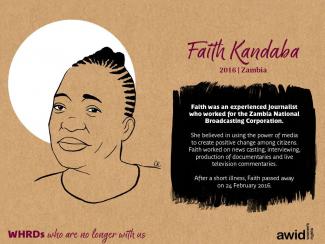
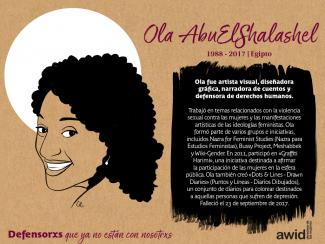
Karen Empeño & Sherlyn Cadapan
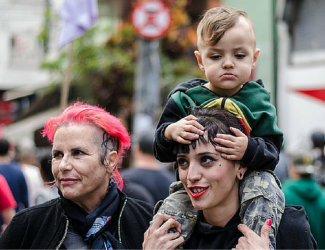
Over the past few years, a troubling new trend at the international human rights level is being observed, where discourses on ‘protecting the family’ are being employed to defend violations committed against family members, to bolster and justify impunity, and to restrict equal rights within and to family life.
The campaign to "Protect the Family" is driven by ultra-conservative efforts to impose "traditional" and patriarchal interpretations of the family, and to move rights out of the hands of family members and into the institution of ‘the family’.
Since 2014, a group of states have been operating as a bloc in human rights spaces under the name “Group of Friends of the Family”, and resolutions on “Protection of the Family” have been successfully passed every year since 2014.
This agenda has spread beyond the Human Rights Council. We have seen regressive language on “the family” being introduced at the Commission on the Status of Women, and attempts made to introduce it in negotiations on the Sustainable Development Goals.
AWID works with partners and allies to jointly resist “Protection of the Family” and other regressive agendas, and to uphold the universality of human rights.
In response to the increased influence of regressive actors in human rights spaces, AWID joined allies to form the Observatory on the Universality of Rights (OURs). OURs is a collaborative project that monitors, analyzes, and shares information on anti-rights initiatives like “Protection of the Family”.
Rights at Risk, the first OURs report, charts a map of the actors making up the global anti-rights lobby, identifies their key discourses and strategies, and the effect they are having on our human rights.
The report outlines “Protection of the Family” as an agenda that has fostered collaboration across a broad range of regressive actors at the UN. It describes it as: “a strategic framework that houses “multiple patriarchal and anti-rights positions, where the framework, in turn, aims to justify and institutionalize these positions.”
|
383 personnes. |

La encuesta está disponible en árabe, español, francés, inglés, portugués y ruso.
Related content
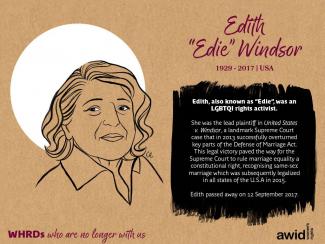
The Guardian: Edith Windsor, icon of gay rights movement, dies aged 88
Rolling Stone: Edith Windsor, Same-Sex Marriage Activist, Dead at 88
BBC: Edie Windsor: Gay rights trailblazer dies aged 88
The New Yorker: Postscript: Edith Windsor, 1929-2017
The Guardian: Goodbye, Edie Windsor. Thank you for never giving up
Love and Justice: Edith Windsor talks with Ariel Levy - The New Yorker Festival - The New Yorker (Video)
Remembering Edie Windsor (Video)
This information will only be available when registration opens.
 La Couverture
|
 La puissante
|
 Le lierre
|
 Le hurlement
|

Production et entrepreneuriat |
 L’Artisan·e
|
L’enquête WITM mondiale est un des piliers essentiels de la troisième édition de notre recherche orientée sur l’action, intitulée Où est l’argent pour l’organisation des mouvements féministes? (abrégé en Où est l’argent ou WITM, pour l’acronyme en anglais). Les résultats de l’enquête seront développés et approfondis à l’occasion de conversations profondes avec des activistes et des financeurs, et les références seront croisées avec d’autres analyses et études existantes sur la situation du financement des mouvements féministes et de l’égalité des genres à travers le monde.
Le rapport complet de la recherche Où est l’argent pour l’organisation des mouvements féministes sera publié en 2026.
 Pour en apprendre davantage sur la manière dont l’AWID met en lumière l’argent utilisé pour et contre les mouvements féministes, consultez notre dossier WITM et nos précédents rapports à ce sujet ici.
English, French, Spanish and Mandarin.
El objetivo fundamental de la encuesta ¿Dónde está el dinero? es arrojar luz sobre la situación financiera de la diversidad de movimientos feministas, por los derechos de las mujeres, la justicia social, las personas LBTQI+ y demás movimientos aliados de todo el mundo y, sobre la base de dicha información, reforzar las razones fundadas para movilizar más y mejores fondos y transferir el poder a los movimientos feministas.
We will update the outcomes of this process in the website in due time.
An online community for and by young feminists working on women’s human rights, gender equality and social justice around the world.
The platform is the go-to place for information and resources on safeguarding the universality of rights in international and regional human rights spaces.
Provides funding for young feminist-led initiatives. It aims to strengthen the capacity of young feminist organizations to leverage resources for their work and to increase donors’ and allies’ commitments to resourcing young feminist activism.
A go-to site to learn about the urgent responses undertaken to protect women human rights defenders and to find tools and resources to support the work and wellness of WHRDs.
A regional initiative created to prevent, respond, document and make public all cases of violence against women human rights defenders in the Mesoamerican region.
The WHRD IC is a resource and advocacy network for the protection and support of women human rights defenders worldwide.
A Coalition of feminist, women´s rights, women´s development, grassroots and social justice organisations working to challenge and reframe teh global development agenda.
The role of the Women’s Major Group is to assure effective public participation of women’s non-governmental groups in the UN policy processes on Sustainable Development, Post2015 and Environmental matters.
An alliance of women’s organizations and networks to advocate for the advancement of gender equality, women’s empowerment and human rights in the Financing for Development (FfD) related UN processes.
“Nous Sommes la Solution has a vision of an Africa where, in solidarity, rural women involved in decision-making can grow, process, sell and consume family farming products while preserving the environment, for a harmonious and sustainable development.”
Non, nous souhaitons recevoir une seule participation par groupe.