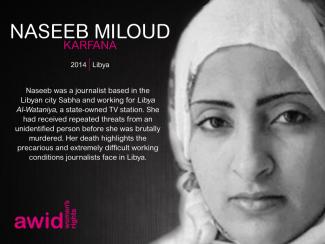
Naseeb Miloud Karfana
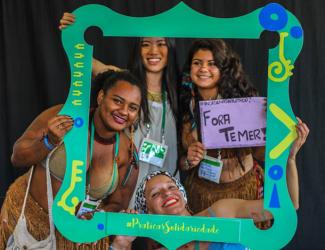
Young feminist activists play a critical role in women’s rights organizations and movements worldwide by bringing up new issues that feminists face today. Their strength, creativity and adaptability are vital to the sustainability of feminist organizing.
At the same time, they face specific impediments to their activism such as limited access to funding and support, lack of capacity-building opportunities, and a significant increase of attacks on young women human rights defenders. This creates a lack of visibility that makes more difficult their inclusion and effective participation within women’s rights movements.
AWID’s young feminist activism program was created to make sure the voices of young women are heard and reflected in feminist discourse. We want to ensure that young feminists have better access to funding, capacity-building opportunities and international processes. In addition to supporting young feminists directly, we are also working with women’s rights activists of all ages on practical models and strategies for effective multigenerational organizing.
We want young feminist activists to play a role in decision-making affecting their rights by:
Fostering community and sharing information through the Young Feminist Wire. Recognizing the importance of online media for the work of young feminists, our team launched the Young Feminist Wire in May 2010 to share information, build capacity through online webinars and e-discussions, and encourage community building.
Researching and building knowledge on young feminist activism, to increase the visibility and impact of young feminist activism within and across women’s rights movements and other key actors such as donors.
Promoting more effective multigenerational organizing, exploring better ways to work together.
Supporting young feminists to engage in global development processes such as those within the United Nations
Collaboration across all of AWID’s priority areas, including the Forum, to ensure young feminists’ key contributions, perspectives, needs and activism are reflected in debates, policies and programs affecting them.
Magaly Quintana était connue de nombreuses personnes au Nicaragua comme « La Maga » (la magicienne). Historienne et activiste féministe, elle était une indéfectible défenseure des droits des femmes, réclamant justice pour les victimes de féminicides.
Magaly était fortement engagée dans la documentation et la collecte de statistiques sur les femmes et les filles tuées dans le cadre de la violence sexuelle dans le pays.
« Elle s’employait à reconstituer la vie de chacune d’entre elles, de leur famille, pour montrer ces vies qui avaient été détruites », Dora María Téllez.
Magaly avait également critiqué le gouvernement pour sa réforme de la loi 779 sur la violence à l’égard des femmes. Résultat du travail acharné des mouvements de femmes nicaraguayens, cette loi incluait – avant sa réforme – d’importantes dispositions criminalisant le féminicide. Elle avançait que les réformes législatives avaient affaibli la loi et restreint la définition des féminicides à des homicides, rendant ainsi « invisibles » les crimes violents perpétrés contre les femmes.
Magaly a commencé à mener des actions féministes au début des années 1980. Directrice du Catholic Women for the Right to Choose, elle a défendu le droit à l’avortement thérapeutique après son interdiction en 2006, de même que soutenu les manifestations contre le gouvernement de Daniel Ortega en 2018.
Née en mai 1952, Magaly est décédée en mai 2019.
« Nous nous reverrons plus tard, ma très chère Magaly Quintana. Merci beaucoup, merci pour l’héritage que tu nous laisses. Nous te reverrons, aussi forte et puissante que toujours. », Erika Guevara Rosas (Directrice américaine d’Amnesty International)
by Fatima B. Derby
In 2017, the AWID #PracticeSolidarity campaign highlighted how young feminists could build feminist futures by showing up for one another, being in cross-regional conversations with one another, marching in solidarity with other activists and collaborating between movements. (...)
< artwork: “Let it Grow” by Gucora Andu
Activists reflection & solidarity circle
✉️ By registration only. Register here
📅 Friday, March 14, 2025
🕒 12.00-2.00pm EST
🏢 Blue Gallery, The Blue Building, 222 East 46th Street
🎙️Facilitated by: Gopika Bashi, AWID Director of Programs
Organizer: Count Me In! Consortium
Informal interactive hearings with the business sector and civil society took place on 8 and 9 April 2015 respectively at UN headquarters in New York.
Que représentent les Forums de l’AWID pour celles et ceux qui y ont assisté ? Quelle est cette magie qui opère lorsque des féministes du monde entier se rassemblent pour célébrer, élaborer des stratégies, apprendre et partager leurs joies ?
L’AWID s’est entretenue avec plus de quarante participant·es aux Forums pour connaître le récit de leur transformation personnelle en tant qu’activistes, celle de leur organisation et des mouvements auxquels elles et ils appartiennent. Elles et ils nous ont également dit ce que nous devrions conserver et renforcer pour les prochains Forums, ce qui distingue les Forums de l’AWID, et ce que nous pouvons améliorer.
Ce rapport contient des enseignements et d’inestimables conseils pour toute personne prévoyant d’organiser des rassemblements régionaux et thématiques en personne, et pour nous-mêmes alors que nous planifions le 15e Forum international de l’AWID.
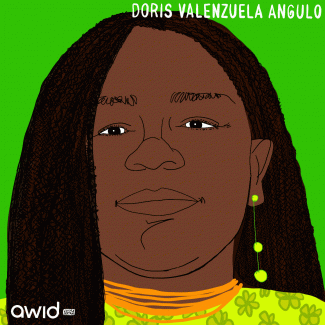
Doris Valenzuela Angulo was an Afro-descendant social activist, leader and human rights defender from Buenaventura, Colombia. She was part of Communities Building Peace in the Territories (CONPAZ), a national network of organizations in communities affected by armed conflict that advocate for non-violence and socio-environmental justice.
Doris defied constant paramilitary violence and pressures from mega projects to displace her community and state collusion. Faced with one of the most difficult contexts in her country, she played a leadership role in an unprecedented initiative of non-violent resistance called Puente Nayero Humanitarian Space, an urban place for community cohesion, safety, creativity and collective action.
This unique non-violent struggle of the families that belonged to Puente Nayero Humanitarian Space, attracted attention and support from both local and international agencies. By September 2014, the Inter-American Commission on Human Rights had granted precautionary protection measures to the community ordering the Colombian State to adopt necessary measures to preserve their lives and personal integrity. However, the threats and violence from the paramilitaries continued. Doris focused her energies on preventing forced recruitment of children and young people by the neo-paramilitaires, continuing on despite the murder of her son Cristian Dainer Aragón Valenzuela in July 2015. Doris also became a target, continuously receiving threats for her activism and the work she did.
The continued aggression and threats against her life forced Doris to leave Colombia. She was residing in Spain from February 2017 to February 2018, as part of the Amnesty International temporary protection program for human rights defenders at risk. In April 2018, Doris was murdered in Murcia, Spain by her ex-partner. She was only 39 years old.
"Doris, spending a whole year with you has taught us how a person can have the ability to transform and generate hope in the face of deeply negative and devastating events during your life...We continue with our commitment in the defense of all human rights. Your courage and your light will always guide us.” - Montserrat Román, Amnesty International Grupo La Palma
"..You knew it. You always knew. And in spite of everything you stood firm against so many injustices, so many miseries, so much persecution. You stood up, haughty and fierce, against those who wanted to make you again abandon your hopes, humble yourself and surrender. Standing up you cried out for your freedom and ours that was yours. Nothing and no one paralyzed your efforts to change the world and make it more generous and livable. You, live among us, more alive today than ever among us despite death. Always live by your gestures, your courage, your greatness when crying for a promised land that you came to invoke with each of your cries for all the deserts you inhabited. You. Always alive. Doris Valenzuela Angulo.
They are only words. I know. I know it too. But the words unite us, protect us, give us strength and encouragement to continue walking towards the light that you defended so much…”
por Gabriela Estefanía Riera Robles
Juliana. ¡Cómo quisiera llamarme Juliana! Es un nombre lleno de poder y presencia, lleno de fuerza y vehemencia. (...)
< arte: «Born Fighters», Borislava Madeit y Stalker Since 1993

Filter for funders that support initiatives in your geographical area.
La financiación para el desarrollo encierra amenazas y oportunidades concretas para los derechos de las mujeres y los derechos humanos de todas las personas. Una financiación y políticas para el desarrollo que sean transformadoras pueden constituir un aporte importante para los cambios sistémicos que se necesitan a fin de garantizar el respeto, la protección y la realización de los derechos humanos de las mujeres.
El año 2015 es importante en el proceso de la FpD. La tercera Conferencia Internacional sobre la FpD tuvo lugar del 13 al 16 de julio de 2015 en Adís Abeba, Etiopía, y los gobiernos están finalizando la Agenda de Desarrollo Post-2015 que incluye acuerdos acerca de cómo se van a financiar los Objetivos de Desarrollo Sostenible.
En su actual etapa, el proceso de la FpD ofrece una oportunidad importante para fijar un marco de financiación que garantice un apoyo financiero efectivo para la implementación de la Agenda Post-2015 y de los Objetivos de Desarrollo Sostenible (ODS). También constituye una oportunidad para abordar las condiciones estructurales y los cambios sistémicos necesarios para la plena implementación de otras agendas y compromisos como los tratados internacionales de derechos humanos y la Plataforma de Acción de Beijing.
En estos últimos trece años, organizaciones por los derechos de las mujeres y feministas han participado activamente en el proceso de la FpD.
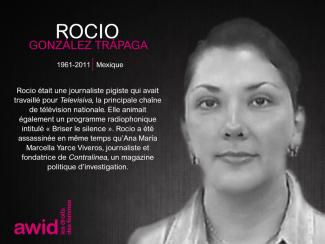
Mena Mangal fue una destacada periodista de televisión, defensora de los derechos de las mujeres y asesora cultural de la Wolesi Jirga, la cámara baja del parlamento nacional de Afganistán.
Durante más de una década, trabajó para Ariana TV, el canal Lamar de lengua Pashto de Tolo TV, y para la emisora privada de televisión nacional afgana Shamshad TV. Como presentadora, Mena se enfocó en los derechos de las mujeres y en los programas de entrevistas culturales.
"La defensora de los derechos de la mujeres Wazhma Frogh dijo que Mangal "tenía una voz fuerte" y se pronunció activamente como defensora de su pueblo".
Fuera de la pantalla, también dirigió páginas populares de redes sociales que defendían los derechos de las niñas y mujeres afganas a la educación y el trabajo. En lo que concierne a su vida privada, Mena escribió extensamente acerca de cómo había sido forzada a contraer un matrimonio arreglado en 2017, y sobre el proceso que tuvo que atravesar para poder obtener finalmente el divorcio.
En un post de Facebook, Mena escribió que estaba recibiendo amenazas de muerte de fuentes desconocidas, pero que aun así continuaría llevando a cabo su trabajo.
El 11 de mayo de 2019, Mena fue atacada por hombres armados desconocidos y asesinada a tiros a plena luz del día en un espacio público del sudeste de Kabul.
"Estamos preocupadxs por la situación actual ya que está teniendo un impacto directo en las mujeres que trabajan fuera de sus casas... Las mujeres periodistas están cambiando de profesión debido a los crecientes riesgos que enfrentan". - Robina Hamdard, defensora de los derechos de las mujeres en Kabul.
Notre tout premier programme du Club de cinéma féministe est désormais accessible : « La tendresse est la plus tranchante des résistances » fait référence à une série de films sur les réalités féministes d’Asie et du Pacifique, sélectionnés par Jess X Snow.
For any questions related to the Call for Forum Activities please contact us, selecting Forum Call for Activities as the subject of your email.

Les mouvements féministes ont énormément évolué et se sont adaptés depuis la dernière fois que nous nous sommes rencontrées de cette manière. Pour nous rappeler pourquoi les Forums de l’AWID sont importants, nous avons demandé à des activistes du monde entier de réfléchir et de partager leurs histoires, leurs impressions et leurs souvenirs. Voici ce que nous avons appris.