Confronting Extractivism & Corporate Power

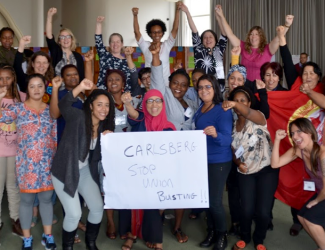
Women human rights defenders (WHRDs) worldwide defend their lands, livelihoods and communities from extractive industries and corporate power. They stand against powerful economic and political interests driving land theft, displacement of communities, loss of livelihoods, and environmental degradation.


Why resist extractive industries?

Extractivism is an economic and political model of development that commodifies nature and prioritizes profit over human rights and the environment. Rooted in colonial history, it reinforces social and economic inequalities locally and globally. Often, Black, rural and Indigenous women are the most affected by extractivism, and are largely excluded from decision-making. Defying these patriarchal and neo-colonial forces, women rise in defense of rights, lands, people and nature.

Critical risks and gender-specific violence

WHRDs confronting extractive industries experience a range of risks, threats and violations, including criminalization, stigmatization, violence and intimidation.  Their stories reveal a strong aspect of gendered and sexualized violence. Perpetrators include state and local authorities, corporations, police, military, paramilitary and private security forces, and at times their own communities.

Acting together

AWID and the Women Human Rights Defenders International Coalition (WHRD-IC) are pleased to announce “Women Human Rights Defenders Confronting Extractivism and Corporate Power”; a cross-regional research project documenting the lived experiences of WHRDs from Asia, Africa and Latin America.

We encourage activists, members of social movements, organized civil society, donors and policy makers to read and use these products for advocacy, education and inspiration.

Share your experience and questions!

Tell us how you are using the resources on WHRDs Confronting extractivism and corporate power.

◾️ How can these resources support your activism and advocacy?

◾️ What additional information or knowledge do you need to make the best use of these resources?

Share your feedback


Thank you!

AWID acknowledges with gratitude the invaluable input of every Woman Human Rights Defender who participated in this project. This project was made possible thanks to your willingness to generously and openly share your experiences and learnings. Your courage, creativity and resilience is an inspiration for us all. Thank you!
Related Content

Our values - Human Rights

Droits humains

nous croyons en une application complète du principe des droits, y compris ceux établis dans les lois internationales, et affirmons la conviction que tous les droits humains sont indissociables, interdépendants et indivisibles. Nous nous engageons à œuvrer pour l'éradication de toutes les discriminations fondées sur le genre, la sexualité, la religion, l'âge, les capacités, l'ethnicité, la race, la nationalité, la classe sociale ou d'autres facteurs.

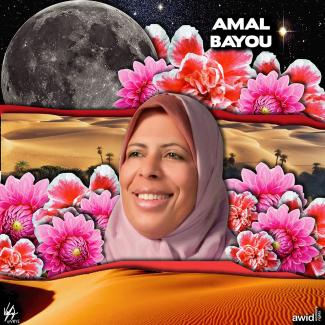
Amal Bayou

Amal fue una destacada política y parlamentaria de Libia.

Fue docente de la Universidad de Benghazi desde 1995 hasta su muerte, en 2017. Amal fue activista de la sociedad civil e integrante de varias iniciativas sociales y políticas. Asistió a las familias de lxs mártires y de lxs desaparecidxs y fue una de lxs fundadorxs de una iniciativa juvenil llamada «Juventud de Benghazi Libia».

En las elecciones parlamentarias de 2014, Amal fue elegida para la Cámara de Representantes con más de 14.000 votos (el mayor número de votos recibido por unx candidatx en las elecciones de 2014). Permanecerá en la memoria de muchxs como una mujer que actuó en política para garantizar un futuro mejor en uno de los contextos de la región más difíciles y afectados por los conflictos.


Amal Bayou, Libya

Snippet FEA Union Otras Photo 4 (EN)

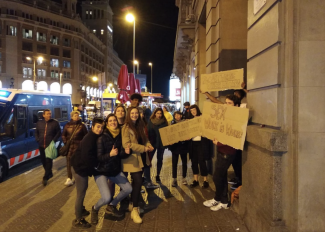
Photo of a group of people at night demonstrating.

What Our Members Say - ES

Lo que dicen nuestrxs miembrxs

Upasana Agarwal

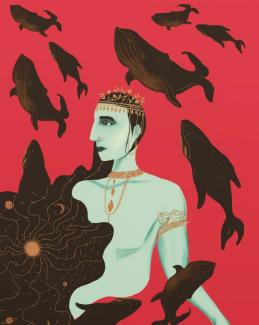
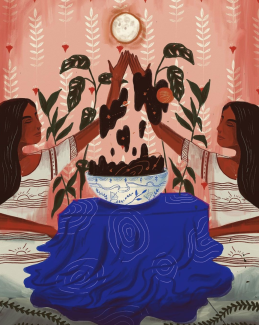
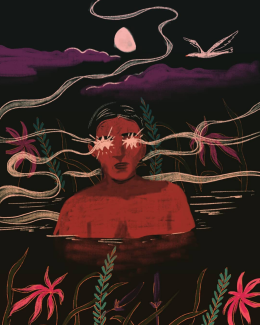
Forgotten Song
Forgotten Song
Ode to the Moon
Ode to the Moon
Vapour and Fire
Vapour and Fire

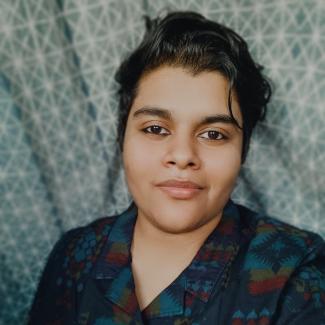
About Upasana Agarwal

Upasana Agarwal

Upasana is a non binary illustrator and artist based out of Kolkata, India. Their work explores identity and personal narratives by using a visual remnant or evidence of the contexts they work with. They are especially drawn to patterns which to them communicate complex truths about the past, present and future.  When Upasana is not illustrating they organise and run a queer and trans community art centre in the city. 

Membership why page - Angelina Mootoo quote

"Joining AWID, I hope I can help in the mobilization of the feminist movement. Not just for the privileged women, but for ALL women and feminist activists."

- Angelina Mootoo, Intersectional and Caribbean Feminist, Guyana/USA

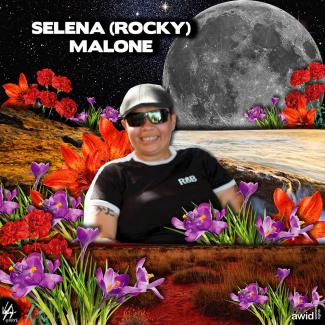
Selena “Rocky” Malone

Engagée auprès de jeunes lesbiennes, gays, bisexuels, transgenres, intersexuels, queers, et transgenres (appelés Brotherboys-BB et Sistergirls-SS dans la communauté aborigène en Australie), Rocky faisait preuve de vision et d'un leadership inspirants.

Rocky avait commencé sa carrière auprès de la police du Queensland en tant qu'agent de liaison. Faire une différence était très important pour elle. Elle a mené un travail de soutien impressionnant auprès de jeunes de cette communauté en tant que responsable du service jeunesse « Open Doors » (portes ouvertes). Rocky a œuvré dans des situations complexes liées spécifiquement aux questions de genre et d'identité sexuelle.Elle avait un don naturel dans ce domaine: c’était une leader communautaire solide, une femme sereine, une amie fidèle, une personne aimante et attentionnée ainsi qu’une actrice du changement. Rocky était membre fondatrice d’IndigiLez Leadership and Support Group. 

En 2016, à la Cour suprême de Brisbane, l'ancien juge de la Haute Cour, Michael Kirby, a cité le nom de Rocky lorsqu'il a loué le travail du service juridique de la communauté LGBTI au fil des années. Rocky s'est engagée très fermement en faveur des droits humains de la communauté « LGBTIQBBSG », elle a repoussé les limites et induits des changements de manière respectueuse et aimante.


Rocky Malone, Australia

Snippet FEA Principles of Work (ES)

Principios

DE TRABAJO

Snippet - CSW69 Image - FR

Entender el contexto de las amenazas anti-derechos

Capítulo 2

El creciente poder de los actores anti-derechos no se está desarrollando en un vacío. Entender el auge del ultranacionalismo, del poder corporativo irrestricto, del incremento de la represión y de la disminución del espacio cívico resulta clave para contextualizar las amenazas anti-derechos que enfrentamos actualmente.

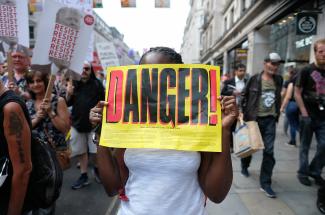
Protester holding a flyer that reads "Danger - Trump and the Far Right."
© Alisdare Hickson / Flickr
Danger - Trump and the Far Right.

Hoy en día, una cantidad considerablemente mayor a la mitad de la población mundial está gobernada por líderes de extrema derecha. En este escenario, lxs defensorxs de derechos humanos y lxs feministas están trabajando arduamente para «mantenerse firmes» y proteger el multilateralismo y el sistema internacional de derechos humanos. También enfrentan el riesgo de que su compromiso acarree represalias violentas. Al mismo tiempo, estas instituciones están cada vez más sujetas a los intereses del sector privado. Las grandes empresas (en particular, las corporaciones transnacionales) están ocupando asientos en la mesa de negociación y posiciones de liderazgo en una gran cantidad de instituciones multilaterales, incluida la ONU. Este nexo de ultranacionalismo, espacio cívico restringido y captura corporativa está teniendo un tremendo impacto sobre la posibilidad de que, alguna vez, logremos obtener derechos humanos para todxs.

Índice de contenidos

  • Nacionalismo y ultranacionalismo
  • Captura corporativa: el poder corporativo irrestricto está poniendo los derechos en riesgo
  • Represalias y espacio cívico restringido para lxs activistas feministas y lxs defensorxs de los derechos humanos de las mujeres y personas LGBTIQ+
  • Historia de movimiento de resistencia: El artículo 16 de la CEDAW: un camino hacia la reforma de las leyes de familia discriminatorias en contextos musulmanes

Lee el informe completo

Questions (Forum page)

¿Preguntas?

¿Tienes preguntas sobre el Foro de AWID o sobre las actividades relacionadas? ¡Tenemos respuestas!

Encuentra las respuestas

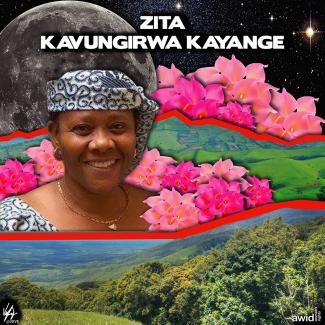
Zita Kavungirwa Kayange

Zita was a women’s rights activist who defended the rights of rural women in Greater Kivu.

She was the first Executive Director of UWAKI - a well known women’s organisation. Through her work with Women's Network for Rights and Peace (RFDP), and the Women's Caucus of South Kivu for Peace, she committed her life to helping to restore peace in the Eastern DRC. She spoke out strongly against the use of sexual violence as a weapon of war.

In 2006, she put herself forward as a candidate in the first democratic elections in the DRC. Although she did not win, she continued to advocate for women’s rights and the South Kivu community remembers her fondly. 


Zita Kavungirwa Kayange, Republic Democratic of Congo

Snippet FEA Principles of work Education and Learning (FR)

Une pile de livres dans une couverture rose et un mortier de graduation noir sur le dessus.

ÉDUCATION ET APPRENTISSAGE CONSTANT

Snippet - Rights and Resources - FR

Droits et ressources : se préparer pour les 30 prochaines années

✉️ Les inscriptions en personne sont closes. Inscrivez-vous au livestream ici
Événement en anglais 

📅 Mercredi 12 mars 2025
🕒 12.00h-13.30h EST

🏢 PNUD, 304 E 45th St. Doha Room, 11th Floor (FF Building)

Organisé par : PNUD, Femena, SRI et AWID