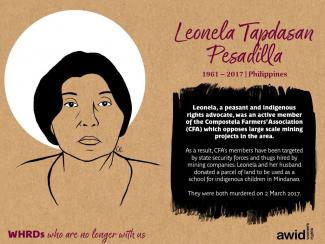
Leonela Tapdasan Pesadilla
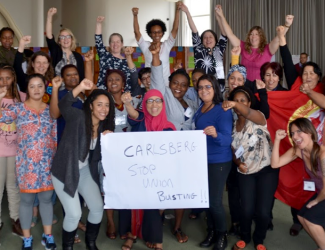
Women human rights defenders (WHRDs) worldwide defend their lands, livelihoods and communities from extractive industries and corporate power. They stand against powerful economic and political interests driving land theft, displacement of communities, loss of livelihoods, and environmental degradation.
Extractivism is an economic and political model of development that commodifies nature and prioritizes profit over human rights and the environment. Rooted in colonial history, it reinforces social and economic inequalities locally and globally. Often, Black, rural and Indigenous women are the most affected by extractivism, and are largely excluded from decision-making. Defying these patriarchal and neo-colonial forces, women rise in defense of rights, lands, people and nature.
WHRDs confronting extractive industries experience a range of risks, threats and violations, including criminalization, stigmatization, violence and intimidation. Their stories reveal a strong aspect of gendered and sexualized violence. Perpetrators include state and local authorities, corporations, police, military, paramilitary and private security forces, and at times their own communities.
AWID and the Women Human Rights Defenders International Coalition (WHRD-IC) are pleased to announce “Women Human Rights Defenders Confronting Extractivism and Corporate Power”; a cross-regional research project documenting the lived experiences of WHRDs from Asia, Africa and Latin America.
"Women Human Rights Defenders confronting extractive industries: an overview of critical risks and Human Rights obligations" is a policy report with a gender perspective. It analyses forms of violations and types of perpetrators, quotes relevant human rights obligations and includes policy recommendations to states, corporations, civil society and donors.
"Weaving resistance through action: Strategies of Women Human Rights Defenders confronting extractive industries" is a practical guide outlining creative and deliberate forms of action, successful tactics and inspiring stories of resistance.
The video “Defending people and planet: Women confronting extractive industries” puts courageous WHRDs from Africa, Asia, and Latin America in the spotlight. They share their struggles for land and life, and speak to the risks and challenges they face in their activism.
Challenging corporate power: Struggles for women’s rights, economic and gender justice is a research paper outlining the impacts of corporate power and offering insights into strategies of resistance.
AWID acknowledges with gratitude the invaluable input of every Woman Human Rights Defender who participated in this project. This project was made possible thanks to your willingness to generously and openly share your experiences and learnings. Your courage, creativity and resilience is an inspiration for us all. Thank you!
Day 1
Women's Forum on Financing for Gender Equality
The Third UN International Conference on Financing for Development
As you may or may not know, AWID is celebrating its 40th Anniversary in 2022 - around the themes of “Gather, Seed, and Disrupt.” To honor this occasion we have invited AWID members, partners and staff to write their own “Love Letter to Feminist Movements”. Together, we have sparked a constellation of feminist movements. Stay close as we forge on the journey ahead and continue to Gather, Seed, and Disrupt.
A note about Our Collection Of Love Letters:
All of these letters are written by activists who are sharing their diverse experiences in feminist movements. Some of them may include difficult or challenging content about abuse, sexual violence, conflict, exclusion and other potential triggering or upsetting pieces. While these letters are filled with love, please take care of yourself when reading the letters.
(with special guests!)
📅Tuesday, March 12
🕒6-9.30pm EST
🏢 Blue Gallery, 222 E 46th St, New York
RSVP required
El tema del 14° Foro Internacional de AWID es «Realidades feministas: nuestro poder en acción».
Entendemos las realidades feministas como los diferentes modos de existir y ser que nos muestran lo que es posible, a pesar de los sistemas de poder dominantes, y en desafío y resistencia contra ellos. Entendemos estas realidades feministas como recuperaciones y corporizaciones de esperanza y poder, multidimensionales, dinámicas, y arraigadas en contextos y momentos históricos específicos.
¿Qué pasaría si volviéramos a imaginar formas de cuidar a nuestras comunidades?
¿Y si la economía no estaría enfocada en la ganancia de una pequeña élite sino en el cuidado de nuestro bienestar individual y colectivo, y de la Naturaleza?
Estas historias tratan de la construcción de comunidades de cuidado con y para las personas que históricamente y actualmente están excluidas, privadas de sus derechos y deshumanizadas tanto por el Estado como por la sociedad.
Estas son las historias de las feministas que centran el cuidado en la economía.
La encuesta está orientada a agrupaciones, organizaciones y movimientos que trabajan específica o primordialmente por los derechos de las mujeres, las personas LBTQI+ y la justicia de género, en todos los contextos, en todos los ámbitos y en todas las regiones. Si alguno de estos es el pilar fundamental de tu agrupación, colectivo, red o cualquier otro tipo de organización —ya sea que esté registrada, sea de reciente creación o de larga data—, te invitamos a responder la encuesta.

*En esta oportunidad, no estamos solicitando respuestas de individuos ni de fondos feministas o de mujeres.
Obtén más información sobre la encuesta:
Consultar las preguntas frecuentes
Siempre hemos trabajado para garantizar que nuestros Foros sean desarrollados conjuntamente con nuestrxs afiliadxs, los movimientos, y nuestros colectivos prioritarios.
Para el Foro 2020 queremos profundizar y fortalecer este espíritu y esta práctica de creación conjunta y colaboración. También reconocemos la necesidad de mejorar el equilibrio entre la inclusión de muchas voces y experiencias y el espacio para que lxs participantes y el equipo respiren, se tomen una pausa, y disfruten de un poco de tiempo de inactividad.
Este Foro será diferente en cuanto a que:
Lorsque vous arriverez au centre-ville de São Paulo, vous verrez le bâtiment Ocupação 9 de Julho (Occupation de l’Avenue du 9 Juillet), un espace culturel et un site important dans la lutte pour le logement social.
C'est le travail du Mouvement des Travailleur·euses Sans-Abri (Movimento dos Sem-Teto do Centro, MSTC), un mouvement de plus de 2000 personnes qui agit dans le centre-ville et convertit les espaces abandonnés en logements pour les travailleur·euses à faible revenu, les enfants, femmes, adultes, personnes âgées, migrant·e·s et réfugié·e·s. Dans ce bâtiment en particulier, 122 familles sont nourries et logées.

To claim your power as an expert on the state of resourcing for feminist movements
Por favor consulta la página «Financiamiento» para obtener algunas ideas sobre cómo puedes financiar tu participación en el próximo Foro. Esto incluye el limitado apoyo que AWID podrá brindar.
Related content
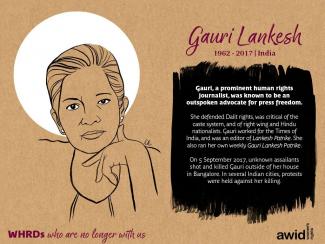
Reporters without Borders: India: Prominent woman journalist gunned down in Bangalore
BBC: Gauri Lankesh: Indian journalist shot dead in Bangalore
Committee to Protect Journalists: Gauri Lankesh Killed
BBC: Gauri Lankesh: Murdered Indian journalist in her own words
The Guardian: The murder of journalist Gauri Lankesh shows India descending into violence
Financial Times - Gauri Lankesh, journalist and activist, 1962-2017
The New York Times: Why was Gauri Lankesh killed?
Black women community organizing in the Cauca Valley in Colombia can be traced back to the country's colonial past, which is marked by the racism, patriarchy, and capitalism that sustained slavery as a means to exploit the region’s rich soils. These organizers are the heroines of a broad movement for black autonomy - one that fights for the sustainable use of the region's forests and natural resources as vital to their culture and livelihood.
For 25 years, the Association of Afro-Descendant Women of the Northern Cauca (Asociación de Mujeres Afrodescendientes del Norte del Cauca, ASOM) has been dedicated to bringing power to Afro-Colombian women’s organizing in northern Cauca.
They became established in 1997 as a response to ongoing human rights violations, the absence of public policies, inadequate management of natural resources, and the lack of opportunities for women in the territory.
They have forged the struggle to secure ethnic-territorial rights, to end violence against women, and gain recognition of women’s roles change-making peace-building in Colombia.