Jean-Marc Ferré | Flickr (CC BY-NC-ND 2.0)
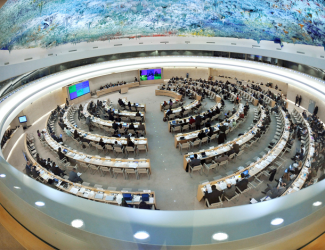
A general view of participants at the 16th session of the Human Rights Council in Geneva, Switzerland.

Human Rights Council (HRC)

The Human Rights Council (HRC) is the key intergovernmental body within the United Nations system responsible for the promotion and protection of all human rights around the globe. It holds three regular sessions a year: in March, June and September. The Office of the UN High Commissioner for Human Rights (OHCHR) is the secretariat for the HRC.

The HRC works by:

  • Debating and passing resolutions on global human rights issues and human rights situations in particular countries

  • Examining complaints from victims of human rights violations or activist organizations on behalf of victims of human rights violations

  • Appointing independent experts (known as “Special Procedures”) to review human rights violations in specific countries and examine and further global human rights issues

  • Engaging in discussions with experts and governments on human rights issues

  • Assessing the human rights records of all UN Member States every four and a half years through the Universal Periodic Review

Learn more about the HRC


AWID works with feminist, progressive and human rights partners to share key knowledge, convene civil society dialogues and events, and influence negotiations and outcomes of the session.

With our partners, our work will:

◾️ Monitor, track and analyze anti-rights actors, discourses and strategies and their impact on resolutions

◾️ Raise awareness of the findings of the 2017 and 2021 OURs Trends Reports.

◾️Support the work of feminist UN experts in the face of backlash and pressure

◾️Advocate for state accountability
 
◾️ Work with feminist movements and civil society organizations to advance rights related to gender and sexuality.
 

Related Content

Snippet - CSW68 - AWID at CSW Post - FR

Snippet FEA A Caring Economy (EN)

A CARING

ECONOMY

Feminists Centering Care in the Economy:
A Cross-Movement Dialogue

What if we reimagined ways of caring for our communities?

What if the economy was not about someone else’s profit but about care for our individual and collective wellbeing? These stories are about building communities of care with and for people who are historically and presently excluded, disenfranchised and dehumanized by both state and society. These are the stories of feminists centering care in the economy.

Enero 2015: 1a sesión para redactar el documento final de la 3a Conferencia sobre FpD

Primera sesión para redactar el Documento Final de la tercera Conferencia Internacional sobre la Financiación para el Desarrollo

  • En enero de 2015, en la sede de la ONU en Nueva York comenzó una serie de sesiones para redactar el Documento Final.
  • Antes de la primera sesión, los facilitadores del proceso preparatorio de la Conferencia de Adís Abeba presentaron los “Elementos” para el llamado “Borrador Cero” del documento, que constituyeron la base para las negociaciones entre gobiernos en torno al Documento Final.
  • En esas sesiones, las organizaciones por los derechos de las mujeres subrayaron la necesidad de que, en los procesos post-2015, la FpD y los medios para su implementación se traten por separado, ya que la FpD brinda a los Estados una oportunidad única de ocuparse de las causas estructurales de la desigualdad.

Snippet - WITM why - FR

Pourquoi devrais-je participer à cette enquête?

Juin 2015

Tenue des autres sessions de rédaction du document final d’Addis-Abeba

Pour plus d’informations, voir le « guide du routard des OSC » (le CSO Hitchhiker’s Guide – en anglais).

Snippet - WITM To Strengthen - ES

Para fortalecer nuestra voz y poder colectivos para obtener más y mejor financiamiento para las organizaciones feministas, por los derechos de las mujeres y de las personas LBTQI+ y demás organizaciones aliadas de todo el mundo.

Snippet FEA Housing is a right (FR)

Three-fold horizontal graphic: 1st of a brown-skinned woman on the right side, she is sitting on a pink carpet and is wearing a pink shirt and yellow dress; 2nd two women of color looking at each other and touching their shoulders, they are on a pink background; 3rd - graphic version of three women cooking.

Le logement est un droit | Les soins soutiennent la vie

What is the 14th AWID Forum theme?

The 14th Forum theme is “Feminist Realities: our power in action”. 

We understand Feminist Realities as the different ways of existing and being that show us what is possible, despite dominant power systems, and in defiance and resistance to them.  We understand these feminist realities as reclamations and embodiments of hope and power, and as  multi-dimentional, dynamic and rooted in specific contexts and historical moments.

Read more about Feminist Realities


Snippet - WITM Survey will remain open - FR

Regardez le webinaire « Où est l'argent?» maintenant !

Le 11 juillet 2024, nous avons eu une conversation étonnante avec de grandes féministes sur l'état de l'écosystème du financement et le pouvoir du recherche « Où est l'argent ? ».

Un merci spécial à Cindy Clark (Thousand Currents), Sachini Perera (RESURJ), Vanessa Thomas (Black Feminist Fund), Lisa Mossberg (SIDA) et Althea Anderson (Fondation Hewlett).

N'oubliez pas que l'enquête restera ouverte jusqu'au 31 août 2024 !

Regardez le webinaire

Snippet FEA ASOM’s activists in encounters (EN)

 
Black woman in a white headscarf and gray t-shirt, she is smiling and is holding a vessel above her head
People demonstrating and holding a long blue poster
Black woman speaking in a mic, there is a black girl standing next to her and a man sitting at the table
Photo of five black women in the front on a demonstration, wearing facemasks and holding posters
Photo of three women sitting around the table and talking in mics.

ASOM’s activists in encounters, parades and events

What will be different about this Forum?

We have always worked towards ensuring that our Forums are co-developed with partners, movements and our priority constituencies.

For our upcoming Forum, we aim to deepen and strengthen that spirit and practice of co-creation and collaboration. We also recognize the need to improve the balance between the inclusion of many voices and experiences with room for participants and staff to breathe, take pause and enjoy some downtime.

This Forum will be different in the following ways: 

  • We will have far less organized Forum activities because we want people to have time to engage, experience, process, talk to each other, etc.  This is key to communicate: you can come to the Forum, be very engaged and active and not facilitate any organized activity (or “session”).
  • We will have Open Spaces - at least one whole afternoon without any organized activities - but also physical spaces available throughout the Forum for people to self-organize meetings, etc.
  • We have a Content and Methodology Committee made up of feminists from different regions with expertise on participatory methodologies to support us and all those leading activities at the Forum to use creative and engaging  formats for the Forum activities. 


Snippet - WITM RESOURCES - ES

Recursos