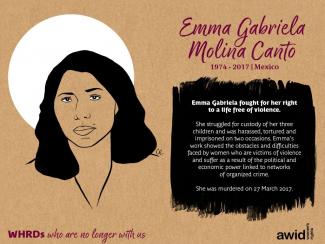
Emma Gabriela Molina Canto
WHRDs are self-identified women and lesbian, bisexual, transgender, queer and intersex (LBTQI) people and others who defend rights and are subject to gender-specific risks and threats due to their human rights work and/or as a direct consequence of their gender identity or sexual orientation.
WHRDs are subject to systematic violence and discrimination due to their identities and unyielding struggles for rights, equality and justice.
The WHRD Program collaborates with international and regional partners as well as the AWID membership to raise awareness about these risks and threats, advocate for feminist and holistic measures of protection and safety, and actively promote a culture of self-care and collective well being in our movements.
WHRDs are exposed to the same types of risks that all other defenders who defend human rights, communities, and the environment face. However, they are also exposed to gender-based violence and gender-specific risks because they challenge existing gender norms within their communities and societies.
We work collaboratively with international and regional networks and our membership
We aim to contribute to a safer world for WHRDs, their families and communities. We believe that action for rights and justice should not put WHRDs at risk; it should be appreciated and celebrated.
Promoting collaboration and coordination among human rights and women’s rights organizations at the international level to strengthen responses concerning safety and wellbeing of WHRDs.
Supporting regional networks of WHRDs and their organizations, such as the Mesoamerican Initiative for WHRDs and the WHRD Middle East and North Africa Coalition, in promoting and strengthening collective action for protection - emphasizing the establishment of solidarity and protection networks, the promotion of self-care, and advocacy and mobilization for the safety of WHRDs;
Increasing the visibility and recognition of WHRDs and their struggles, as well as the risks that they encounter by documenting the attacks that they face, and researching, producing, and disseminating information on their struggles, strategies, and challenges:
Mobilizing urgent responses of international solidarity for WHRDs at risk through our international and regional networks, and our active membership.
El objetivo fundamental de la encuesta ¿Dónde está el dinero? es arrojar luz sobre la situación financiera de la diversidad de movimientos feministas, por los derechos de las mujeres, la justicia social, las personas LBTQI+ y demás movimientos aliados de todo el mundo y, sobre la base de dicha información, reforzar las razones fundadas para movilizar más y mejores fondos y transferir el poder a los movimientos feministas.
Como parte de nuestro compromiso de lograr una interacción más profunda con artistas y la práctica de la creación conjunta de las Realidades Feministas, AWID colaboró con un grupo de trabajo de artisvistas para promover y fortalecer las agendas y realidades feministas en sus comunidades y movimientos a través de sus expresiones creativas. Nuestra intención en este punto es reunir a creativxs feministas en un espacio pujante y valiente donde puedan desarrollarse y vivir en libertad, y donde puedan romper las narrativas tóxicas para sustituirlas por alternativas transformadoras.
A number of men who share our commitment to feminism and women’s human rights are members of AWID.
Non, nous souhaitons recevoir une seule participation par groupe.
Yes, the survey can be accessed using a smartphone.
Pendant des décennies, les universitaires et défenseur·euse·s féministes ont développé d’importantes notions liées au genre afin de comprendre et combattre l’oppression et la discrimination. Ces notions sont maintenant devenues la cible d’acteur·ice·s antidroits qui prétendent que les rôles de genre patriarcaux oppressifs relèvent du « bon sens », peignant stratégiquement toutes les autres idées, normes culturelles et formes de vie sociale comme une idéologie dangereuse et conspirationniste.
Lisez le dossier sur Les Discours Sur L’ « Idéologie Du Genre » : Une Menace Pour Les Droits Humains
Nous vous conseillons de demander conseil à un-e avocat-e, de communiquer avec un refuge pour femmes ou un centre d’accueil près de chez vous.
Les HotPeachPages, une ressource en ligne, contiennent des liens vers les refuges pour femmes dans le monde entier. L’AWID ne peut garantir l’exactitude ou la qualité de ces listes, mais elles peuvent constituer un bon point de départ si vous ne connaissez aucune organisation près de chez vous.
Sí, invitamos a compartir más impresiones acerca de alguna cuestión que sea de importancia para ti respondiendo a las preguntas abiertas al término de la encuesta.
What if we reimagined ways of caring for our communities?
What if the economy was not about someone else’s profit but about care for our individual and collective wellbeing? These stories are about building communities of care with and for people who are historically and presently excluded, disenfranchised and dehumanized by both state and society. These are the stories of feminists centering care in the economy.
Follow-up International Conference on Financing for Development, Doha, Qatar