None On Record

Young Feminist Activism

Organizing creatively, facing an increasing threat

Young feminist activists play a critical role in women’s rights organizations and movements worldwide by bringing up new issues that feminists face today. Their strength, creativity and adaptability are vital to the sustainability of feminist organizing.

At the same time, they face specific impediments to their activism such as limited access to funding and support, lack of capacity-building opportunities, and a significant increase of attacks on young women human rights defenders. This creates a lack of visibility that makes more difficult their inclusion and effective participation within women’s rights movements.

A multigenerational approach

AWID’s young feminist activism program was created to make sure the voices of young women are heard and reflected in feminist discourse. We want to ensure that young feminists have better access to funding, capacity-building opportunities and international processes. In addition to supporting young feminists directly, we are also working with women’s rights activists of all ages on practical models and strategies for effective multigenerational organizing.

Our Actions

We want young feminist activists to play a role in decision-making affecting their rights by:

  • Fostering community and sharing information through the Young Feminist Wire. Recognizing the importance of online media for the work of young feminists, our team launched the Young Feminist Wire in May 2010 to share information, build capacity through online webinars and e-discussions, and encourage community building.

  • Researching and building knowledge on young feminist activism, to increase the visibility and impact of young feminist activism within and across women’s rights movements and other key actors such as donors.

  • Promoting more effective multigenerational organizing, exploring better ways to work together.

  • Supporting young feminists to engage in global development processes such as those within the United Nations

  • Collaboration across all of AWID’s priority areas, including the Forum, to ensure young feminists’ key contributions, perspectives, needs and activism are reflected in debates, policies and programs affecting them.

Related Content

Snippet Video C&H (EN)

Snippet - CSW68 - Follow the Money - EN

Follow the Money:

Illicit Financial Flows & Anti-Rights Actors

📅Monday, March 11
🕒4:30 - 6pm EST

Organisers: AWID, IJSC and NAWI
🏢 Church Center of the United Nations, 777 United Nations Plaza, New York, 11th Floor
(French and Spanish interpretation available)

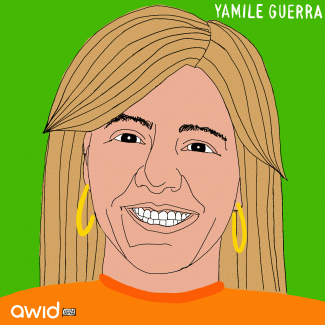
Yamile Guerra

Yamile Guerra was a well-known lawyer, community leader and political activist in the Santander region of Colombia.

She was actively working to resolve disputes between local communities and developers, advocating against illegal land appropriation. Yamile had occupied various political posts, including as the Secretary General for the Santander government in Bogota and also aspired for the Mayor’s Office of Bucaramanga. In the last few years of her life, Yamile became increasingly active in environmental causes, particularly in the defense of the biodiverse wetlands of Santurbán against development, a region which supplies nearly 2 million people with freshwater.

According to her family and friends, Yamile received daily threats against her life and had asked the authorities for protection. 

“She was very very aware of this issue [land litigation] and she said many times that she felt insecure.” - Alixon Navarro Munoz, journalist and friend of Guerra family

On July 20, 2019 Yamile was shot to death by two men in Floridablanca, Santander. She had just finished discussing a land dispute with them. A suspect was later arrested for her murder and admitted to being paid to carry out her assassination. According to reports, Yamile was the third member of her family to have been killed in relation to land disputes. Her father, Hernando Guerra was murdered several years previously.

Yamile’s assassination is part of a wave of violence and systematic killing of hundreds of social activists and human rights defenders in Colombia. According to the Institute for Development and Peace Studies (INDEPAZ), at the time of Yamile’s death, over 700 community leaders and human rights activists had been killed since the country signed a peace agreement in August 2016. Most were murdered for confronting illegal drug trafficking and mining operations, with indigenous people, Afro-Colombians and women human rights defenders being most at risk. 

Less than a week after Yamile’s death, thousands of Colombians marched all over towns and cities, holding up black and white photos of activists who had been killed, with signs that read: "Without leaders there can be no peace" and "No more bloodshed”.

Yamile Guerra was only 42 years old at the time of her assassination. 
What is the 14th AWID Forum theme?

The 14th Forum theme is “Feminist Realities: our power in action”. 

We understand Feminist Realities as the different ways of existing and being that show us what is possible, despite dominant power systems, and in defiance and resistance to them.  We understand these feminist realities as reclamations and embodiments of hope and power, and as  multi-dimentional, dynamic and rooted in specific contexts and historical moments.

Read more about Feminist Realities


Snippet FEA FIGHT LIKE SOMEONE WHO CARES (EN)

São Paulo, Brasil

COZINHA OCUPAÇÃO 9 DE JULHO

Lucha como alguien

QUIEN CUIDA

Snippet - CSW68 - March 13 - EN

Day 3

13th March

Binta Sarr

Binta Sarr fue una activista por la justicia social, económica, cultural y política, y una ingeniera hidráulica en Senegal. Después de 13 años en la administración pública, Binta dejó ese camino para trabajar con mujeres rurales y marginadas.

Fue de este compromiso que surgió la Association for the Advancement of Senegalese Women [Asociación para el Avance de las Mujeres Senegalesas] (APROFES, por sus siglas en inglés), un movimiento y organización de base que Binta fundó en 1987. Uno de sus principales enfoques fue la formación de dirigentes, en relación no solo con las actividades económicas, sino también con los derechos de las mujeres y el acceso a los puestos de toma de decisiones.

"Las poblaciones de base deben organizarse, movilizarse, asumir el control ciudadano y exigir la gobernabilidad democrática en todos los sectores del espacio público. La prioridad de los movimientos sociales debe ir más allá de la lucha contra la pobreza y debe centrarse en programas de desarrollo articulados y coherentes en consonancia con los principios de los derechos humanos, teniendo en cuenta al mismo tiempo sus necesidades y preocupaciones tanto a nivel nacional como subregional y desde una perspectiva de integración africana y mundial". - Binta Sarr

Partiendo de la convicción de Binta de que el cambio fundamental de la condición de la mujer requiere una transformación de las actitudes masculinas, APROFES adoptó un enfoque interdisciplinario,  al utilizar la radio, los seminarios y el teatro popular, además de proporcionar una educación pública innovadora y  brindar apoyo cultural a las acciones de sensibilización. Su compañía de teatro popular representó piezas originales sobre el sistema de castas en el Senegal, el alcoholismo y la violencia conyugal. Binta y su equipo también analizaron la conexión crucial entre la comunidad y el mundo en general.

"Para APROFES, se trata de estudiar y tener en cuenta las interacciones entre lo micro y lo macro, lo local y lo global y también, las diferentes facetas del desarrollo. Desde la esclavitud hasta la colonización, el neocolonialismo y la mercantilización del desarrollo humano, la mayor parte de los recursos de África y del Tercer Mundo (petróleo, oro, minerales y otros recursos naturales) están todavía bajo el control de carteles financieros y las otras multinacionales que dominan este mundo globalizado". - Binta Sarr

Binta fue una de las integrantes fundadoras de la sección femenina de la Asociación Cultural y Deportiva Magg Daan. Recibió distinciones del Gobernador Regional y del Ministro de Hidrología por su "devoción por la población rural".

Nacida en 1954 en Guiguineo, un pequeño pueblo rural, Binta falleció en septiembre de 2019.


Tributos:

"La pérdida es inconmensurable, el dolor es pesado y profundo, pero resistiremos para no llorar a Binta; no lloraremos a Binta, mantendremos la imagen de su amplia sonrisa en todas las circunstancias, para resistir e inspirarnos en ella, para mantener, consolidar y desarrollar su obra..." - Página de Facebook de Aprofes, 24 de septiembre de 2019.

"¡Adiós Binta! Creemos que tu inmenso legado será preservado." - Elimane FALL , presidente de ACS Magg-Daan

What will be different about this Forum?

We have always worked towards ensuring that our Forums are co-developed with partners, movements and our priority constituencies.

For our upcoming Forum, we aim to deepen and strengthen that spirit and practice of co-creation and collaboration. We also recognize the need to improve the balance between the inclusion of many voices and experiences with room for participants and staff to breathe, take pause and enjoy some downtime.

This Forum will be different in the following ways: 

  • We will have far less organized Forum activities because we want people to have time to engage, experience, process, talk to each other, etc.  This is key to communicate: you can come to the Forum, be very engaged and active and not facilitate any organized activity (or “session”).
  • We will have Open Spaces - at least one whole afternoon without any organized activities - but also physical spaces available throughout the Forum for people to self-organize meetings, etc.
  • We have a Content and Methodology Committee made up of feminists from different regions with expertise on participatory methodologies to support us and all those leading activities at the Forum to use creative and engaging  formats for the Forum activities. 


Snippet FEA Ocupação 9 de Julho is more than just a building (FR)

Mais Ocupação 9 de Julho est plus qu'un bâtiment.

C'est un centre communautaire, où l'on peut suivre des cours et se former à des activités créatives génératrices de revenus comme la coiffure, la cuisine et la création artistique. Les enfants peuvent également profiter d'activités culturelles et éducatives.

Le MSTC ne travaille pas seul. Iels collaborent avec des institutions et des collectifs artistiques pour produire des expériences culturelles, sportives et éducatives, ainsi qu'un accès critique à des services de santé. Depuis sa création, ce projet participatif a été porté essentiellement par des femmes, sous la direction de l'activiste afro-brésilienne Carmen Silva, autrefois sans abri.


Snippet - Intro WITM - EN

Where is the Money for Feminist Organizing? Survey Results

Thanks to our global feminist community! From May to August 2024, nearly 1,200 organizations working for Women's rights, gender justice, and LBTQI+ equality shared their experiences in the WITM survey. The results offer a unique picture of how feminist movements are resourced and where gaps remain.

Stay tuned for the upcoming report for more analysis!
 

Learn more about the insights

Laurie Carlos

Laurie Carlos était une comédienne, réalisatrice, danseuse, dramaturge et poétesse aux États-Unis. Artiste hors pair et visionnaire, c’est avec de puissants modes de communication qu’elle a su transmettre son art. 

« Laurie entrait dans la pièce (n’importe quelle pièce/toutes les pièces) avec une perspicacité déroutante, un génie artistique, une rigueur incarnée, une féroce réalité – et une détermination à être libre... et à libérer les autres. Une faiseuse de magie. Une devineresse. Une métamorphe. Laurie m’a dit un jour qu’elle entrait dans le corps des gens pour trouver ce dont ils et elles avaient besoin. » - Sharon Bridgforth

Elle a employé plusieurs styles de performance alliant les gestes rythmiques au texte. Laurie encadrait les nouveaux·elles comédien·ne·s, performeur·euse·s et dramaturges, et a contribué à développer leur travail dans le cadre de la bourse Naked Stages pour les artistes émergent·e·s. Associée artistique au Penumbra Theatre, elle a participé à la sélection de scripts à produire, dans l’objectif « d’intégrer des voix plus féminines dans le théâtre ». Laurie faisait également partie des Urban Bush Women, une compagnie de danse contemporaine reconnue qui contait les histoires de femmes de la diaspora africaine.

Elle fit ses débuts à Broadway dans le rôle de Lady in Blue, en 1976, dans la production originale et primée du drame poétique For colored girls who have considered suicide / when the rainbow is enuf de Ntozake Shange. L’oeuvre de Laurie inclut White Chocolate, The Cooking Show et Organdy Falsetto

« Je raconte les histoires à travers le mouvement – les danses intérieures qui se produisent spontanément, comme dans la vie – la musique et le texte. Si j’écris une ligne, ce n’est pas forcément une ligne qui sera dite ; ce peut être une ligne qui sera bougée. Une ligne à partir de laquelle de la musique est créée. Le geste devient phrase. Tant de ce que nous sommes en tant que femmes, en tant qu’êtres, tient aux gestes que nous exprimons les un·e·s par rapport aux autres, tout le temps, et particulièrement dans les moments d’émotion. Le geste devient une phrase, ou un état de fait. Si j’écris “quatre gestes” dans un script, cela ne signifie pas que je ne dis rien;cela veut dire que j’ai ouvert la voie à ce que quelque chose soit dit physiquement. » Laurie Carlos

Laurie est née et a grandi à New York, a travaillé et vécu à Minneapolis-Saint-Paul. Elle est décédée le 29 décembre 2016, à l’âge de 67 ans, après un combat contre le cancer du côlon. 


Hommages :

« Je pense que c’était exactement l’intention de Laurie. De nous sauver. De la médiocrité. De l’ego. De la paresse. De la création artistique inaboutie. De la paralysie par la peur.
Laurie voulait nous aider à briller pleinement.
Dans notre expression artistique.
Dans nos vies. » - Sharon Bridgforth pour le Pillsbury House Theatre

« Quiconque connaissait Laurie aurait dit que c’était une personne singulière. Elle était sa propre personne. Elle était sa propre personne, sa propre artiste ; elle mettait en scène le monde tel qu’elle le connaissait avec un vrai style et une compréhension fine, et elle habitait son art. » – Lou Bellamy, Fondatrice de la Penumbra Theatre Company, pour le Star Tribune 

Lire un hommage complet par Sharon Bridgforth (seulement en anglais)

How can I fund my participation in the AWID Forum? Many activists will not be able to afford the cost of the Forum – is AWID doing anything to provide assistance?

Please visit the "Funding ideas" page to get some ideas and inspiration for how you can fund your participation at the next Forum, including the limited support AWID will be able to provide.

Snippet FEA ASOM Challenges Story 1 (EN)

CHALLENGES:

  • Climate Change
  • Access to financial credit Intermediaries
  • Cultivation for illicit usage

Snippet - WITM To make - ES

Para darle visibilidad a la complejidad de la dotación de recursos para las diversas formas de organización feministas.

Roxana Reyes Rivas

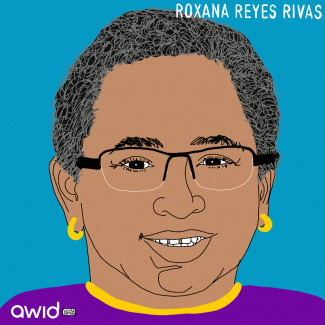
Roxana Reyes Rivas, philosopher, feminist, lesbian, poet, politician and LGBT and women’s rights activist from Costa Rica. Owner of a sharp pen and incisive humour, a laugh a minute. She was born in 1960 and raised in San Ramón of Alajuela, when it was a rural town, and her whole life she would break away from the mandates of what it meant to be a woman.   

With El Reguero (Costa Rican lesbian group) she organized lesbian festivals for over a decade, fun-filled formative spaces to come together at a time when the Costa Rican government and society persecuted and criminalized the lesbian existence. For hundreds of women the lesbian festivals where the only place they could be themselves and come together with others like them.  

Roxana would often say founding political parties was one of her hobbies. “It’s important for people to understand there are other ways to do politics, that many issues need to be solved collectively”. She was one of the founders of the New Feminist League and VAMOS, a human rights focused political party.

“The philosophical trade is meant to jab, to help people ask themselves questions. A philosopher who doesn’t irritate anyone is not doing her job”. For 30 years Roxana taught philosophy at several Costa Rican public universities. Through her guidance, generations of students reflected about the ethical dilemmas in science and technology.  

Roxana’s favourite tool was humour, she created the Glowing Pumpkin award, an acknowledgement to ignorance that she would bestow upon public figures, through her social media channels, mocking their anti-rights expressions and statements.  

An aggressive cancer took Roxana at the end of 2019, before she could publish a compilation of her poems, a departing gift from the creative mind of a feminist who always raised her voice against injustice.

Will there be pre-Forum convenings this time around?

We have been contacted by global and regional partners about some ideas for pre-Forum convenings and we will share more information about these ideas soon.

If you plan to organize a meeting before the Forum please let us know!

Contact us


Many beautiful things emerged from the 2016 Black Feminisms Forum (BFF) that was organized by an Advisory Group and funded by AWID. Some of the independent organizing that arose from the BFF include Black feminist organizing in Brazil. While we won’t have another BFF this year, we remain committed to sharing some key learnings with anyone interested in continuing work around Black feminist organizing.