Análisis Especiales

AWID es un organización feminista internacional de membresía, que brinda apoyo a los movimientos que trabajan para lograr la justicia de género y los derechos de las mujeres en todo el mundo.

Foro de AWID: Co-creando futuros feministas

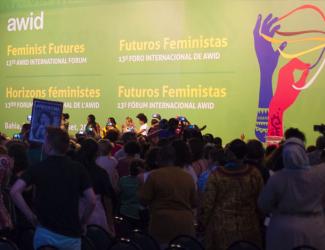
En septiembre de 2016, 1800 feministas y activistas por los derechos de las mujeres de todos los rincones de nuestros movimientos se congregaron en las costas de Bahia, en el 13º Foro Internacional de AWID.

En esta sección se destacan los logros, los aprendizajes y los recursos que surgieron de las ricas conversaciones mantenidas. Te invitamos a analizar, compartir y comentar.


¿Qué ha pasado desde 2016?

Uno de los aportes más importantes del Foro fue la necesidad de ampliar y profundizar nuestro trabajo entre movimientos, frente a la confluencia de los fascismos en auge, fundamentalismos, codicia corporativa y cambio climático.

Con esto en mente, AWID, en asociación con múltiples aliadxs, ha estado trabajando para que estas semillas de resistencia:

AWID se ha comprometido, mediante su próximo plan estratégico y su proceso del Foro, a continuar y profundizar las relaciones, las lecciones y los procesos iniciados en el Foro 2016 y basándonos en el momento actual.

¿Que pasa ahora?

El mundo es un lugar muy diferente de lo que era un año atrás, y seguirá cambiando en los próximos años.

El próximo Foro de AWID se realizará en la región del Pacífico Asiático (el lugar y la fecha exactos serán anunciados en 2018). Esperamos que te unas a nosotrxs.

Sobre el Foro de AWID

Los Foros de AWID comenzaron en 1983 en Washington DC. Desde entonces, el evento ha crecido hasta convertirse en muchas cosas para muchas personas: un proceso iterativo para darle forma a nuestros análisis, objetivos y acciones; un hito crucial que fortalece los feminismos de lxs participantes e infunde energías a sus procesos de organización; un hogar político donde lxs defensoras de derechos humanos encuentran un santuario y solidaridad.

Más información sobre los Foros anteriores

Contenido relacionado

Snippet - CSW69 spaces to watch out for - ES

Espacios para tener en cuenta en la CSW69

Obtén más información sobre los próximos eventos de la CSW69 que AWID está coorganizando

Quel est le thème du 14e Forum de l’AWID ?

Le 14e Forum a pour thème « Réalités féministes: notre pouvoir en action ».

Nous concevons les Réalités féministes comme différentes façons d’exister et d’être qui nous révèlent ce qui est possible, au mépris et malgré les systèmes de pouvoir dominants, et en résistance à ces derniers. Nous concevons ces réalités féministes comme des revendications et des incarnations d’espoir et de pouvoir, et comme des réalités multidimensionnelles, dynamiques et ancrées dans des contextes et des moments historiques spécifiques. 

En savoir plus sur les réalités féministes

A Collective Love Print

The Circle’s Conspiracy of Writers | Wazina Zondon

Decorative element
Teta Research Network
Wazina Zondon Portrait
Also known as the Teta Research Network, The Conspiracy of Writers was founded in 2021 in the context of Kohl’s weekly writing circles. The Network is a transnational group of queer and feminist writers who engage in collective writing, thinking, and world-making.  Wazina Zondon is an Afghan raised in New York City. Her storycollecting and storytelling work centers collective memories and rites of passage in the diaspora. Currently, she is working on Faith: in Love/faith in love which (re)traces her parent’s love story and family’s inherited love print.


Love is a contraband in Hell,
cause love is acid
that eats away bars. 

But you, me, and tomorrow
hold hands and make vows
that struggle will multiply.

The hacksaw has two blades.
The shotgun has two barrels.
We are pregnant with freedom.
We are a conspiracy.

It is our duty to fight for freedom.
It is our duty to win.
We must love each other and support each other.
We have nothing to lose but our chains.

- “Love” by Assata Shakur

Cover for article A Collective Love Print showing two people kissing

“If we can inherit trauma, can we inherit an imprint related to love?”

That is the question Wazina Zondon asks in her collective memoir Loveprint. Loveprint is a wandering, an overlap, a deviation that (re)creates, at the intersection of interviews and personal essays, our family’s stories and insights on love, partnership and romance. Under Wazina’s guidance, the circle’s conspiracy of writers came together and attempted to reproduce this literal blueprint in the form of collective writing, where our different stories, our genders and sexual identities complement and contradict each other. With our voices overlapping, we complete each other’s sentences to create a conversation, a memorial, pieces of ourselves that speak to a “we.”

What are the origins of your love print?

I am a so-called “happy accident.” There is much narration about this – an accidental life, one that is entirely wanted at the same time. I feel this shaped my way of loving, I don’t just fall in love; I risk the slips that lead to the fall. Perhaps it made me an amor fati kind of person. 

I was told that I was an unwanted child. So I grew up to become an unwanted adult. The origins of my love print are based on being eternally unwelcomed. I am not a fruit of love or any happy feelings but rather one pain and burden. I don’t have a love print – at least not in this sense.

I know for a fact that both my parents were in love at some point, but mental health is such a demon, and until one confronts their demons, there is no winning.

I will never associate “love” with my parents or normative family. Love growing up was full of violence and responsibilities I didn’t sign up for or was even ready for. For the longest time, it felt like life and love were about carrying a big rock uphill. While my parents “loved each other,” it was a toxic ethos of violence, jealousy, and insecurity to grow up in. I grew up wanting to crave stability, and this is what is me now. I am a risk taker, but never in my “love space.”

I don’t know why my mother chose to host a child (me) within her.
She does not love in this form.

My mother tells me that if I have to think about “finding” love, I should never look at her marriage as a template. My love print comes instead from my raising dogs for the last two decades (18 years to be precise). The other way around is true as well – they raised me. I understand more and more about love and its many layers in their company.

I haven’t known love from a “print.” In our household we don’t talk about love. I had to teach myself how to love. It was hard work. Still, I fail and still, I keep on trying and I fail everyday. Perhaps failure is my love print.

My love print is the care, warmth, and understanding I give to others
surrounding me, whether a stranger, a friend, a relative, a lover. 
My love print is political – uncalculated and unthought of.

I was born under heavy shelling. 
My love print is the negative 
print of that.

Lessons learned about love

I know more about what love is not than I know about what love is. 

Love is neither anxiety nor panic.

Love is not asking permission to live or breathe. It is always about love and there is no love without freedom.

Everything you do is about using your heart except love. Love is about using your mind. 

Sometimes I fear that my love language is lost in translation.

--- There are many ways
to map the origins
of how to
how not to
love
not love
love just enough
love far too much
some love
some loss
to love
to love lost ---


I cannot stand the idea of the couple. I cannot stand the idea of living alone while aging either. I am tired of doing the chores alone, moving houses alone, paying rent and bills alone... I imagine getting a stroke alone, and it scares me. I have no plan of “partnering up.” I want a world where I can get married to a friend, buy a house with a friend, not have sex.

Loving many does not corrupt a love shared between two, and whether love is romantic or not is really not that important.

When I reflect on the shoddy state of my relationships, I realize that I am in the relationship I was trained to be in. With all my “radicalness” I have not yet unlearned shitty gendered norms.

My need for stability feels “not radical” enough. I want to get out of this labeling. I want something I never had. I want to make it beautiful. I want to feel beautiful and safe – and only stability makes me feel that. Safe, sound, knowing home is neither about violence nor strife.


--- Love print – love to smell the books to see 
where they were printed
I try to think of the origin of my 
understanding and practice of love
Do we need origin, it is not the same as purity? 
No purity or origin of love. 
Why is it understanding and practice, 
and not “emotion” that comes to mind? ---


When I call my parents, I don’t hang up the phone after we’ve said
goodbye, so I can hear the sounds of home.

What do we need to be/feel loved in death?

During my Sunni burial, I want all the women and men to come together for my burial. What’s with not being able to go say goodbye to dead people from a different sex? It will be Sunni because my mother would want it to be. It will be eco-friendly; no need for the headstone. I love all burial rituals. Quran is good, but I also want music. I really like Asmahan, Um Kulthum, and The Stone Roses.

I have a Monday-Friday playlist and two different ones for the weekend: one for Saturday and one for Sunday playlist. I would like those who loved me to play the music that I used to listen to, respecting the days – with some margin of tolerance as long as they stick to the playlists.

I want to be surrounded by the one(s) who have loved me, even for a moment. And in music and embowered in fresh cut flowers. I don’t want to be discovered dead; I want to pass away mid-laugh with loved ones.

I want to be remembered as someone who loved.

I don’t need to feel loved in death. I need the people around me to feel I loved them, even after I die. Being loved in death is about those who are alive. So I think more about how we come together as a living and loving community in the death of those we love and live with. How we take their memories with us. How we become archives of their lives.

 --- Sometimes, you can only love people in their death. ---

I have to think back to the body being connected to a space. My family is very tiny and although we come from different places, it is as if every generation moved somewhere new. Perhaps this is the reason why death is not connected to a special place, a cemetery. It is common in our family to bury the dead without names or gravestones, or to distribute the ashes in the wind. I feel at peace with this kind of spaceless remembrance. The idea that my ashes fertilize new life gives me the sense of being loved, being remembered through recreation. My grandmother died earlier this year due to complications after the vaccination. Two hours after she died, my family sat laughing tears about her jokes, her hilarious way to tell stories. We laughed and loved, and it was as though she sat with us again. This is what would make me feel at peace – fertilizing soil, fertilizing conversations, and collective remembrance.

--- There were
Two streets that I used 
To walk
To run
To play
To stay

There were 
Five hours when the sun
Was hot
The sky was blue
The earth was green

There was 
A flower I could
Smell
Touch
Squeeze
Crush

There were
The friends I could
Caress
The food
I could 
inhale
The language
That would roll off my
lips

There might still be

Those many places

And things

And people

After me  ---

Perhaps a promise that I will be “spatially commemorated” as a plant and taken care of in turns until it becomes a tree is enough. No name, no plaques – just the plant/tree, and knowing that it will be cared for. As for my body, I want to be cremated without any rituals and my bone ashes set free in the Arabian sea.

I need my body to be treated as subversively as it’s lived.

I do not want to be buried next to my family. In this tiny drawer next to all of the people who never knew me. Trapped in death as I was in life. I want to be cremated, and my ashes finally set free. 

I want to be allowed to pass, not hang in the in-between, so it is a presence, an active process, a trespassing.

I will ask of you: 

  • To release me and let me pass
  • To not let nostalgia muddy this moment because I will ask only for the normalcy of your expressions
  • I have snuck the gentle glimpses and hoarded away the already small and large ways you loved me in order to be sustained. I kept myself alive on these
  • To set a finite amount of time to grieve
  • To be be reminded there is no separation in the beauty of loving; it is infinite and it regenerates without the body

I want to be remembered for the love I put into the world.
I want my body to be given away, and my organs
to further fuel love in (an)other live(s).


--- The smell of jasmine ---


Cover image for Communicating Desire
 
Explore Transnational Embodiments

This journal edition in partnership with Kohl: a Journal for Body and Gender Research, will explore feminist solutions, proposals and realities for transforming our current world, our bodies and our sexualities.

Explore

Cover image, woman biting a fruit
 

التجسيدات العابرة للحدود

نصدر النسخة هذه من المجلة بالشراكة مع «كحل: مجلة لأبحاث الجسد والجندر»، وسنستكشف عبرها الحلول والاقتراحات وأنواع الواقع النسوية لتغيير عالمنا الحالي وكذلك أجسادنا وجنسانياتنا.

استكشف المجلة

Snippet FEA FEMINIST COOPERATIVISM (EN)

FEMINIST

COOPERATIVISM

When work and
solidarity go together

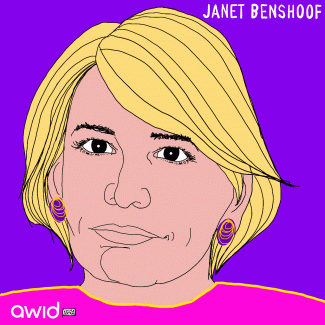
Janet Benshoof

Janet Benshoof was a human rights lawyer from the United States and an advocate for women’s equality, sexual and reproductive rights.

She campaigned to broaden access to contraceptives and abortions across the world, and battled anti-abortion rulings and in the American territory of Guam. She was arrested in 1990 for opposing her country’s most restrictive abortion law, but won an injunction at the local court in Guam that blocked the law and eventually won at the Ninth Circuit Court of Appeals, striking down the law for good.

“The women in Guam are in a very tragic situation. I never intend to be quiet about that.” - Janet Benshoof for People Magazine

Janet established landmark legal precedents including the US Food and Drug Administrations’ approval of emergency contraception, as well as the application of international law to ensure the rights of rape victims in the Iraqi High Tribunal’s prosecution of Saddam-era war crimes. 

Janet was President and founder of the Global Justice Center, as well as founder of the Center for Reproductive Rights, the world’s first international human rights organization focused on reproductive choice and equality. She served 15 years as Director of the American Civil Liberties Union’s Reproductive Rights Project, where she spearheaded litigation shaping US constitutional law on gender equality, free speech, and reproductive rights.

“Janet was known for her brilliant legal mind, her sharp sense of humor, and for her courage in the face of injustice.” - Anthony D. Romero

Named one of the “100 Most Influential Lawyers in America” by the National Law Journal, Janet was the recipient of numerous awards and honors. 

She was born in May 1947 and passed away in December 2017. 

Snippet - Feminist Community Evening - ES

Una noche de la comunidad feminista 

✉️ Requiere inscripción previa. Regístrate aquí

📅 Miércoles 12 de marzo de 2025
🕒 De 05:00 a 07:00 p.m., EST

🏢 Chef's Kitchen Loft with Terrace, 216 East 45th St 13th Floor New York

Organizan: Women Enabled International y AWID

En quoi ce Forum sera-t-il différent?

Nous avons toujours veillé à ce que nos Forums soient développés conjointement avec nos partenaires, nos mouvements et nos groupes prioritaires.

Pour cette édition 2020, nous visons à approfondir et renforcer cet esprit et cette pratique de co-création et de collaboration. Nous reconnaissons également la nécessité d’améliorer l’équilibre entre l’inclusion de nombreuses voix et les expériences, tout en laissant aux participant-e-s et au personnel la possibilité de respirer, faire une pause et profiter de certains temps d’arrêt.

Ce Forum sera différent des diverses façons suivantes: 

  • Nous aurons beaucoup moins d’activités sur le Forum car nous voulons que les personnes aient le temps de s’impliquer, d’expérimenter, d’assimiler, de se parler, etc. C’est un élément fondamental à la communication: vous pouvez venir au Forum, être très impliqué-e et actif-ve et n’animer aucune activité organisée (ou “session”). 
  • Nous aurons des espaces ouverts - au moins une après-midi entière sans activité organisée - mais aussi des espaces physiques disponibles sur toute la durée du Forum pour que les personnes puissent organiser elles-mêmes des réunions, etc.  
  • Nous avons un Comité « contenu et méthodologie » composé de féministes provenant de différentes régions et possédant une expertise sur les méthodologies participatives pour nous soutenir, et encourager tou-te-s ceux-celles menant des activités sur le Forum à utiliser des formats créatifs et attrayants.

Chers mouvements féministes : Une lettre du conseil d'administration

Chers mouvements féministes,

Au nom du Conseil d’administration, je souhaite exprimer notre plus profonde gratitude, notre appréciation et tout notre respect pour Hakima Abbas et Cindy Clark, nos deux extraordinaires codirectrices exécutives ces cinq dernières années, qui quittent leurs fonctions pour laisser place à un nouveau leadership de l’AWID, alors que nous entrons dans une nouvelle phase de la vie de notre organisation avec un nouveau plan stratégique. Elles ont systématiquement mis en application les meilleurs principes de leadership organisationnel féministe et d’éthique du soin lorsqu’elles nous guidaient, lors des temps bien troubles et imprévisibles de la récente histoire du monde, cette syndémie de COVID-19 et la spirale politique mondiale descendante qui s’en est suivie. Elles ont tenu l’AWID, notre personnel et notre CA fermement, doucement et avec amour alors que nous éprouvions toutes et tous ces situations inconnues. Elles se sont également accrochées à la vision et à la mission de l’AWID lorsqu’elles ont dû, avec respect et stratégie, réagir aux différents changements, dont la difficile annulation du forum de l’AWID.

La nature, la portée et le poids des responsabilités de la direction de l’AWID nous incitent à choisir de conserver, à l’avenir, ce modèle de codirection. Notre première expérience de cette codirection a été une véritable réussite, comme tout le monde a pu le constater.

Reconnaissant tout à fait le potentiel immense qui existe au sein de l’équipe actuelle, le CA a décidé de privilégier un processus de recrutement en interne dans un premier temps. Nous pensons terminer cette transition d’ici la fin de l’année 2022. Hakima et Cindy décaleront leur départ, pour permettre une transition en douceur vers le nouveau leadership.

Il est difficile pour le Conseil d’administration et d’autres, qui ont travaillé étroitement avec elles et qui les aiment, de voir Cindy et Hakima quitter l’AWID. Rassurez-vous, le CA de l’AWID mène ce processus de transition de manière à ce que les belles marques indélébiles et inspirantes que laissent Hakima et Cindy soient inscrites dans les quatre décennies de notre histoire. Nous assurerons l’arrivée et le soutien de la nouvelle direction et veillerons à ce que ce processus nous inspire à faire mieux encore à cette étape de la vie de l’AWID.

Les grandes transformations dans les organisations ne sont jamais simples ni faciles. Elles sont parfois contraintes, hors du contrôle de quiconque, tendues, voire destructrices. J’ai vu, mais vous aussi, des exemples de telles transitions. Il arrive également que les besoins et les aspirations du personnel soient alignés avec ceux de l’organisation. Bien que nous n’ayons ni choisi ni souhaité le départ de Cindy et Hakima, leur décision et l’entrée de l’AWID dans un nouveau plan stratégique et une nouvelle décennie d’existence sont alignées. Et mieux que tout encore, nous sommes entre les mains merveilleuses, super compétentes, créatives et féministes du personnel et du CA de l’AWID.

Nous vous remercions, chers mouvements féministes, pour votre confiance dans l’AWID. Nous vous demandons également de soutenir notre transition de leadership au cours des mois à venir. Continuons à construire, approfondir et renforcer nos connexions, comme nous le faisons depuis 40 ans.

Nous reviendrons vers vous dans les prochaines semaines pour vous tenir au courant de nos mises à jour et des évolutions concrètes.

Avec solidarité et amour féministes,
Margo Okazawa-Rey,
Présidente, Conseil d’administration de l’AWID

Snippet FEA In numbers (ES)

EN CIFRAS

Juli Dugdale

Juli Dugdale fue una feminista australiana que practicaba un liderazgo intergeneracional arraigado en los principios del feminismo, la inclusión y la igualdad. Fue líder, colega y mentora para muchas mujeres, especialmente, para las mujeres jóvenes de todo el mundo.

Juli fue una integrante comprometida del equipo del movimiento Young Women's Christian Association [Asociación Cristiana de Mujeres Jóvenes] (YWCA, por su siglas en inglés), una voluntaria y una ferviente defensora del liderazgo de las mujeres jóvenes por más de 30 años.

Se convirtió en un vínculo fuerte entre el movimiento australiano y la Oficina de la YWCA Mundial. Su confianza en la capacidad de liderazgo de las mujeres jóvenes llevó a establecer una asociación de varios años con el Departamento de Asuntos Exteriores y Comercio de Australia y a la creación del manual Rise Up (Rebélate), una guía global para el liderazgo transformador de las mujeres jóvenes, lanzada en 2018.

Juli falleció en Ginebra el 12 de agosto de 2019.


Tributos:

"Para quienes llegaron a trabajar con Juli, fue un privilegio.  Quienes no lo hicieron,  pueden tener la certeza de que su legado continúa en el trabajo que hacemos cada día y en la misión del movimiento de la YWCA". - YWCA Australia

"Juli Dugdale siempre ocupará un lugar profundo en el corazón de muchas personas en el movimiento de la YWCA, especialmente aquí, en Aotearoa, y a través del Pacífico. Juli tenía una relación especial con el Pacífico y fue un apoyo increíble para las mujeres jóvenes de allí. Ella era humilde, amable, cariñosa, dedicada, apasionada y tenía un corazón generoso. Ella encarnó la visión de la YWCA de "liderazgo transformador" con una extraordinaria visión y previsión de futuro, y ayudó a empoderar a generaciones de mujeres jóvenes líderes de todo el mundo". - YWCA Nueva Zelanda

Snippet - CSW69 - Feminist Solidarity Space 12 - FR

Espace de solidarité féministe

✉️ Sur inscription pour les grands groupes. Espace ouvert pour les petits groupes. Inscrivez-vous ici

📅 Mercredi 12 mars 2025
🕒 14.00h-16.00h EST

🏢 Chef's Kitchen Loft with Terrace, 216 East 45th St 13th Floor, New York 

Organisé par : AWID

Comment puis-je financer ma participation au Forum de l’AWID ? De nombreux-ses activistes n’auront pas les moyens de payer les frais relatifs au Forum – l’AWID a-t-elle pris des mesures pour leur fournir de l’assistance ?

Veuillez visiter la page « Financement » pour obtenir des idées et vous inspirer sur les façons dont financer votre participation au prochain Forum, y compris pour vous informer sur le soutien limité que l’AWID sera en mesure de fournir. 

Love letter to Feminist Movements #3

Love Letter to Feminism

By: Marianne Mesfin Asfaw

Scrapbook envelopes that say Love Letters to Feminist Movements. The envelope on top says From Marianne Mesfin Asfaw

I have many fond memories in my journey with feminism, but one in particular that stands out. It was during my time at graduate school, at a lecture I attended as part of a Feminist Theory course. This lecture was on African feminism and in it the professor talked about the history of Pan Africanism and the ways in which it was patriarchal, male-centric, and how Pan Africanist scholars perpetuated the erasure of African women. She talked about how African women’s contributions to the anti-colonial and decolonial struggles on the continent are rarely, if ever, discussed and given their due credit. We read about the African feminist scholars challenging this erasure and actively unearthing these stories of African women led movements and resistance efforts. It seems so simple but what stood out to me the most was that somebody put the words African and feminist together. Better yet, that there were many more of us out there wrestling with the complicated history, politics and societal norms in the various corners of the continent and we were all using a feminist lens to do this. I came out of that lecture feeling moved and completely mind-blown. After the lecture three of my friends (all African feminists) and I spent some time debriefing outside the classroom. We were all so struck by the brilliance of the lecture and the content but, more than anything, we all felt so seen. That feeling stood out to me. 

Falling in love feminism was thrilling. It felt like finally getting to talk to your longtime crush and finding out that they like you back. I call it my crush because in high school I referred to myself as a feminist but I didn’t feel like I knew enough about it. Was there a right way to be feminist? What if I wasn’t doing it right? Attending my first Women’s Studies lecture answered some of these questions for me. It was thrilling to learn about stories of feminist resistance and dismantling the patriarchy. I felt so affirmed and validated, but I also felt like something was missing.

Deepening my relationship with feminism through academia, at an institution where the students and teaching staff were mostly white meant that, for those first few years, I noticed that we rarely had discussions about how race and anti-blackness show up in mainstream feminist movements. In most courses we had maybe 1 week, or worse 1 lecture, dedicated to race and we would usually read something by bell hooks, Kimberly Crenshaw’s work on intersectionality, and maybe Patricia Hill Collins. The following week we were back to sidelining the topic. I dealt with this by centring race and black feminism in almost all my assignments, by writing about black hair and respectability politics, the hypersexualization of black women’s bodies, and so much more. Over time I realized that I was trying to fill a gap but didn’t quite know what it was. 

Encountering and learning about African feminism was a full circle moment. I realized that there was so much more I had to learn.

Mainly that my Africanness and my feminist politics did not have to be separate. In fact, there was so much that they could learn from each other and there were African feminists out there already doing this work. It was the missing piece that felt so elusive during my exploration of feminism throughout my academic journey.

Feminism to me is the antithesis to social and political apathy. It also means once you adopt a feminist lens, nothing can ever be the same. My friends and I used to talk about how it was like putting on glasses that you can never take off because you now see the world for what it is, mess and all. A mess you can’t simply ignore or walk away from. Therefore my vow to the feminist movement is to never stop learning, to keep stretching the bounds of my empathy and to never live passively. To dedicate more time and space in my life to feminist movements and to continue to amplify, celebrate, document and cite the work of African feminists. I also commit to centring care and prioritizing pleasure in this feminist journey because we can’t sustain our movements without this.
 

Snippet Intro The Feminist Realities Magazine (FR)

Magazine des Réalités Féministes

À l’AWID, nous concevons ces réalités féministes comme les exemples vivants des mondes que nous savons possibles. Nous concevons ces diverses réalités féministes comme des revendications et des incarnations d’espoir et de pouvoir.  Elles sont ancrées dans les multiples manières de vivre, de penser et de faire autrement, que ce soit au niveau  des expressions quotidiennes de nos modes de vie ou nos manières d'être en relations les un.e.s avec les autres ou au niveau de systèmes alternatifs de gouvernance et de justice.

Les Réalités féministes combattent les systèmes de pouvoir dominants tels que le patriarcat, le capitalisme et la suprématie blanche. 

Télécharger le magazine complet (PDF)

Feuilleter le magazine

Sarah Maldoror

“Je n’adhère pas au concept de ‘tiers-monde’. Je fais des films pour que les gens puissent les comprendre indépendamment de leur race ou de leur couleur. Pour moi, il n’y a que des exploiteurs et des exploités, c’est tout. Faire un film, c’est prendre position.” - Sarah Maldoror 

Sarah Maldoror, cinéaste française d’origine antillaise, fut une pionnière du cinéma panafricain. Elle plaça ses préoccupations politiques et son engagement de longue date dans les mouvements de décolonisation au coeur de son oeuvre.

Son film révolutionnaire Sambizanga (1972), avec son “image révolutionnaire”, retrace la lutte de libération anticoloniale des activistes angolais et retranscrit le point de vue d’une femme qui se trouve dans ce moment historique.   

“Pour beaucoup de cinéastes africains, le cinéma est un outil de la révolution, une éducation politique pour transformer les consciences. Il s’inscrivait dans l’émergence d’un cinéma du Tiers-Monde cherchant à décoloniser la pensée pour favoriser des changements radicaux dans la société.” - Sarah Maldoror

Au cours de sa carrière, Sarah a fondé, aux côtés d’un certain nombre d’artistes africain·e·s et caribéen·ne·s, la première compagnie de théâtre noire en France (1956). Elle a réalisé une quarantaine de films, y compris d’importants documentaires qui mettent en valeur les vies et l’oeuvre d’artistes noir·e·s, notamment celles de son ami et poète Aimé Césaire qui lui écrivit ceci: 

“À Sarah Maldoror qui, caméra au poing, 
combat l’oppression, l’aliénation 
et défie la connerie humaine”. 

Sarah a également voulu permettre aux femmes africaines de s'approprier davantage le processus de réalisation des films. Dans une interview, elle faisait remarquer : 

"La femme africaine doit être partout. Elle doit être à l'image, derrière la caméra, au montage, à toutes les étapes de la fabrication d'un film. C'est elle qui doit parler de ses problèmes…”  

Sarah a laissé un héritage incroyablement puissant qui doit être transmis. 

Née le 19 juillet 1929, Sarah est décédée le 13 avril 2020 des suites de complications liées au coronavirus.


Regardez Sambizanga et lisez la critique de film parue dans le New York Times en 1973 (seulement en anglais)

Snippet - WCFM Content Body - EN

Feminist and gender justice movements continue to be chronically underfunded in the face of global funding cuts and freezes, and rising fascisms. Growing resource scarcity has impacted the most vulnerable communities, particularly in Global South regions with progressively closing civic spaces. 


In response to these challenges, we collaborated with Impactmapper to co-create a comprehensive resource that combines two powerful tools to strengthen the funding ecosystem for social justice movements.

Y aura-t-il des événements préalables au Forum cette fois-ci ?

Des partenaires mondiaux et régionaux nous ont déjà communiqué certaines idées de rassemblements préalables au Forum, dont nous vous ferons part sous peu. 

Si vous projetez d’organiser une réunion avant le Forum,  n’hésitez pas à nous le faire savoir !

Contactez-nous


Plusieurs belles choses ont émergé du Forum des féminismes noires (BFF, selon son acronyme anglais),  qui avait été organisé en 2016 par un Groupe consultatif et financé par l’AWID. À l’issue de ce BFF, certaines organisations indépendantes ont ainsi pu voir le jour, telles ques des organisations féministes noires au Brésil. Bien que le BFF n’aura pas lieu cette année, nous nous engageons à partager certains apprentissages clés avec toute personne intéressée à poursuivre le travail d'organisation féministe noire.