Análisis Especiales

AWID es un organización feminista internacional de membresía, que brinda apoyo a los movimientos que trabajan para lograr la justicia de género y los derechos de las mujeres en todo el mundo.

Foro de AWID: Co-creando futuros feministas

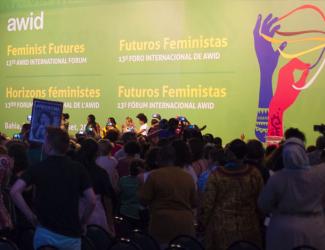
En septiembre de 2016, 1800 feministas y activistas por los derechos de las mujeres de todos los rincones de nuestros movimientos se congregaron en las costas de Bahia, en el 13º Foro Internacional de AWID.

En esta sección se destacan los logros, los aprendizajes y los recursos que surgieron de las ricas conversaciones mantenidas. Te invitamos a analizar, compartir y comentar.


¿Qué ha pasado desde 2016?

Uno de los aportes más importantes del Foro fue la necesidad de ampliar y profundizar nuestro trabajo entre movimientos, frente a la confluencia de los fascismos en auge, fundamentalismos, codicia corporativa y cambio climático.

Con esto en mente, AWID, en asociación con múltiples aliadxs, ha estado trabajando para que estas semillas de resistencia:

AWID se ha comprometido, mediante su próximo plan estratégico y su proceso del Foro, a continuar y profundizar las relaciones, las lecciones y los procesos iniciados en el Foro 2016 y basándonos en el momento actual.

¿Que pasa ahora?

El mundo es un lugar muy diferente de lo que era un año atrás, y seguirá cambiando en los próximos años.

El próximo Foro de AWID se realizará en la región del Pacífico Asiático (el lugar y la fecha exactos serán anunciados en 2018). Esperamos que te unas a nosotrxs.

Sobre el Foro de AWID

Los Foros de AWID comenzaron en 1983 en Washington DC. Desde entonces, el evento ha crecido hasta convertirse en muchas cosas para muchas personas: un proceso iterativo para darle forma a nuestros análisis, objetivos y acciones; un hito crucial que fortalece los feminismos de lxs participantes e infunde energías a sus procesos de organización; un hogar político donde lxs defensoras de derechos humanos encuentran un santuario y solidaridad.

Más información sobre los Foros anteriores

Contenido relacionado

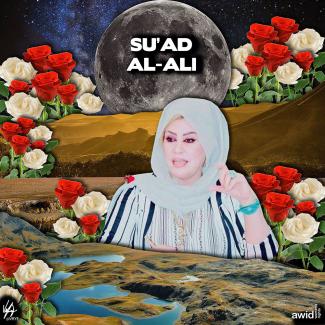
Su’ad Al-Ali

Ardente défenseure des droits des femmes et des enfants, Su’ad dirigeait Al-Weed Al-Alaiami, une organisation irakienne de défense des droits humains.

Elle a participé aux manifestations de juillet 2018 qui ont eu lieu à Bassorah et dans plusieurs autres villes irakiennes pour protester contre le chômage, réclamer des emplois et des services publics appropriés pour les citoyen-ne-s, ainsi que pour exiger l'élimination de la corruption endémique. Le 25 septembre 2018, Su’ad a été assassinée dans le quartier d’Al-Abbasiyah, dans le centre-ville de Bassorah.

Une vidéo de l’incident a montré une personne qui s'est approchée d'elle alors qu'elle montait dans sa voiture, et lui a tiré une balle dans la tête avant de pointer son arme sur son chauffeur, Hussain Hassan, qui a été blessé à l'épaule. Su’ad Al-Ali avait 46 ans et était mère de quatre enfants.


Su'ad Al Ali, Iraq

Как долго будет доступен опрос?

Опрос будет доступен до конца августа 2024 года. Пожалуйста, заполните его в течение этого срока, чтобы ваши ответы были включены в анализ.

Body

Merci d'avoir téléchargé la Boîte à outils des réalités féministes

Snippet FEA Story 1 Maps Economies of Care (EN)

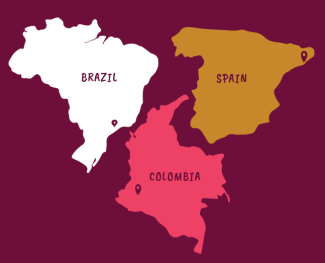
Burgundy background with maps of Brazil in white, Spain in mustard yellow, and Colombia in pink

Fahmida Riaz

« Après
Après l’amour la première fois,
Nos corps et nos esprits nus
Une galerie des glaces,
Complètement désarmés, absolument fragiles,
Nous nous couchons dans les bras de l’autre
Respirant attentivement,
Avec la crainte de briser
Ces figurines en cristal. » - Fahmida Riaz

Fahmida Riaz a brisé les tabous sociaux en écrivant sur le désir des femmes dans ses poèmes, créant des récits alternatifs à propos du corps des femmes et de leur sexualité, et établissant de nouveaux standards dans la littérature urdu.

Son travail s’est confronté à de sévères critiques de la part des conservateurs, qui l’ont accusée d’utiliser des expressions érotiques et « pornographiques » dans son langage poétique.  

Fahmida a finalement été mise sur liste noire et accusée de sédition en vertu de l’article 124A du Code pénal pakistanais sous la dictature de Zia-ul-Haq. Forcée à l’exil en 1981, elle a passé presque sept ans en Inde avant de retourner au Pakistan. 

Dans la préface de « Badan Dareeda » (Un corps ravagé), un recueil de poèmes publié en 1974, elle écrit :

Si, en effet, je suis forcée à me tenir aujourd’hui devant ce maqtal et me confronte à la potence, je dois y faire face, la tête haute. Mes poèmes sont la trace d’une tête mutilée : des sons émanant même lorsque suspendue par des cordes… Un corps ravagé a pris la forme de razmia, ou  d’un son de rupture. Et si cette rupture est effectivement choquante pour les gens, c’est que la poète a atteint son intention : elle a réussi à la perturber. (traduction de l’urdu vers l’anglais par Asad Alvi) 

La splendeur de Fahmida résidait dans sa défiance de toute logique ou toute catégorie particulière de genre, nation, religion ou culture. Elle refusait d’être mise dans le rôle d’une « femme poète », brisant les définitions traditionnelles de la poésie féminine, des concepts et des thématiques (variant entre conscience politique, corps, culture, désir, religion, foyer), et renversant les inhibitions assignées à son genre.   

« Il faut que vous compreniez que la culture ne peut avoir d’essence. Les cultures changent, circulent entre elles, formant de nouvelles cultures. La culture est née de cette façon. Il n’y a pas de conflits de cultures. »

Fahmida a écrit plus de 15 livres de poésie et de fiction, dont son poème ‘Taaziyati Qaraardaaden’ («Résolutions de condoléances» en anglais) qui pourrait servir d'hommage approprié à sa vie et à son héritage et de collection de poèmes (Apna Jurm To Saabit He «Mon crime est prouvé») publié en 1988 durant son exil.

Fahmida Riaz est née à Meerut, en Inde, le 28 juillet 1946 et est décédée le 21 novembre 2018 à Lahore, au Pakistan. 
FRMag - My queer Ramadan

My Queer Ramadan 

by Amal Amer

I pray with my family for the first time in six years while wrapped in a keffiyah I scavenged from a dumpster. (...)

Read

artwork: “Angels go out at night too” by Chloé Luu >

Snippet - Home page promo WITM - EN

"Where is the money for feminist organizing?"

Building on our 20-year history of mobilizing more and better funding for feminist-led social change, AWID invites you to complete the new iteration of our flagship survey, WITM.

START THE SURVEY Learn more

Disclaimer: Communications with AWID staff

If you have received emails from any staff members at AWID, we would like you to understand the following:

  • The information contained in this communication is confidential and is intended solely for the addressee. 

  • This communication may contain information proprietary to the Association for Women’s Rights in Development (AWID), and may not be reproduced or disseminated in whole or in part without AWID's written consent. 

  • AWID does not warrant that any information contained herein is complete or correct. This communication is not an offer to enter into any agreement and is not a confirmation of any agreement described herein unless the context clearly indicates the contrary. 

  • AWID is not acting as your adviser in any agreement that may be proposed herein, and this communication does not constitute a recommendation, guidance or proposal to enter into any agreement. 

  • AWID does not guarantee or otherwise assure the expected results of any agreement. This communication may contain views or opinions that are not necessarily those of AWID. 

  • You shall not be entitled to place any reliance on the information contained in this communication for the purposes of entering into any proposed agreement or otherwise.

Snippet - That Feminist Fire Logo (ES)

Texto en blanco que dice el título de nuestro podcast en español: Ese fuego feminista

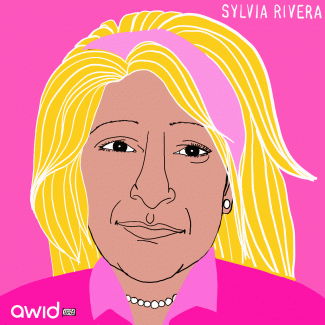
Sylvia Rivera

Sylvia Rivera was a civil rights activist, a transvestite and sex worker.

Known as the New York Drag queen of color, Silvia was fierce and tireless in her advocacy, in defense of those who  were marginalized and excluded as the “gay rights” movement mainstreamed in the United States in the early 1970’s.

In a well-known speech on Christopher Street Day in 1973, Sylvia, shouted through a crowd of LGBT community members: 

“You all tell me, go and hide my tail between my legs.
I will no longer put up with this shit.
I have been beaten.
I have had my nose broken.
I have been thrown in jail.
I have lost my job.
I have lost my apartment.
For gay liberation, and you all treat me this way?
What the fuck’s wrong with you all?
Think about that!” 

In 1969, at age 17, Silvia took part in the iconic Stonewall Riots by allegedly throwing the second Molotov cocktail to protest the police raid of the gay bar in Manhattan. She continued to be a central figure in the uprisings that followed, organizing rallies and fighting back police brutality.

In 1970, Sylvia worked together with Marsha P. Johnson to establish Street Transvestite Action Revolutionaries (S.T.A.R.), a political collective and organisation that would set up projects of mutual support for trans people living on the streets, those struggling with drug addiction and in prisons and in particular for trans people of color and those living in poverty. 

Defiant of labels, Silvia lived life in a way that challenged people in the gay liberation movement to think differently. She said: 

“I left home at age 10 in 1961. I hustled on 42nd Street. The early 60s was not a good time for drag queens, effeminate boys or boys that wore makeup like we did. Back then we were beat up by the police, by everybody. I didn't really come out as a drag queen until the late 60s. when drag queens were arrested, what degradation there was. I remember the first time I got arrested, I wasn't even in full drag. I was walking down the street and the cops just snatched me. People now want to call me a lesbian because I'm with Julia, and I say, "No. I'm just me. I'm not a lesbian." I'm tired of being labeled. I don't even like the label transgender. I'm tired of living with labels. I just want to be who I am. I am Sylvia Rivera. 

Through her activism and courage, Sylvia offered a mirror that reflected all that was wrong within society, but also the possibility of transformation. Sylvia was born in 1951 and passed away in 2002. 

FRMag - Ashawo Work na Work

"Ashawo Work na Work": Cómo lxs jóvenes feministas de Ghana están haciendo realidad los futuros feministas

por Fatima B. Derby

En 2017, la campaña de AWID #PracticaSolidaridad destacó cómo lxs jóvenes feministas podían construir un futuro feminista apoyándose mutuamente, participando en conversaciones interregionales entre ellxs, marchando en solidaridad con otrxs activistas y abriendo canales de colaboración entre los movimientos. (...)

Leer

< arte: «Let it Grow» [Déjalo crecer], Gucora Andu 

What Our Members Say - FR

Ce que disent nos membres

Calling all artists & creative activists to come together in a new Slack community!

Our thoughts are with the many people all around the world who are most affected by the repercussions of the global COVID-19 pandemic, especially marginalised communities that are historically oppressed.

This is an invitation for artists and creative activists to join a virtual space to connect, build community, and support each other through these challenging times. For this we have created a new Slack community to safely share insights, learnings, life-hacks, resources, advice, fears and anxieties, hopeful and joyful reminders, and in general chat about how we’re doing.

Join us on Slack

After filling out the form, we will send you a personal invitation to the community.


About this community:

For those who are new to Slack, we’ll have orientation sessions and materials available after you sign up.

Since we are working in three languages (English, Spanish, French) we invite you to write in the language you are the most comfortable with and use online translation tools (Google Translate or others) to participate in discussions.

Co-creating welcoming and safe spaces:

Please refer to the Community Guidelines

The co-creation of our feminist realities starts with ourselves and how we treat each other. We are dedicated to creating and protecting safe and supportive spaces for our communities both online and in person.  We also consider that safe and welcoming spaces are co-owned and co-created. We expect our members to act in a manner that is ethical, responsible and consistent with the values of AWID and assume collective responsibility to ensure an atmosphere of mutual respect and solidarity.

Weekly Prompts: 

As part of our ongoing discussions, we will offer weekly prompts in Slack with the intention to gently facilitate dialogue and inspire art-making processes. This can be an introspective process, but to make the most out of this community, we welcome you to interact with other community members and share thoughts as part of our discussions. The intention is to invite folks to respond freely and gradually by writing or making art in whatever way feels best. 

We hope to have relevant and timely discussions with you, so we invite your suggestions and feedback. In general, the themes will center the experiences and perspectives of artists, writers, and creators -- and they will make space for folks to vision into and beyond the current global climate through the lens of feminist realities.


Join us on Slack

Snippet Forum Stories Download (EN)