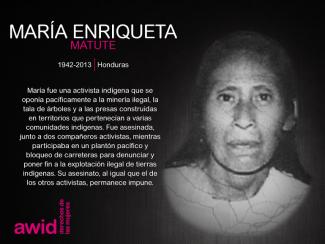
Maria Enriqueta Matute
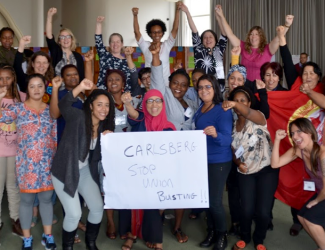
Women human rights defenders (WHRDs) worldwide defend their lands, livelihoods and communities from extractive industries and corporate power. They stand against powerful economic and political interests driving land theft, displacement of communities, loss of livelihoods, and environmental degradation.
Extractivism is an economic and political model of development that commodifies nature and prioritizes profit over human rights and the environment. Rooted in colonial history, it reinforces social and economic inequalities locally and globally. Often, Black, rural and Indigenous women are the most affected by extractivism, and are largely excluded from decision-making. Defying these patriarchal and neo-colonial forces, women rise in defense of rights, lands, people and nature.
WHRDs confronting extractive industries experience a range of risks, threats and violations, including criminalization, stigmatization, violence and intimidation. Their stories reveal a strong aspect of gendered and sexualized violence. Perpetrators include state and local authorities, corporations, police, military, paramilitary and private security forces, and at times their own communities.
AWID and the Women Human Rights Defenders International Coalition (WHRD-IC) are pleased to announce “Women Human Rights Defenders Confronting Extractivism and Corporate Power”; a cross-regional research project documenting the lived experiences of WHRDs from Asia, Africa and Latin America.
"Women Human Rights Defenders confronting extractive industries: an overview of critical risks and Human Rights obligations" is a policy report with a gender perspective. It analyses forms of violations and types of perpetrators, quotes relevant human rights obligations and includes policy recommendations to states, corporations, civil society and donors.
"Weaving resistance through action: Strategies of Women Human Rights Defenders confronting extractive industries" is a practical guide outlining creative and deliberate forms of action, successful tactics and inspiring stories of resistance.
The video “Defending people and planet: Women confronting extractive industries” puts courageous WHRDs from Africa, Asia, and Latin America in the spotlight. They share their struggles for land and life, and speak to the risks and challenges they face in their activism.
Challenging corporate power: Struggles for women’s rights, economic and gender justice is a research paper outlining the impacts of corporate power and offering insights into strategies of resistance.
AWID acknowledges with gratitude the invaluable input of every Woman Human Rights Defender who participated in this project. This project was made possible thanks to your willingness to generously and openly share your experiences and learnings. Your courage, creativity and resilience is an inspiration for us all. Thank you!
Dans cette sélection de films, vous découvrirez les voix de réalisatrices qui ne se contentent pas de restituer les réalités féministes palpitant dans chaque recoin de ce territoire vaste et divers, mais explorerez aussi des oeuvres qui, dans leur conception même, s'interrogent sur le pourquoi, le qui et le comment du cinéma ou de l'audiovisuel. Ces femmes comprennent le cinéma comme un outil de lutte, comme quelque chose de plus que de simples images à apprécier sur un écran. Pour ces réalisatrices ou collectifs de cinéastes, le cinéma et l'audiovisuel constituent un outil capable de promouvoir la discussion, d'ouvrir un débat, bref, une ressource pour la pédagogie populaire et féministe.
ตอบแบบสั้นคือ ใช่! AWID กำลังทำงานร่วมกับคณะกรรมการการเข้าถึงเพื่อให้มั่นใจว่าฟอรัมนี้จะสามารถเข้าถึงได้มากที่สุดเท่าที่จะเป็นไปได้ เรากำลังทำการตรวจสอบการเข้าถึงสถานที่จัดงานฟอรัม โรงแรมโดยรอบ และการคมนาคมขนส่ง ข้อมูลโดยละเอียดเกี่ยวกับการช่วยการเข้าถึงของ AWID ฟอรัม จะถูกอัปเดทเนื้อหาที่นี่ก่อนที่จะเปิดการลงทะเบียน ในระหว่างนี้ หากมีคำถามใดๆ โปรดติดต่อเรา
Contenu lié
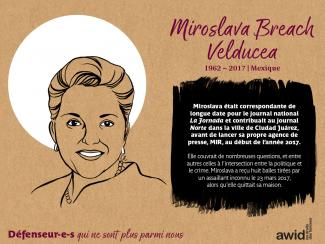
RFI: Une journaliste tuée au Mexique, la troisième en moins d’un mois
Consultez notre guide : « Un tout petit guide pour l’organisation de festivals féministes internationaux et d’événements en ligne. »
This year, we, alongside feminist activists from across the world, will be at CSW68 in New York, to challenge capitalist, neoliberal narratives and false solutions around poverty, development and financing. Through in-person events, lives on our socials, an exhibit booth and more; we are showing up to convene, amplify and support the voices and participation of our members, partners and allies.
Learn more about our program this year below.
Premier Dialogue de haut niveau sur le financement du développement, 29-30 octobre 2003.
Les dialogues de haut niveau de l’Assemble générale des Nations Unies sur le financement du développement, tenus tous les deux ans, sont l’un des mécanismes de suivi de la Conférence de Monterrey. À la suite de ce premier dialogue, huit tables rondes ont été organisées autour de différentes questions comprenant les subventions agricoles, le commerce, l’allègement de la dette et le financement des OMD. Toutes les discussions se concentraient sur les manières de faire face aux obstacles structurels qui pesaient sur ces questions et défavorisaient les nations « en développement ».
D'autres mécanismes de suivi de la Conférence de Monterrey :
CARING ECONOMIESLAND AND AGROECOLOGYFEMINIST COOPERATIVISMFEMINIST UNION ORGANIZING

✉️ Sur invitation uniquement
📅Mardi 12 mars
🕒14 h - 15 h 30 HNE
Organisateur : Consortium de l'Observatoire sur l'universalité des droits (OURs)
🏢Blue Gallery, 222 E 46th St, New York
The Fifth High- Level Dialogue on Financing for Development, 7 – 8 December 2011, marked the beginning of the Post 2015 development agenda discussions, and the link to financing for development. The conference gave a special focus to increasing aid to finance the MDG’s. In his closing remarks, the Secretary General called on members to begin to consider the post-2015 development framework.
Contenido relacionado
Greenpeace USA: El precio del activismo (página 8)
 |
 |
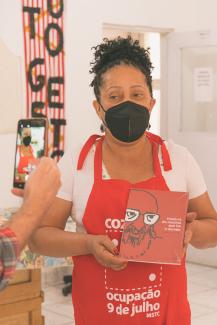 |
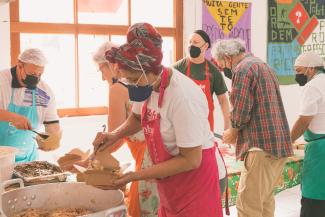
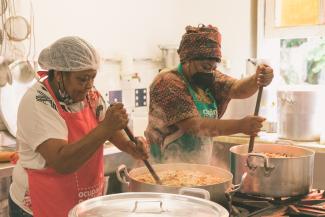
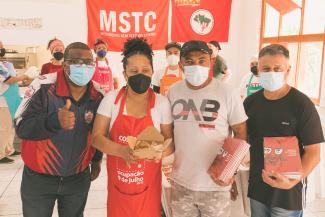 Mujeres y colaboradorxs en la cocina de Ocupação 9 de Julho |
 |
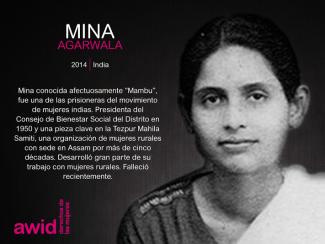
Through in-person events, lives on our socials, an exhibit booth and more; we are showing up to convene, amplify and support the voices and participation of our members, partners and allies.
Together we will Reclaim Feminist Power by uplifting feminist alternatives and visions around economies that center collective systems of care and nurture both the planet and people.
Follow us on social media for more details on how to participate! Be part of the conversations using the hashtags #AWIDatCSW68 and #ReclaimFeministPower.
Instagram | Facebook | LinkedIn | X (Twitter)