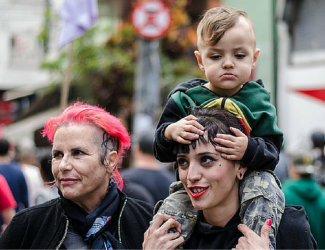
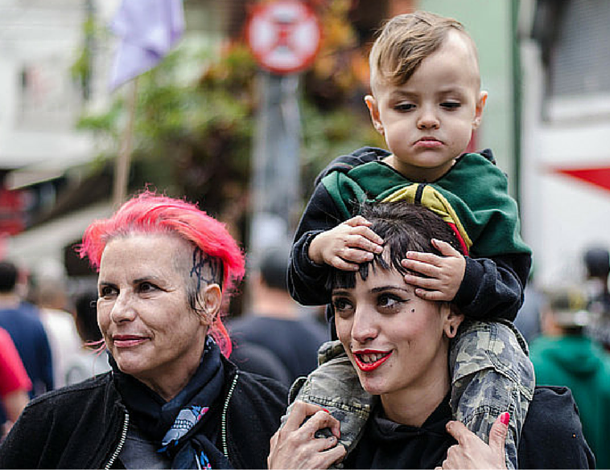
Flickr/Leonardo Veras (CC BY 2.0)

Protection of the Family

The Issue

Over the past few years, a troubling new trend at the international human rights level is being observed, where discourses on ‘protecting the family’ are being employed to defend violations committed against family members, to bolster and justify impunity, and to restrict equal rights within and to family life.

The campaign to "Protect the Family" is driven by ultra-conservative efforts to impose "traditional" and patriarchal interpretations of the family, and to move rights out of the hands of family members and into the institution of ‘the family’.

“Protection of the Family” efforts stem from:

  • rising traditionalism,
  • rising cultural, social and religious conservatism and
  • sentiment hostile to women’s human rights, sexual rights, child rights and the rights of persons with non-normative gender identities and sexual orientations.

Since 2014, a group of states have been operating as a bloc in human rights spaces under the name “Group of Friends of the Family”, and resolutions on “Protection of the Family” have been successfully passed every year since 2014.

This agenda has spread beyond the Human Rights Council. We have seen regressive language on “the family” being introduced at the Commission on the Status of Women, and attempts made to introduce it in negotiations on the Sustainable Development Goals.


Our Approach

AWID works with partners and allies to jointly resist “Protection of the Family” and other regressive agendas, and to uphold the universality of human rights.

In response to the increased influence of regressive actors in human rights spaces, AWID joined allies to form the Observatory on the Universality of Rights (OURs).  OURs is a collaborative project that monitors, analyzes, and shares information on anti-rights initiatives like  “Protection of the Family”.

Rights at Risk, the first OURs report, charts a map of the actors making up the global anti-rights lobby, identifies their key discourses and strategies, and the effect they are having on our human rights.   

The report outlines “Protection of the Family” as an agenda that has fostered collaboration across a broad range of regressive actors at the UN.  It describes it as: “a strategic framework that houses “multiple patriarchal and anti-rights positions, where the framework, in turn, aims to justify and institutionalize these positions.”
 

Related Content

Defending our land and ourselves from corporate power

These industries 'extract' raw materials from the Earth: mining, timber, gas, oil are some examples

This economical model exploits nature and as it intensifies, so does the inequality between global North with their large corporations, and the global South, where resources are extracted.

Land contamination, water pollution, environmental damage, communities displaced are only some of the consequences.

Find more on our report on EXTRACTIVE INDUSTRIES

There are sustainable alternatives for the environment and women's rights.


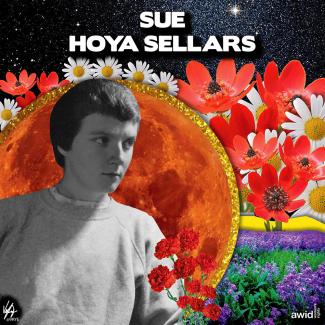
Sue Hoya Sellars

Sue fue artista, activista y maestra y nació en 1936 en Maryland, Estados Unidos.

Creó arte para mujeres y sobre mujeres. Como lesbiana feminista, y durante un tiempo también separatista, se dedicó a la creación de espacios sólo para mujeres. En 1976 compró tierras que todavía son conservadas por mujeres que van temporariamente a hacer arte. Sue mantuvo una apasionada posición en la protección de las mujeres y las niñas.

Con su innovador enfoque futurista, clásico y antropológico, llenaba cada habitación en la que entraba con su intelecto, su excentricidad auténtica, su ingenio implacable y su humor. Sus ideas acerca de la conciencia y la creatividad siguen inspirando a mucha gente.


Sue Hoya Sellars, USA

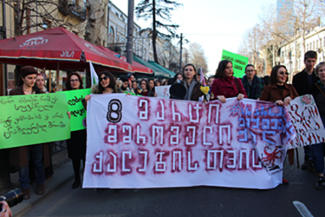
Snippet FEA Workers demonstrations in Georgia 2 (FR)

La photo montre une manifestation où une foule de personnes tient une bannière en géorgien qui se lit comme suit : « Le 8 mars pour les femmes travailleuses ».

Моего языка нет в списке и мне сложно заполнить опрос – что мне делать?

AWID стремится к языковой справедливости, и мы сожалеем, что на данный момент проведение опроса на большем количестве языков не представляется возможным. Если вам нужна помощь в переводе или вы хотите заполнить анкету на любом другом языке, пожалуйста, свяжитесь с нами по адресу witm@awid.org

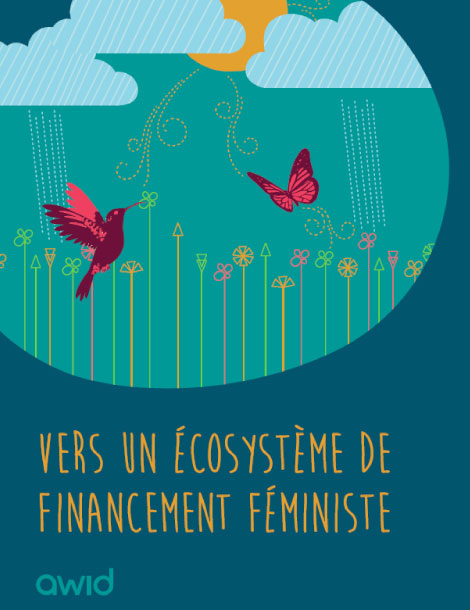
Voici votre guide pratique et les infographies «Vers un écosystème de financement féministe»

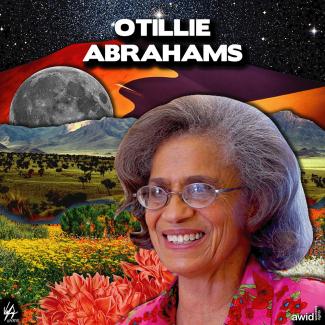
Ottilie Abrahams

Ottilie était une militante féministe, éducatrice et politicienne namibienne.

Elle était l'une des fondatrices de l'Organisation populaire du Sud-Ouest africain (SWAPO), du Yu Chi Chan Club (groupe révolutionnaire armé) et du Front de libération nationale du Sud-Ouest africain (SWANLIF). Ottilie a également été une des fondatrices de la Namibian Women’s Association et du Girl Child Project. Tout au long de sa vie, Ottilie a plaidé en faveur du droit de discuter, de penser, de contester et de réclamer. Elle a mobilisé des femmes, organisé des assemblées d’étudiants et d’enseignants et critiqué d'autres camarades pour leur élitisme et leur corruption.

Ottilie a œuvré sans relâche pour démanteler le patriarcat et faire émerger une démocratie participative, féministe, libératrice et transformatrice.

Ottilie disait souvent : « Je me reposerai quand je serai morte. »


Ottilie Abrahams, Namibia

Snippet FEA Unfair Policies (EN)

Pink justice scales

UNFAIR POLICIES

Become a member - English (homepage block)

Join Us

By joining AWID, you are becoming part of worldwide feminist organizing, a collective power that is rooted in working across movements and is based on solidarity.

Become a Member

O nosso grupo não recebeu qualquer financiamento nos três anos entre 2021 e 2023. Devemos preencher o questionário mesmo assim?

Sim, ainda queremos a sua resposta, independentemente de terem recebido financiamento em três, dois, um, ou qualquer um dos anos entre 2021 e 2023.

The AWID Forum Access Fund

We strive to make the AWID Forum a truly global gathering with participation from a diverse array of movements, regions and generations. To this end, AWID mobilizes resources for a limited Access Fund (AF) to assist some participants with the costs of attending the Forum. 

The 14th AWID International Forum will take place 11-14 January 2021, in Taipei, Taiwan. 


How will  the Access Fund be allocated?

For this AWID Forum, there will be no application process. 

Access Fund grants will be allocated by invitation only to:

  • Two  persons per activity selected for the Forum program (decided by those organizations, groups or individuals organizing the activity) 
  • Participants who identify as part of Priority Forum  Constituencies (PFCs) recommended by the organizations, networks and groups who are co-creating the Forum with AWID. 
  • PFCs are those which we consider would strengthen our collective power as movements, are not centered in mainstream feminist movements, and whose Feminist Realities we would like to honor, celebrate and visibilize: 
    - Black feminists 
    - Indigenous feminists
    - Trans, gender non-conforming and intersex feminists
    - Feminists with disabilities 
    - Feminist sex workers and informal workers, including migrant workers
    - Feminists affected by migration 
    - Women affected by drug policy
    - Feminists from the Forum regions (with a focus on the Pacific and mainland China) 

In addition, AWID will fund approximately 100 participants from the Forum’s location. Forum Committee Members (Content and Methodology, Access and Host) as well as those in the Artists Working Group [link] are also granted Access Fund support.

What does the Access Fund cover?

For selected participants, the Access Fund will cover the cost of their:

  • Flight
  • Accommodation
  • Visa
  • Local transportation in Taipei
  • Travel medical insurance

The Access Fund will NOT cover their: 

  • Forum registration fee
  • Transportation to and from the airport in their city of departure
  • Other incidental costs

Apart from the Access Fund, how can I fund my participation at the Forum?

We have listed other ideas on how to fund your participation at the AWID Forum on the Funding Ideas page. 

More Funding Ideas

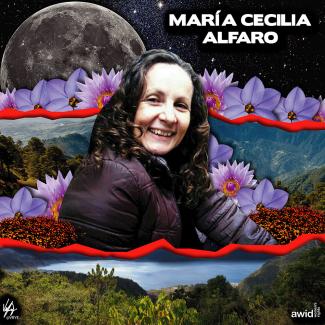
María Cecilia Alfaro Quesada

Most of María’s life was devoted to incorporating a feminist and gender perspective in institutional and organizational work, and capacity building in Latin America. 

As a child, María had a strong interest in art, communication, nature, literature, and the achievement of justice, especially for women and marginalized groups.

María was committed to sexual and reproductive rights and was a member of the National Board for Integral Education in Sexuality. She is remembered by those who loved her as a “passionate and restless fighter” with a strong commitment to women’s and children’s rights.


María Cecilia Alfaro Quesada, Guatemala
Main image
Story-2-Banner.png
Body

Snippet FEA Sopo Japaridze (ES)

Tenemos el placer de presentarte a Sopo Japaridze, feminista feroz, líder sindical y presidenta del sindicato independiente de servicios Red de Solidaridad.

Dejó el país cuando era muy joven para ir a los Estados Unidos, donde se volvió políticamente muy activa como organizadora laboral. Siempre mantuvo a Georgia en su mente todo ese tiempo, hasta que un día, dos décadas después, decidió regresar.

La confederación sindical georgiana existente en este momento era menos que ideal. Entonces, equipada con sus habilidades, conocimientos y experiencia en organización laboral, Sopo regresó a Georgia y formó su propio sindicato.

También es una apasionada investigadora y escritora. Estudia relaciones laborales y sociales, escribe para varias publicaciones y es una de lxs editorxs de Left East, una plataforma analítica de Europa del Este. También cofundó la iniciativa y el podcast de historia política, Reimaginando la Georgia soviética, donde explora las complejidades y los matices de las experiencias del país bajo la Unión Soviética, para entender mejor su pasado y construir un futuro mejor.

Reason to join 4

Piensa en grande. Gracias a nuestro alcance internacional, podemos combinar el trabajo analítico con herramientas políticas y prácticas para la incidencia y la transformación, con el objeto de promover la causa de los movimientos feministas en todos los ámbitos.

لماذا تسألون عن اسم المجموعة، المنظمة و\ أو الحركة التي تعبئ الاستطلاع؟

نسأل عن هذه المعلومات كي نسهّل عملية المعالجة وكي نستطيع أن نتواصل مع مجموعتكم/ن في حالة لم تستطيعون تكملة الاستطلاع و\ أو في حالة كانت لديكم/ن شكوك أو أسئلة إضافية. يمكنكم/ن قراءة المزيد عن كيف نستعمل المعلومات التي نجمعها خلال عملنا هنا.