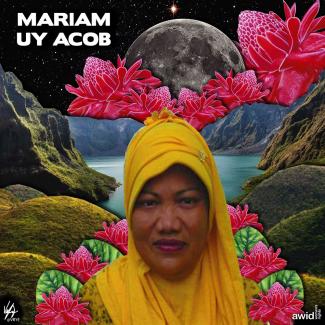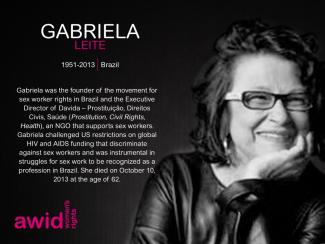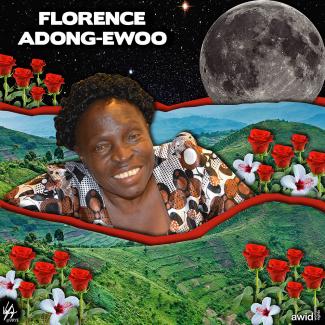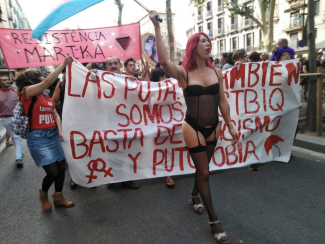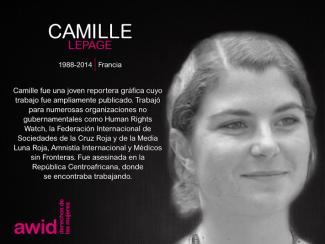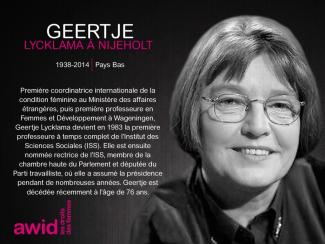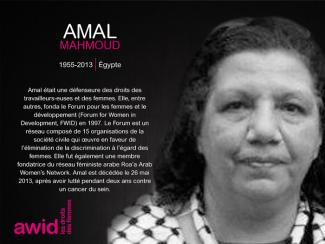
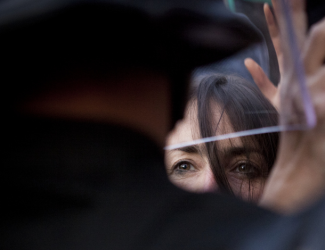
WHRDs are self-identified women and lesbian, bisexual, transgender, queer and intersex (LBTQI) people and others who defend rights and are subject to gender-specific risks and threats due to their human rights work and/or as a direct consequence of their gender identity or sexual orientation.
WHRDs are subject to systematic violence and discrimination due to their identities and unyielding struggles for rights, equality and justice.
The WHRD Program collaborates with international and regional partners as well as the AWID membership to raise awareness about these risks and threats, advocate for feminist and holistic measures of protection and safety, and actively promote a culture of self-care and collective well being in our movements.
Risks and threats targeting WHRDs
WHRDs are exposed to the same types of risks that all other defenders who defend human rights, communities, and the environment face. However, they are also exposed to gender-based violence and gender-specific risks because they challenge existing gender norms within their communities and societies.
By defending rights, WHRDs are at risk of:
Physical assault and death
Intimidation and harassment, including in online spaces
Judicial harassment and criminalization
Burnout
A collaborative, holistic approach to safety
We work collaboratively with international and regional networks and our membership
to raise awareness about human rights abuses and violations against WHRDs and the systemic violence and discrimination they experience
to strengthen protection mechanisms and ensure more effective and timely responses to WHRDs at risk
We work to promote a holistic approach to protection which includes:
emphasizing the importance of self-care and collective well being, and recognizing that what care and wellbeing mean may differ across cultures
documenting the violations targeting WHRDs using a feminist intersectional perspective;
promoting the social recognition and celebration of the work and resilience of WHRDs ; and
building civic spaces that are conducive to dismantling structural inequalities without restrictions or obstacles
Our Actions
We aim to contribute to a safer world for WHRDs, their families and communities. We believe that action for rights and justice should not put WHRDs at risk; it should be appreciated and celebrated.
Promoting collaboration and coordination among human rights and women’s rights organizations at the international level to strengthen responses concerning safety and wellbeing of WHRDs.
Supporting regional networks of WHRDs and their organizations, such as the Mesoamerican Initiative for WHRDs and the WHRD Middle East and North Africa Coalition, in promoting and strengthening collective action for protection - emphasizing the establishment of solidarity and protection networks, the promotion of self-care, and advocacy and mobilization for the safety of WHRDs;
Increasing the visibility and recognition of WHRDs and their struggles, as well as the risks that they encounter by documenting the attacks that they face, and researching, producing, and disseminating information on their struggles, strategies, and challenges:
Mobilizing urgent responses of international solidarity for WHRDs at risk through our international and regional networks, and our active membership.
Related Content
Snippet - Home page promo WITM - EN
"Where is the money for feminist organizing?"
Building on our 20-year history of mobilizing more and better funding for feminist-led social change, AWID invites you to complete the new iteration of our flagship survey, WITM.
Juli Dugdale était une féministe australienne pratiquant un leadership intergénérationnel ancré dans les principes du féminisme, de l’inclusion et de l’égalité. Elle était une leader, une pair et une encadrante pour de nombreuses femmes, et particulièrement des jeunes femmes du monde entier.
Juli a été une membre dévouée de l’équipe de l’Association des jeunes femmes chrétiennes (YWCA), bénévole et fervente défenseure du leadership des jeunes femmes pendant plus de 30 ans.
Elle assurait un lien très fort entre le mouvement australien du YWCA et le bureau international. Sa confiance dans les capacités de leadership des jeunes femmes a entre autres donné lieu à un partenariat pluriannuel avec le ministère australien des Affaires étrangères et du Commerce, de même qu’à la rédaction du manuel Rise Up, un guide mondial pour le leadership transformationnel des jeunes femmes, lancé en 2018.
Juli est décédée à Genève, en Suisse, le 12 août 2019.
Hommages :
« Pour celles et ceux qui ont travaillé avec Juli, ce fut un privilège. Pour celles et ceux qui n’ont pas travaillé avec elle, sachez que son héritage perdure dans le travail que nous faisons tous les jours, et dans la mission du mouvement des YWCA. » – YWCA Australie
« Juli Dugdale occupera toujours une place privilégiée dans le cœur de nombreuses personnes du mouvement du YWCA, particulièrement ici en Aotearoa et dans le Pacifique. Juli entretenait une relation particulière avec le Pacifique, et soutenait de manière remarquable les jeunes femmes de la région. De nature humble, aimable, aimante, affectueuse, dévouée et passionnée, elle avait un cœur généreux. Elle incarnait la vision du « leadership transformationnel » du YWCA avec une vision et une clairvoyance extraordinaires, et a de plus aidé à renforcer les capacités de générations de jeunes femmes leaders dans le monde. » – YWCA Nouvelle-Zélande
FRMag - Roots of Love and Resilience
Kunyit asam: Las raíces del amor y la resiliencia
por Prinka Saraswati
El ciclo menstrual habitualmente abarca entre 27 y 30 días. En ese lapso, el período en sí dura de 5 a 7 días. La fatiga, los cambios de humor y los espasmos son el resultado de la inflamación durante la menstruación.
Merci d'avoir participé à la création de nos Horizons féministes
Un grand MERCI d'avoir pris part au 13ème Forum international de l'AWID !
Toute l'équipe de l'AWID vous remercie de nous avoir rejoint pour ces quatre jours d'apprentissage et de célébrations, pour envisager, rêver et co-créer nos Horizons féministes.
Nous avons été incroyablement inspiré-e-s et enthousiasmé-e-s par tout ce travail collectif que nous avons accompli ensemble !
Pour plus d'images, d'inspiration et de ressources :
“I want to tell all Tunisians: We have to unite to say no to censorship and opinion trials.” - Lina Ben Mhenni (2013 interview)
Lina Ben Mhenni was a Tunisian blogger, activist and linguistics lecturer. She was vocal against internet censorship, defended the freedom of expression and was an advocate for women’s and human rights. Lina also fought for the release of students arrested under former President Zine El Abidine.
“It’s true that information and the internet are important but being on the ground is crucial for a revolution. Some people here in Tunisia think that change can occur just by clicking like on the internet. I believe you have to be active on the ground. And of course, join actions on the field with the action on the web.” - Lina Ben Mhenni (Interview in POCIT)
In 2010, she co-organized a protest that challenged the government suppression of media and internet censorship. Lina was widely known for her blog “A Tunisian Girl” and recognized for her work during the Tunisian revolution in 2011. In her blog, she reported on the news from the uprising, shared images documenting protests and was among the few voices who spoke about the killings and crackdown on protesters in Sidi Bouzid. Lina blogged using her real name instead of a pseudonym to protect her identity, one of only a few bloggers to do so.
“Our freedom of expression is in real danger. I am afraid that we are losing the unique fruits of the revolution: the disappearance of fear and our freedom of speech. We have to keep on fighting to protect and preserve this right.” — Lina Ben Mhenni (2013 interview)
Lina was only 36 years old when she passed away on 27 January 2020, as a result of complications from an autoimmune disease.
"Freedom, better education and health - that's all we wanted. When we failed, she pushed us." Lina’s school teacher Hala.
FRMag - Mainstreaming The Invisible
Intégrer les réalités féministes invisibles
par Dr. Pragati Singh
En 2019, j’étais invitée par le réseau BBC pour intervenir lors de la conférence intitulée 100 women (100 femmes) à Delhi, en Inde, à propos de « L’avenir de l’amour, des relations et des familles ». (...)
The search for alternative means of food production based on environmental sustainability is gaining ground across regions. This worldwide search comes with a common characteristic: the need to involve rural people and particularly women, building on their local priorities and knowledge by employing the principle of agroecology.
Definition
Agroecology is a way of practicing agriculture or using technologies that do not harm the environment. It proposes breaking with the hegemonic rural development model based on large landed estates and single-crop plantations that benefit mostly agricultural businesses and entrenches social exclusion.
In family farming, agroecology manifests as a resistance to the current development model and its social, cultural, environmental, and economic problems. It opposes the lack of the farmer’s financial capital autonomy; and it symbolizes a resistance to the current agribusiness model.
Feminist perspective
Efforts based solely on agroecology may not be sufficient to solve all problems of women’s marginalization and invisibility. A feminist perspective is then crucial to analyze the norms associated with the idea of family as currently constituted as the perfect institution, as well as with the condition of women’s subordination.
In simpler terms, it is important to include in this debate a reflection on socially constructed gender roles to advance the emancipatory potential of agroecology.
En rejoignant l’AWID, vous intégrez l’organisation féministe mondiale, un pouvoir collectif qui se fonde sur la solidarité et puise ses racines dans le travail entre les mouvements.
Gloria Chicaiza, una activista social y ambiental ecuatoriana, fue una ferviente defensora de la tierra y el agua. Desafió el statu quo, al luchar contra un modelo de desarrollo basado en la extracción, y trabajó incansablemente por la justicia ecológica y los derechos de las comunidades afectadas por la minería.
Gloria participó en las acciones de resistencia para la protección del ecosistema en distintas áreas de Ecuador. Con pasión y dedicación, Gloria apoyó al movimiento indígena y ambiental, a sus comunidades y a las organizaciones que se oponen a los proyectos de minería y protegen sus territorios y sus proyectos de vida colectivos. En foros locales e internacionales, se pronunció contra la criminalización del disenso y la resistencia, contra la presión y la violencia ejercidas contra lxs activistas comunitarixs (y, en particular, contra las defensoras de derechos humanos), y a favor de los esfuerzos comunitarios por la soberanía alimentaria y la sustentabilidad.
Fue Coordinadora del Área de Justicia Minera de Acción Ecológica, participó en la Red Latinoamericana de Mujeres Defensoras de Derechos Sociales y Ambientales, e integró la Junta Directiva del Observatorio de Conflictos Mineros de América Latina (OCMAL).
En 2014 Gloria apoyó la coordinación de una delegación a la Conferencia Internacional sobre Cambio Climático (COP 20) de la ONU. El grupo estuvo integrado por veinticinco mujeres indígenas de América Latina.
Gloria falleció el 28 de diciembre de 2019 por complicaciones de un trasplante de pulmón. Es recordada por su resistencia y su incansable trabajo.
«El camino más rápido para llegar a la sustentabilidad sigue siendo la resistencia.» - Gloria Chicaiza (entrevista de 2010)
«Gracias Glorita, por sostener la esperanza, por mantener el tejido fuerte, por conectar la comunidad, por las manos unidas, por la solidaridad, gracias Glorita por acompañarnos en los momentos más difíciles. Gracias por enseñarnos que, a lo largo de la vida, nadie se cansa.» - Chakana News
«Fue más intrépida, más audaz y más generosa que su cuerpo; ese cuerpo que enfrentó toletes y bombas lacrimógenas, que paseó bajo la cadencia de los tambores y las batucadas, que incubó otra vida, hermosa y digna, como la suya. Haz dejado de toser, querida amiga, pero hoy, más que nunca, tu voz me quema adentro.» - Pablo Ospina Peralta
«Gloria Chicaiza valoraba ser una de muchxs, y así prosperaba. Y, humilde como era, tenía una extraordinaria capacidad para llevar y mantener un ritmo sostenido y estruendoso, un pulso de afirmación de la vida que guiaba, movilizaba e inspiraba a las comunidades y a las redes para la protección de la Madre Tierra. Se oponía a toda forma de violencia contra los cuerpos-territorios. Apoyaba el buen vivir.» - Gabriela Jiménez, Coordinadora de Asociaciones para América Latina, KAIROS
«Gracias Gloria Chicaiza, desde el infinito estamos seguros de que seguirás apoyando nuestra lucha.. Tú, que continuaste acompañándonos en la lucha a pesar de que tu salud fallara. Vivirás en los bosques y en el agua que defendiste con tanta valentía, vivirás en nuestros corazones.» - Comunidad de Intag, Ecuador
The Naranjo Batey community is far from the city, but it’s full of hard-working people brimming with enthusiasm. A girl named Dieula lived there. (...)
Member states and women's rights advocates and organisations are gathering at the United Nations Headquarters in New York from 13 - 24 March for the 61st Commission on the Status of Women to address ‘women’s economic empowerment’ in the context of Sustainable Development Goal 5.
Whilst AWID is looking forward to physically meeting those of you who will be in New York, we want to engage with all those who cannot attend CSW, and as much as possible, amplify your voices in relevant spaces.
Continue reading to find out how to engage with AWID around CSW, whether you are attending physically or not.
Participate in an artistic takeover!
We are thrilled that AWID member Nayani Thiyagarajah is attending CSW this year and will take over the AWID Instagram. She will be available onsite to connect with other members for a possible feature on our Instagram. She will also explore possibilities of including some AWID members in a short film on the theme, ‘The personal is political’, a story of Nayani’s participation in this year’s CSW.
Nayani Thiyagarajah
Who is Nayani?
Nayani Thiyagarajah is a director, producer, and writer, dedicated to stories for the screen. A daughter of the Tamil diaspora, she calls Toronto home. For over 10 years, Nayani has worked in the arts and cultural industries. Her first independent feature documentary Shadeism: Digging Deeper (2015) had its World Premiere at the 2015 Zanzibar International Film Festival, where it won a Special Jury Prize. Nayani recently launched [RE]FRAME, with her producing partner Camaro West, a production company based out of Atlanta and Toronto, focused on re-framing the narratives around Black, Indigenous, and other people of colour through storytelling on screen.
On a more serious note, it should be noted that Nayani has a strange laugh, she's quite awkward, and her head is always in the clouds. She feels blessed beyond belief to create stories for the screen and play make believe for a living. Above all else, she believes in love.
Interested in meeting Nayani and being considered for inclusion in the film?
Send an email to membership@awid.org with the subject line “CSW Artistic Takeover”
By 13 March 2017
Please include your full name and country information.
Can't attend? Voice it!
If you are not able to attend CSW61 because of a travel ban, either due to the one imposed by the Trump administration or one you are facing from your own government, please share your story with us.
Send us messages you want heard in the United Nations spaces concerning funding, the impact of the reinstatement of the Global Gag Rule, and the need to push back against all types of religious fundamentalisms. You can send these in the following formats:
Video: no longer than two minutes and sent through a file sharing folder (for example dropbox, google drive)
Audio: no longer than two minutes and sent through a file sharing folder (for example dropbox, google drive)
Image: you can share a photo or a poster of your message
Text: no longer than 200 words and sent in the body of an email or in a word document
AWID members tell us that connecting with other members at CSW is valuable. In such a huge advocacy space, it is useful to connect with others including activists working on similar issues, or originating from the same country or region. Recognising the importance of connecting for movement building, we invite you to:
Interested in connecting with other members @CSW61?
If you are attending the CSW, we’d love to see what’s going on through your eyes!
Show us by capturing a moment you find speaks to the energy in the CSW space, be it on or off site. We hope to publish some of your ‘images’ on our social media channels and share on awid.org.
You can send us:
colour and/ or black and white photographs with a title (if you wish) and
a caption (no longer than 100 words) about the story your image tells.
Please also include:
your full name and country of origin and
let us know if we can publish the information you shared (in part or in full).